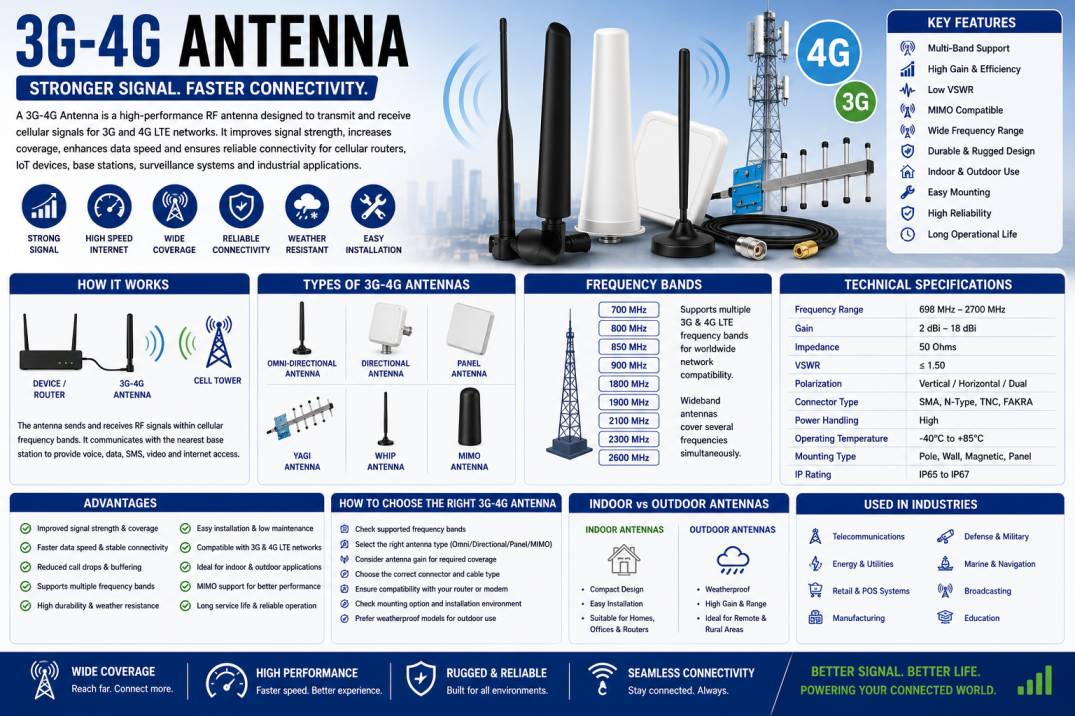
A 3G-4G Antenna is a specialized radio frequency (RF) antenna designed to transmit and receive wireless signals for third-generation (3G) and fourth-generation (4G LTE) cellular communication networks. It plays a crucial role in providing reliable voice calls, high-speed internet, video streaming, IoT connectivity, and wireless data communication across mobile devices and communication systems.
As demand for seamless mobile connectivity continues to increase, 3G-4G antennas have become essential components in cellular base stations, routers, IoT gateways, wireless modems, industrial automation systems, smart cities, transportation, healthcare, and surveillance networks. These antennas improve signal strength, expand network coverage, reduce communication dead zones, and enhance overall network performance.
Modern 3G-4G antennas are available in various designs, including omnidirectional, directional, panel, Yagi, whip, and MIMO antennas. They support multiple frequency bands and are engineered to provide stable performance in both indoor and outdoor environments.
This comprehensive guide explains everything you need to know about 3G-4G Antennas, including their working principle, construction, types, specifications, applications, advantages, and selection criteria.
What Is a 3G-4G Antenna?
A 3G-4G Antenna is a high-frequency communication antenna that enables wireless devices to send and receive cellular signals over 3G and 4G LTE networks.
The antenna converts electrical RF signals into electromagnetic waves for transmission through the air and converts incoming electromagnetic waves back into electrical signals for communication devices.
Depending on the application, a 3G-4G antenna may be used with:
- Cellular routers
- LTE gateways
- Mobile base stations
- IoT devices
- Wireless terminals
- Signal boosters
- Remote monitoring systems
Its primary function is to maximize signal quality, increase communication range, and improve data transmission speed.
How Does a 3G-4G Antenna Work?
A 3G-4G antenna works by radiating and receiving electromagnetic waves within designated cellular frequency bands.
The communication process includes:
- Mobile device generates RF signals.
- RF signals travel to the antenna.
- The antenna converts electrical energy into radio waves.
- Radio waves travel to the nearest cellular tower.
- The tower processes and routes the communication.
- Incoming signals are received by the antenna.
- The antenna converts radio waves back into electrical signals.
This continuous two-way communication enables voice, SMS, internet access, video calls, and wireless data transmission.
Construction of a 3G-4G Antenna
Radiating Element
The radiating element generates and receives RF energy.
Common designs include:
- Dipole
- Monopole
- Patch
- Printed PCB antenna
Ground Plane
The ground plane improves radiation efficiency and stabilizes antenna performance.
Dielectric Material
The dielectric supports the radiating element and maintains electrical insulation.
Common materials include:
- PTFE
- FR4
- Ceramic
- Rogers PCB
RF Connector
The antenna connects to communication equipment using connectors such as:
- SMA
- N-Type
- TNC
- FAKRA
- BNC
- RP-SMA
Protective Housing
Outdoor antennas use weather-resistant housings manufactured from:
- ABS Plastic
- Polycarbonate
- Fiberglass
- Aluminum
These housings protect against UV radiation, rain, dust, and extreme temperatures.
Working Principle of a 3G-4G Antenna
The antenna receives and transmits RF signals within cellular frequency bands.
The working process involves:
- Cellular modem sends RF signal.
- Antenna radiates electromagnetic waves.
- Nearby base station receives the signal.
- Communication network processes the data.
- Incoming RF signals return through the antenna.
- Connected device receives the information.
Proper antenna placement significantly improves communication quality and network reliability.
Types of 3G-4G Antennas
Omni-Directional Antenna
Radiates signals in all horizontal directions.
Commonly used for:
- Homes
- Offices
- Cellular routers
- IoT systems
Directional Antenna
Focuses RF energy toward a specific cellular tower.
Ideal for:
- Rural installations
- Long-distance communication
- Signal enhancement
Panel Antenna
Provides moderate gain with directional coverage.
Used in:
- Buildings
- DAS systems
- Wireless infrastructure
Yagi Antenna
High-gain directional antenna designed for weak-signal environments.
Suitable for:
- Remote locations
- Rural broadband
- Cellular repeaters
Whip Antenna
Compact antenna commonly installed on:
- Vehicles
- Routers
- Communication terminals
MIMO Antenna
Supports Multiple Input Multiple Output technology for higher LTE speeds and improved signal quality.
Widely used in:
- 4G LTE routers
- Base stations
- Industrial gateways
Frequency Bands Supported
3G-4G antennas support multiple frequency bands depending on regional network standards.
Common frequency bands include:
- 700 MHz
- 800 MHz
- 850 MHz
- 900 MHz
- 1800 MHz
- 1900 MHz
- 2100 MHz
- 2300 MHz
- 2600 MHz
Wideband antennas support several of these frequencies simultaneously.
Technical Specifications
| Specification | Typical Value |
|---|---|
| Frequency Range | 698 MHz – 2700 MHz |
| Gain | 2 dBi – 18 dBi |
| Polarization | Vertical / Horizontal / Dual |
| Impedance | 50 Ohms |
| VSWR | ≤ 1.50 |
| Connector Type | SMA, N-Type, TNC, FAKRA |
| Power Handling | High |
| Operating Temperature | -40°C to +85°C |
| Mounting Type | Pole, Wall, Magnetic, Panel |
| IP Rating | IP65 to IP67 |
Key Features of 3G-4G Antennas
- Wide frequency coverage
- High signal gain
- Excellent radiation efficiency
- Stable LTE performance
- Low VSWR
- Weather-resistant construction
- Easy installation
- MIMO compatibility
- High durability
- Long operational life
- Indoor and outdoor models
- Broad network compatibility
Applications of 3G-4G Antennas
Cellular Base Stations
Provide wireless network coverage for mobile users.
LTE Routers
Improve internet connectivity in homes and offices.
Industrial IoT
Support machine-to-machine communication.
Smart Cities
Enable intelligent transportation and connected infrastructure.
Transportation
Used in buses, trains, trucks, and fleet management systems.
Agriculture
Support smart farming equipment and remote monitoring.
Healthcare
Enable telemedicine and connected medical devices.
Surveillance Systems
Provide reliable connectivity for remote CCTV installations.
Retail
Support wireless payment terminals and digital kiosks.
Energy Sector
Monitor remote power stations and utility infrastructure.
Advantages of 3G-4G Antennas
- Improved signal strength
- Faster internet speeds
- Expanded coverage area
- Reduced dropped connections
- Better voice quality
- Enhanced LTE performance
- Reliable outdoor operation
- Supports multiple frequency bands
- Compatible with MIMO technology
- Easy installation
- Low maintenance
- Long service life
Limitations of 3G-4G Antennas
- Signal performance depends on tower distance
- Physical obstacles can reduce efficiency
- Incorrect installation affects performance
- High-gain antennas require accurate alignment
- Outdoor models require weatherproof mounting
How to Choose the Right 3G-4G Antenna
When selecting a 3G-4G antenna, consider the following:
- Supported frequency bands
- Antenna gain
- Polarization
- Connector type
- Cable length
- Indoor or outdoor installation
- Mounting method
- MIMO compatibility
- Environmental conditions
- Network operator requirements
3G-4G Antenna vs Wi-Fi Antenna
| Feature | 3G-4G Antenna | Wi-Fi Antenna |
|---|---|---|
| Network Type | Cellular | Wireless LAN |
| Frequency Range | 698–2700 MHz | 2.4 GHz & 5 GHz |
| Coverage | Wide Area | Local Area |
| Main Application | Mobile Networks | Wi-Fi Networks |
| SIM Card Support | Yes | No |
| Internet Source | Cellular Tower | Router or Access Point |
Industries Using 3G-4G Antennas
3G-4G Antennas are widely used in:
- Telecommunications
- Transportation
- Industrial Automation
- Smart Cities
- Agriculture
- Healthcare
- Security & Surveillance
- Energy & Utilities
- Retail
- Manufacturing
- Marine Communication
- Defense
Maintenance Tips
To maximize antenna performance:
- Install the antenna at the recommended height.
- Keep connectors clean and corrosion-free.
- Inspect RF cables regularly.
- Avoid physical damage.
- Tighten connectors securely.
- Protect outdoor installations from lightning.
- Check VSWR during maintenance.
Future Trends of 3G-4G Antennas
Although 5G networks are expanding globally, 3G and 4G antennas continue to play a vital role in providing reliable connectivity for billions of users, especially in developing regions and industrial applications. Manufacturers are designing multi-band antennas that support 2G, 3G, 4G, and 5G simultaneously, enabling smooth network migration and future scalability. Innovations such as compact MIMO antennas, high-efficiency wideband designs, AI-assisted network optimization, and rugged antennas for IoT and smart infrastructure will continue to enhance wireless communication performance for years to come.
Conclusion
A 3G-4G Antenna is an essential component of modern cellular communication systems, enabling reliable voice and data connectivity across a wide range of applications. Its ability to improve signal strength, expand network coverage, support multiple frequency bands, and enhance LTE performance makes it indispensable for telecommunications, industrial automation, transportation, healthcare, surveillance, and smart city deployments. By selecting the right antenna based on frequency, gain, polarization, connector type, and installation environment, users can achieve optimal wireless performance and long-term communication reliability.
Frequently Asked Questions (FAQs)
1. What is a 3G-4G antenna?
A 3G-4G antenna is an RF antenna designed to transmit and receive cellular signals for 3G and 4G LTE communication networks.
2. What is a 3G-4G antenna used for?
It is used to improve signal strength and wireless connectivity in LTE routers, cellular modems, IoT devices, signal boosters, and base stations.
3. What frequency bands do 3G-4G antennas support?
Most 3G-4G antennas support multiple cellular bands, including 700 MHz, 800 MHz, 850 MHz, 900 MHz, 1800 MHz, 1900 MHz, 2100 MHz, 2300 MHz, and 2600 MHz.
4. What are the different types of 3G-4G antennas?
Common types include Omni-Directional, Directional, Panel, Yagi, Whip, and MIMO antennas.
5. What is MIMO in a 4G antenna?
MIMO (Multiple Input Multiple Output) uses multiple antennas to improve data speed, signal quality, and network capacity.
6. Can a 3G-4G antenna be used outdoors?
Yes. Many models feature weatherproof housings with IP65 or IP67 protection for reliable outdoor operation.
7. What gain should I choose for a 3G-4G antenna?
Low-gain antennas (2–5 dBi) are suitable for nearby towers, while high-gain antennas (8–18 dBi) are ideal for long-distance or weak-signal areas.
8. Which connectors are commonly used with 3G-4G antennas?
Common RF connectors include SMA, N-Type, TNC, FAKRA, BNC, and RP-SMA.
9. Which industries use 3G-4G antennas?
They are widely used in telecommunications, transportation, healthcare, manufacturing, agriculture, security, energy, smart cities, and industrial automation.
10. How do I choose the right 3G-4G antenna?
Choose a 3G-4G antenna based on supported frequency bands, gain, polarization, connector type, installation environment, cable length, MIMO support, and your network coverage requirements.