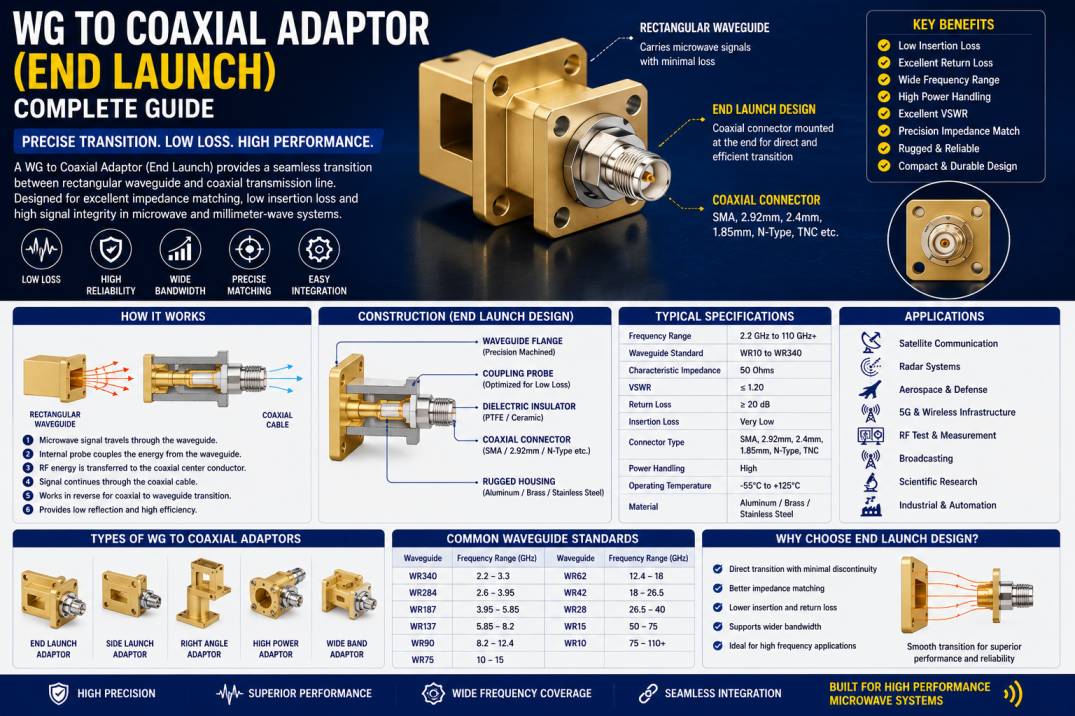
A WG to Coaxial Adaptor (End Launch) is a specialized microwave component that enables efficient signal transmission between a rectangular waveguide (WG) and a coaxial transmission line. It serves as a critical interface in RF and microwave systems, allowing engineers to connect waveguide-based equipment with coaxial connectors while maintaining low insertion loss, excellent impedance matching, and high signal integrity.
As microwave and millimeter-wave communication systems continue to evolve, the demand for reliable waveguide-to-coaxial transitions has increased significantly. WG to Coaxial Adaptors are widely used in satellite communication, radar systems, aerospace, defense, 5G infrastructure, laboratory testing, wireless communication, scientific research, and RF measurement systems.
The End Launch configuration refers to a design where the coaxial connector is mounted directly at the end of the waveguide, providing a straight-line signal transition. This design minimizes discontinuities, reduces reflections, and improves broadband performance.
This comprehensive guide explains everything about WG to Coaxial Adaptors (End Launch), including their construction, working principle, specifications, applications, advantages, and selection criteria.
What Is a WG to Coaxial Adaptor (End Launch)?
A WG to Coaxial Adaptor (End Launch) is a passive microwave transition device that converts electromagnetic waves traveling inside a waveguide into electrical signals transmitted through a coaxial cable, or vice versa.
The adaptor provides an efficient interface between two different transmission media:
- Rectangular Waveguide
- Coaxial Transmission Line
It is commonly used whenever microwave equipment with waveguide interfaces needs to connect to coaxial-based instruments, antennas, amplifiers, or RF test equipment.
The End Launch design positions the coaxial connector directly at the waveguide opening, creating a smooth transition that minimizes signal distortion and power loss.
How Does a WG to Coaxial Adaptor (End Launch) Work?
A WG to Coaxial Adaptor works by converting the dominant electromagnetic mode inside the waveguide into the transverse electromagnetic (TEM) mode used by coaxial cables.
The operation includes the following steps:
- Microwave signals enter the rectangular waveguide.
- Electromagnetic energy propagates through the waveguide.
- An internal probe or coupling element captures the microwave energy.
- The probe transfers energy to the coaxial center conductor.
- The coaxial connector carries the RF signal through the cable.
- The process also works in reverse for signal transmission from coaxial cable to waveguide.
This transition is carefully engineered to minimize insertion loss, return loss, and impedance mismatch.
Construction of a WG to Coaxial Adaptor (End Launch)
Rectangular Waveguide
The waveguide carries microwave signals with minimal transmission loss.
Common waveguide standards include:
- WR90
- WR75
- WR62
- WR51
- WR42
- WR34
- WR28
- WR22
- WR15
- WR10
The waveguide size determines the operating frequency.
Coupling Probe
The coupling probe is positioned inside the waveguide and transfers RF energy between the waveguide and coaxial connector.
Its dimensions are carefully optimized for maximum efficiency.
Coaxial Connector
Common connector types include:
- SMA
- 2.92 mm (K Connector)
- 2.4 mm
- 1.85 mm
- N-Type
- TNC
The connector selection depends on frequency and power requirements.
Dielectric Insulator
The dielectric supports the center conductor while maintaining electrical insulation.
Typical materials include:
- PTFE
- Air dielectric
- High-frequency ceramics
Housing
The adaptor body is precision machined using:
- Aluminum
- Brass
- Stainless Steel
These materials provide excellent mechanical stability and corrosion resistance.
Working Principle
WG to Coaxial Adaptors operate by matching the electromagnetic field distribution between a waveguide and a coaxial transmission line.
The transition must maintain:
- Constant impedance
- Low reflection
- High transmission efficiency
- Stable phase response
- Broadband performance
Proper probe placement and precision machining ensure efficient energy conversion across the specified frequency band.
Key Features of WG to Coaxial Adaptors (End Launch)
- Low insertion loss
- Excellent return loss
- High power handling
- Wide frequency coverage
- Precision impedance matching
- Compact design
- Rugged construction
- Excellent VSWR performance
- High mechanical reliability
- Broadband operation
- Corrosion-resistant materials
- Easy integration with RF systems
Technical Specifications
| Specification | Typical Value |
| Frequency Range | 2.6 GHz to 110 GHz (depending on waveguide) |
| Characteristic Impedance | 50 Ohms |
| VSWR | ≤ 1.20 |
| Return Loss | Better than 20 dB |
| Insertion Loss | Very Low |
| Connector Type | SMA, K, 2.4 mm, 1.85 mm, N-Type |
| Waveguide Standard | WR10 to WR340 |
| Power Handling | High |
| Operating Temperature | -55°C to +125°C |
| Material | Aluminum, Brass, Stainless Steel |
Types of WG to Coaxial Adaptors
End Launch Adaptor
The coaxial connector is mounted directly at the end of the waveguide, providing a straight signal path and excellent electrical performance.
Side Launch Adaptor
The connector is mounted on the side of the waveguide.
This configuration is useful where installation space is limited.
Right-Angle Waveguide Adaptor
Designed for systems requiring a 90-degree RF transition.
Precision Test Adaptor
Used in RF laboratories for high-accuracy microwave measurements.
High-Power Waveguide Adaptor
Designed for radar transmitters, satellite communication, and high-power microwave applications.
Common Waveguide Standards
| Waveguide | Frequency Range |
| WR340 | 2.2 – 3.3 GHz |
| WR284 | 2.6 – 3.95 GHz |
| WR187 | 3.95 – 5.85 GHz |
| WR137 | 5.85 – 8.2 GHz |
| WR90 | 8.2 – 12.4 GHz |
| WR75 | 10 – 15 GHz |
| WR62 | 12.4 – 18 GHz |
| WR42 | 18 – 26.5 GHz |
| WR28 | 26.5 – 40 GHz |
| WR15 | 50 – 75 GHz |
| WR10 | 75 – 110 GHz |
Applications of WG to Coaxial Adaptors
Satellite Communication
Connects microwave waveguides with RF transmission equipment.
Radar Systems
Supports high-frequency radar transmitters and receivers.
Aerospace
Used in aircraft communication and navigation systems.
Defense
Supports electronic warfare, surveillance, and military microwave communication.
5G Infrastructure
Used in millimeter-wave testing and antenna development.
RF Test Laboratories
Connects network analyzers, signal generators, and microwave instruments.
Scientific Research
Supports microwave experiments in universities and research institutions.
Broadcasting
Used in microwave transmission systems and broadcast infrastructure.
Industrial Automation
Supports high-frequency sensing and industrial RF communication.
Semiconductor Testing
Used for wafer-level microwave testing and high-frequency measurements.
Advantages of WG to Coaxial Adaptors (End Launch)
- Excellent impedance matching
- Low insertion loss
- High return loss performance
- Reliable microwave signal transition
- Wide operating frequency range
- Compact mechanical design
- High durability
- Excellent power handling
- Easy installation
- Long service life
- High measurement accuracy
- Suitable for precision RF systems
Limitations of WG to Coaxial Adaptors
- Higher cost than standard RF connectors
- Frequency limited by waveguide size
- Precision machining required
- Installation requires proper waveguide alignment
- Specialized components for high-frequency applications
How to Choose the Right WG to Coaxial Adaptor (End Launch)
When selecting a WG to Coaxial Adaptor, consider the following factors:
- Operating frequency
- Waveguide standard
- Connector type
- Power handling
- VSWR
- Return loss
- Material quality
- Environmental conditions
- Mechanical compatibility
- Application requirements
WG to Coaxial Adaptor vs Waveguide Flange
| Feature | WG to Coaxial Adaptor | Waveguide Flange |
| Signal Conversion | Yes | No |
| Connector Interface | Coaxial | Waveguide Only |
| RF Transition | Waveguide to Coax | Waveguide to Waveguide |
| Applications | RF Equipment Integration | Waveguide Assembly |
| Measurement Capability | High | Standard |
Industries Using WG to Coaxial Adaptors
WG to Coaxial Adaptors are widely used in:
- Telecommunications
- Aerospace
- Defense
- Satellite Communication
- Scientific Research
- RF Testing
- Broadcasting
- Semiconductor Manufacturing
- Medical Electronics
- Industrial Automation
Maintenance Tips
To maximize adaptor performance:
- Keep waveguide flanges clean.
- Inspect RF connectors regularly.
- Avoid mechanical impact.
- Use proper flange torque.
- Protect connectors from dust and moisture.
- Verify VSWR during maintenance.
- Store adaptors in dry environments.
Future Trends of WG to Coaxial Adaptors
As microwave communication advances toward 5G Advanced, 6G, satellite broadband, autonomous vehicles, aerospace communication, and terahertz technologies, WG to Coaxial Adaptors are evolving to support higher frequencies, lower insertion loss, and improved impedance matching. Modern designs use precision CNC machining, advanced dielectric materials, lightweight alloys, and tighter manufacturing tolerances to enhance performance. Future adaptors will support frequencies beyond 110 GHz and play a critical role in next-generation RF testing, high-speed wireless communication, advanced radar systems, and space exploration technologies.
Conclusion
WG to Coaxial Adaptors (End Launch) are essential microwave components that provide efficient transitions between rectangular waveguides and coaxial transmission lines. Their precision engineering, low insertion loss, excellent impedance matching, and broad frequency support make them indispensable in satellite communication, radar systems, aerospace, defense, RF testing, and modern wireless communication. Selecting the appropriate waveguide standard, connector type, operating frequency, and electrical specifications ensures reliable signal transmission, improved measurement accuracy, and long-term system performance.
Frequently Asked Questions (FAQs)
1. What is a WG to Coaxial Adaptor (End Launch)?
A WG to Coaxial Adaptor (End Launch) is a microwave transition device that converts RF signals between a rectangular waveguide and a coaxial transmission line using an end-mounted coaxial connector.
2. What is the purpose of a WG to Coaxial Adaptor?
Its primary purpose is to provide efficient signal transmission between waveguide-based equipment and coaxial RF systems with minimal insertion loss and reflections.
3. What is an End Launch adaptor?
An End Launch adaptor positions the coaxial connector directly at the end of the waveguide, creating a straight RF transition with improved impedance matching and broadband performance.
4. Which connector types are commonly used?
Common connector types include SMA, N-Type, 2.92 mm (K), 2.4 mm, 1.85 mm, and TNC connectors.
5. What frequency range do WG to Coaxial Adaptors support?
Depending on the waveguide size, they typically support frequencies from 2.2 GHz to 110 GHz or higher for specialized models.
6. Where are WG to Coaxial Adaptors used?
They are widely used in satellite communication, radar systems, aerospace, defense, RF testing laboratories, 5G infrastructure, semiconductor testing, and scientific research.
7. What are the advantages of an End Launch adaptor?
It offers low insertion loss, excellent return loss, stable impedance matching, high power handling, compact design, and reliable microwave signal transmission.
8. What materials are used to manufacture WG to Coaxial Adaptors?
They are commonly manufactured from aluminum, brass, and stainless steel, with PTFE or ceramic dielectric materials for insulation.
9. How do I choose the right WG to Coaxial Adaptor?
Select an adaptor based on operating frequency, waveguide standard, connector type, VSWR, return loss, power handling, material quality, and application requirements.
10. What is the difference between a WG to Coaxial Adaptor and a Waveguide Flange?
A WG to Coaxial Adaptor converts signals between waveguide and coaxial systems, while a waveguide flange simply connects two waveguide sections without changing the transmission medium.