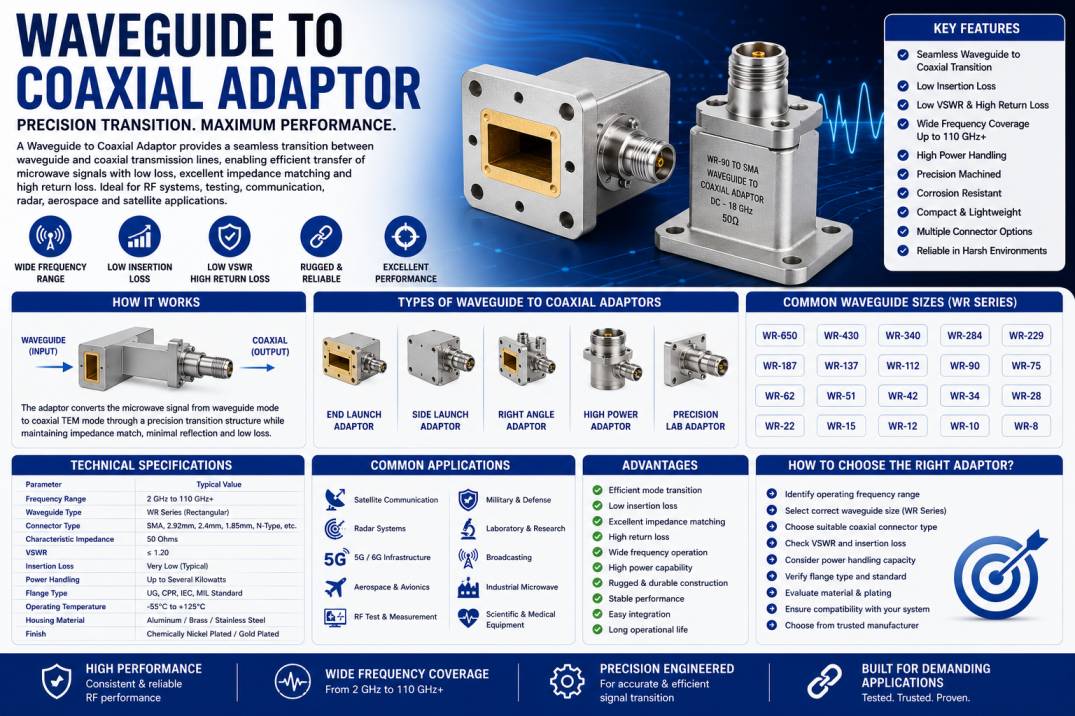
A Waveguide to Coaxial Adaptor is a specialized RF and microwave component designed to provide a seamless transition between a waveguide transmission line and a coaxial cable. It enables efficient transfer of high-frequency electromagnetic signals while maintaining excellent impedance matching, low insertion loss, and minimal signal reflection. These adaptors are widely used in microwave communication systems, satellite communication, radar equipment, aerospace, defense, laboratory testing, 5G infrastructure, and scientific research.
Waveguides are highly efficient for transmitting microwave and millimeter-wave signals over short distances with minimal loss, while coaxial cables are more practical for connecting RF instruments, antennas, amplifiers, and communication devices. A Waveguide to Coaxial Adaptor bridges these two transmission media, ensuring reliable signal transmission without degrading electrical performance.
With the expansion of advanced wireless technologies such as 5G, satellite internet, autonomous vehicles, aerospace communication, and radar systems, Waveguide to Coaxial Adaptors have become indispensable components in modern RF and microwave engineering.
This comprehensive guide explains everything about Waveguide to Coaxial Adaptors, including their working principle, construction, types, specifications, applications, advantages, and selection criteria.
What Is a Waveguide to Coaxial Adaptor?
A Waveguide to Coaxial Adaptor is an RF transition device that converts electromagnetic waves propagating inside a waveguide into signals suitable for transmission through a coaxial cable, or vice versa.
It provides an efficient impedance transition between the rectangular or circular waveguide and the coaxial transmission line while minimizing signal reflections and insertion loss.
Waveguide to Coaxial Adaptors are available in various waveguide sizes and connector interfaces, making them suitable for frequencies ranging from several gigahertz to over 110 GHz.
How Does a Waveguide to Coaxial Adaptor Work?
A Waveguide to Coaxial Adaptor works by converting the dominant waveguide propagation mode into the transverse electromagnetic (TEM) mode used by coaxial cables.
The operation includes:
- Microwave signal enters the waveguide.
- The adaptor’s transition structure converts the waveguide mode into coaxial mode.
- Impedance is carefully matched to reduce reflections.
- The converted signal exits through the coaxial connector.
- Signal integrity is maintained with minimal insertion loss.
The reverse process also works when transmitting signals from coaxial equipment into a waveguide system.
Construction of a Waveguide to Coaxial Adaptor
Waveguide Interface
The waveguide flange connects directly to the microwave waveguide.
Common flange standards include:
- UG Flanges
- CPR Flanges
- IEC Flanges
- MIL Standard Flanges
Transition Section
The transition structure converts electromagnetic energy between waveguide and coaxial transmission.
Common transition methods include:
- Probe transition
- Loop transition
- Ridge transition
- Aperture coupling
Coaxial Connector
The adaptor connects to RF equipment using precision coaxial connectors such as:
- SMA
- 2.92 mm (K Connector)
- 2.4 mm
- 1.85 mm
- N-Type
- TNC
- BNC
- 3.5 mm
Housing
The housing is precision machined to ensure excellent electrical performance.
Common materials include:
- Aluminum
- Brass
- Stainless Steel
- Copper Alloy
Gold-Plated Contacts
Gold-plated contacts improve conductivity, reduce corrosion, and enhance connector durability.
Working Principle of a Waveguide to Coaxial Adaptor
The adaptor performs electromagnetic mode conversion through carefully engineered transition geometry.
The operating sequence includes:
- RF signal enters the waveguide.
- Guided microwave energy reaches the transition section.
- Electromagnetic mode conversion occurs.
- Signal is impedance matched.
- RF energy exits through the coaxial connector.
- Low VSWR and minimal insertion loss are maintained.
Types of Waveguide to Coaxial Adaptors
End Launch Adaptor
The coaxial connector is positioned at the end of the waveguide.
Commonly used in laboratory testing and microwave systems.
Side Launch Adaptor
The coaxial connector is mounted on the side of the waveguide.
Provides compact installation in limited spaces.
Right Angle Adaptor
Designed where installation requires a 90-degree connector orientation.
Precision Laboratory Adaptor
Manufactured with tight mechanical tolerances for calibration and measurement systems.
High-Power Waveguide Adaptor
Designed for radar, satellite, and military systems requiring high RF power handling.
Millimeter-Wave Adaptor
Supports frequencies above 40 GHz and up to 110 GHz or higher.
Technical Specifications
| Specification | Typical Value |
|---|---|
| Frequency Range | 2 GHz to 110 GHz+ |
| Characteristic Impedance | 50 Ohms |
| VSWR | ≤ 1.20 |
| Insertion Loss | Very Low |
| Connector Types | SMA, N-Type, 2.92 mm, 2.4 mm, 1.85 mm |
| Waveguide Standards | WR Series |
| Flange Type | UG, CPR, IEC |
| Operating Temperature | -55°C to +125°C |
| Housing Material | Aluminum, Brass, Stainless Steel |
| Power Handling | High |
Common Waveguide Sizes
Waveguide to Coaxial Adaptors are available for numerous WR waveguide standards.
Popular waveguide sizes include:
- WR650
- WR430
- WR340
- WR284
- WR229
- WR187
- WR137
- WR112
- WR90
- WR75
- WR62
- WR51
- WR42
- WR34
- WR28
- WR22
- WR15
- WR12
- WR10
- WR8
Key Features of Waveguide to Coaxial Adaptors
- Low insertion loss
- Excellent impedance matching
- High return loss
- Wide frequency coverage
- Precision machining
- High power handling
- Compact design
- Reliable RF transition
- Low VSWR
- Corrosion-resistant materials
- Long operational life
- Easy installation
Applications of Waveguide to Coaxial Adaptors
Satellite Communication
Connects microwave equipment with satellite antennas and transceivers.
Radar Systems
Provides RF transitions between radar waveguides and testing equipment.
5G Infrastructure
Supports millimeter-wave communication systems and base station testing.
Aerospace
Used in aircraft communication, avionics, and navigation systems.
Defense
Supports electronic warfare, missile guidance, and military communication.
RF Test Laboratories
Connects network analyzers, spectrum analyzers, and signal generators to waveguide components.
Scientific Research
Used in microwave experiments, universities, and research institutions.
Semiconductor Testing
Supports wafer-level microwave device characterization.
Broadcasting
Used in high-frequency RF transmission systems.
Industrial Microwave Systems
Supports industrial heating, sensing, and measurement equipment.
Advantages of Waveguide to Coaxial Adaptors
- Efficient RF signal transition
- Minimal insertion loss
- Excellent return loss
- Wide operating frequency
- High power capability
- Precision mechanical alignment
- Stable electrical performance
- Long service life
- Reliable laboratory measurements
- Compact installation
- Easy system integration
- Rugged construction
Limitations of Waveguide to Coaxial Adaptors
- Higher cost than standard RF adapters
- Frequency-specific designs
- Requires compatible waveguide size
- Precision installation is essential
- Mechanical damage can affect RF performance
How to Choose the Right Waveguide to Coaxial Adaptor
Before selecting a Waveguide to Coaxial Adaptor, consider:
- Operating frequency
- Waveguide size (WR series)
- Coaxial connector type
- VSWR
- Insertion loss
- Power handling
- Flange compatibility
- Mechanical orientation
- Environmental conditions
- Application requirements
Waveguide to Coaxial Adaptor vs Standard RF Adapter
| Feature | Waveguide to Coaxial Adaptor | Standard RF Adapter |
|---|---|---|
| Primary Function | Waveguide to Coaxial Transition | Connector Conversion |
| Frequency Range | Up to 110 GHz+ | Typically Up to 67 GHz |
| Waveguide Support | Yes | No |
| Mode Conversion | Yes | No |
| Insertion Loss | Very Low | Low |
| Applications | Microwave Systems | General RF Connections |
Industries Using Waveguide to Coaxial Adaptors
Waveguide to Coaxial Adaptors are widely used in:
- Telecommunications
- Aerospace
- Defense
- Satellite Communication
- Radar Engineering
- Scientific Research
- Semiconductor Manufacturing
- Medical Electronics
- Industrial Microwave Systems
- RF Test Laboratories
Maintenance Tips
To maximize adaptor performance:
- Keep waveguide flanges clean.
- Protect coaxial connectors with dust caps.
- Use the recommended torque when tightening connectors.
- Avoid physical impact.
- Inspect connectors regularly.
- Store in a dry, clean environment.
- Verify VSWR periodically in precision applications.
Future Trends of Waveguide to Coaxial Adaptors
As 5G Advanced, 6G, satellite internet, autonomous vehicles, aerospace systems, and millimeter-wave communication continue to evolve, Waveguide to Coaxial Adaptors are advancing with broader frequency support, lower insertion loss, improved impedance matching, and enhanced manufacturing precision. New materials, additive manufacturing techniques, and compact transition designs are enabling operation beyond 110 GHz while supporting next-generation radar, quantum communication, semiconductor testing, and terahertz research.
Conclusion
Waveguide to Coaxial Adaptors are essential RF components that enable efficient transitions between waveguide systems and coaxial transmission lines. Their precision engineering, excellent impedance matching, low insertion loss, and high-frequency capability make them indispensable in microwave communication, satellite systems, radar, aerospace, defense, laboratory testing, and scientific research. Choosing the correct adaptor based on frequency range, waveguide size, connector type, power handling, and application ensures reliable signal transmission and optimum RF system performance.
Frequently Asked Questions (FAQs)
1. What is a Waveguide to Coaxial Adaptor?
A Waveguide to Coaxial Adaptor is an RF component that converts microwave signals between a waveguide and a coaxial cable while maintaining low loss and proper impedance matching.
2. What is a Waveguide to Coaxial Adaptor used for?
It is used in satellite communication, radar systems, RF testing, aerospace, defense, microwave communication, and laboratory applications.
3. How does a Waveguide to Coaxial Adaptor work?
It converts the electromagnetic waveguide mode into the TEM mode used by coaxial cables through a precision transition structure, ensuring efficient signal transfer.
4. What frequency range does a Waveguide to Coaxial Adaptor support?
Depending on the waveguide size and design, these adaptors typically support frequencies from 2 GHz to more than 110 GHz.
5. Which coaxial connectors are commonly available?
Common connector options include SMA, N-Type, 2.92 mm (K), 2.4 mm, 1.85 mm, 3.5 mm, TNC, and BNC.
6. What are the advantages of a Waveguide to Coaxial Adaptor?
They offer low insertion loss, excellent impedance matching, high power handling, low VSWR, reliable signal transition, and long operational life.
7. Which industries commonly use Waveguide to Coaxial Adaptors?
They are widely used in telecommunications, aerospace, defense, satellite communication, radar engineering, semiconductor testing, industrial microwave systems, and RF laboratories.
8. What waveguide sizes are supported?
Waveguide to Coaxial Adaptors are available for WR series waveguides, including WR90, WR75, WR62, WR42, WR28, WR15, WR10, and many other standard sizes.
9. Can Waveguide to Coaxial Adaptors handle high RF power?
Yes. High-power models are designed for demanding applications such as radar, satellite communication, and military microwave systems.
10. How do I choose the right Waveguide to Coaxial Adaptor?
Choose an adaptor based on operating frequency, WR waveguide size, coaxial connector type, VSWR, insertion loss, power handling, flange compatibility, installation orientation, and environmental conditions.