
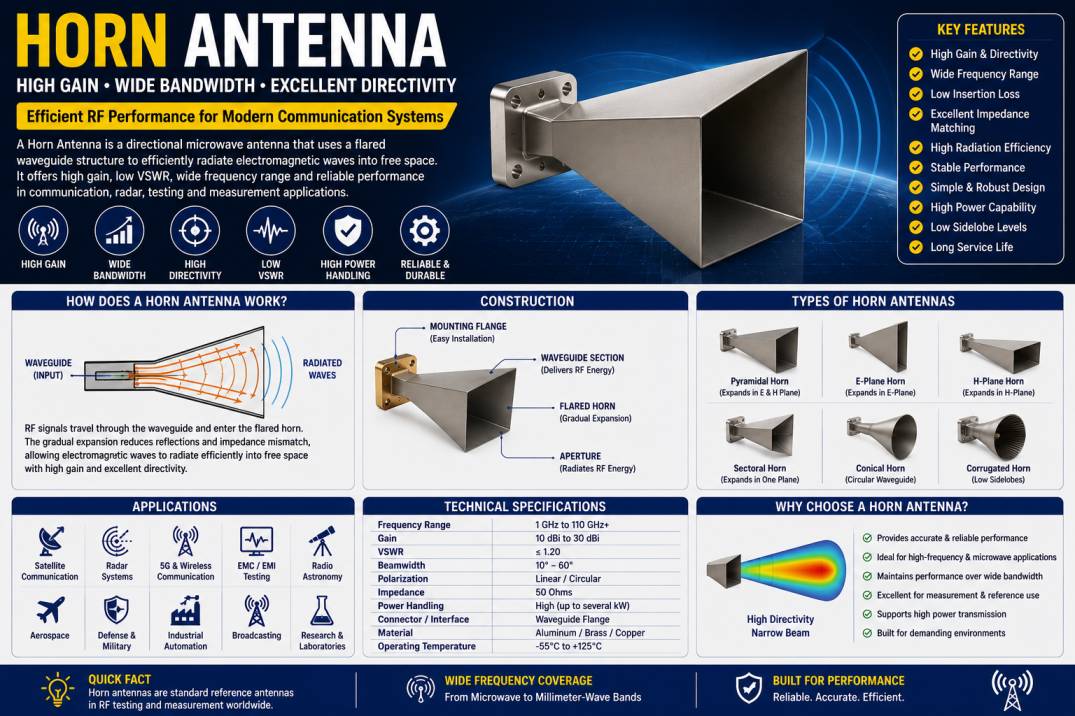
A Horn Antenna is one of the most widely used high-frequency antennas in radio frequency (RF), microwave, and millimeter-wave communication systems. Known for its simple construction, high gain, wide bandwidth, and excellent directivity, the horn antenna has become a standard solution for transmitting and receiving electromagnetic waves in applications such as satellite communication, radar systems, radio astronomy, electromagnetic compatibility (EMC) testing, aerospace, defense, and 5G wireless infrastructure.
The horn antenna is essentially an extension of a waveguide that gradually flares outward to efficiently radiate electromagnetic energy into free space. This gradual expansion minimizes signal reflections, improves impedance matching, and increases radiation efficiency compared to a standard waveguide opening.
Horn antennas operate across a wide frequency spectrum ranging from microwave frequencies to millimeter-wave bands exceeding 100 GHz. Their excellent radiation characteristics, predictable performance, and high-power handling capabilities make them an ideal choice for both commercial and military communication systems.
This comprehensive guide explains everything you need to know about Horn Antennas, including their working principle, construction, types, specifications, applications, advantages, and selection criteria.
What Is a Horn Antenna?
A Horn Antenna is a directional microwave antenna consisting of a flared metallic waveguide that efficiently radiates radio frequency energy into free space. The flared horn section acts as a transition between the waveguide and the surrounding environment, reducing impedance mismatch and increasing radiation efficiency.
Unlike omnidirectional antennas, horn antennas focus RF energy into a narrow beam, providing higher gain and better directivity.
Horn antennas are commonly used as standard gain antennas in antenna measurement laboratories due to their stable performance and well-defined radiation characteristics.
How Does a Horn Antenna Work?
A Horn Antenna works by guiding electromagnetic waves through a waveguide and gradually expanding them using a flared horn structure.
As the RF signal travels through the waveguide, the horn opening increases the effective aperture, allowing the electromagnetic waves to spread smoothly into free space.
This gradual expansion reduces wave reflections at the antenna opening and improves impedance matching between the waveguide and the air.
The result is efficient radiation with high directivity, low VSWR, and minimal signal distortion.
Construction of a Horn Antenna
Waveguide Section
The waveguide delivers RF energy from the transmitter to the horn.
It also determines the operating frequency band of the antenna.
Flared Horn
The flared section gradually expands from the waveguide opening.
Its shape determines the antenna gain, beamwidth, and radiation pattern.
Aperture
The aperture is the open end of the horn where electromagnetic waves radiate into free space.
A larger aperture generally produces higher antenna gain.
Metallic Body
Horn antennas are typically manufactured from:
- Aluminum
- Brass
- Copper
- Stainless Steel
The metallic body ensures excellent conductivity and mechanical strength.
Mounting Flange
The flange provides mechanical support and allows easy installation onto waveguide systems or antenna positioning equipment.
Working Principle of a Horn Antenna
The horn antenna operates by converting guided electromagnetic waves into free-space waves with minimal reflection.
The process includes:
- RF signal enters the waveguide.
- Electromagnetic waves propagate toward the horn.
- The flared horn gradually expands the wavefront.
- Impedance mismatch is minimized.
- RF energy radiates efficiently through the aperture.
- The antenna produces a highly directional radiation pattern.
Types of Horn Antennas
E-Plane Horn Antenna
The horn expands only in the electric field (E-plane).
It provides moderate gain and is commonly used in microwave communication.
H-Plane Horn Antenna
The horn expands only in the magnetic field (H-plane).
It offers different beamwidth characteristics than the E-plane horn.
Pyramidal Horn Antenna
The horn expands in both the E-plane and H-plane.
It is one of the most commonly used horn antenna designs due to its balanced radiation pattern and high gain.
Sectoral Horn Antenna
Expansion occurs in only one plane.
These antennas are used when directional control is required in a specific plane.
Conical Horn Antenna
Constructed from circular waveguides.
Widely used in satellite communication and radar applications.
Corrugated Horn Antenna
Features internal grooves that improve radiation symmetry and reduce sidelobes.
Commonly used in space communication, radio astronomy, and precision measurement systems.
Technical Specifications
| Specification | Typical Value |
| Frequency Range | 1 GHz to 110 GHz+ |
| Gain | 10 dBi to 30 dBi |
| VSWR | ≤ 1.20 |
| Polarization | Linear or Circular |
| Beamwidth | 10°–60° |
| Impedance | 50 Ohms |
| Power Handling | High |
| Connector Type | Waveguide Flange |
| Material | Aluminum, Brass, Copper |
| Operating Temperature | -55°C to +125°C |
Key Features of Horn Antennas
- High gain
- Excellent directivity
- Wide bandwidth
- Low VSWR
- High radiation efficiency
- Stable performance
- Excellent impedance matching
- High power handling
- Simple construction
- Low sidelobe levels
- Reliable operation
- Long service life
Applications of Horn Antennas
Satellite Communication
Used for satellite uplink and downlink communication.
Radar Systems
Provides high-gain microwave transmission for military and aviation radar.
5G Communication
Supports millimeter-wave communication and antenna testing.
Electromagnetic Compatibility (EMC)
Used as standard antennas for EMC and EMI testing.
Antenna Measurement Laboratories
Serves as a reference antenna for gain and radiation pattern measurements.
Radio Astronomy
Receives weak signals from deep-space radio sources.
Aerospace
Supports aircraft communication, navigation, and testing systems.
Defense
Used in electronic warfare, surveillance, and missile guidance systems.
Industrial Automation
Supports microwave sensing and wireless industrial communication.
Scientific Research
Widely used in universities and research laboratories for RF experiments.
Advantages of Horn Antennas
- Wide operating bandwidth
- High gain
- Excellent directivity
- Low reflection loss
- High efficiency
- Simple design
- Easy manufacturing
- High power capability
- Stable radiation pattern
- Excellent measurement accuracy
- Reliable outdoor performance
- Minimal maintenance
Limitations of Horn Antennas
- Larger size at lower frequencies
- Narrow beamwidth
- Limited portability
- Requires waveguide feed
- Higher cost for precision microwave models
How to Choose the Right Horn Antenna
When selecting a Horn Antenna, consider the following factors:
- Operating frequency
- Gain requirement
- Beamwidth
- Polarization
- Waveguide size
- VSWR
- Power handling
- Environmental conditions
- Material quality
- Application type
Horn Antenna vs Parabolic Antenna
| Feature | Horn Antenna | Parabolic Antenna |
| Gain | Moderate to High | Very High |
| Bandwidth | Wide | Moderate |
| Beamwidth | Moderate | Very Narrow |
| Size | Compact | Larger |
| Feed System | Waveguide | Feed Horn + Reflector |
| Installation | Easy | More Complex |
| Applications | RF Testing, Radar | Satellite Communication |
Industries Using Horn Antennas
Horn Antennas are widely used in:
- Telecommunications
- Aerospace
- Defense
- Satellite Communication
- Broadcasting
- Research Laboratories
- Medical Electronics
- Automotive Radar
- Industrial Automation
- Semiconductor Testing
Maintenance Tips
To maximize antenna performance:
- Keep the horn aperture clean.
- Avoid physical deformation.
- Protect from moisture and dust.
- Inspect mounting hardware regularly.
- Ensure proper waveguide alignment.
- Store in a dry environment.
- Verify VSWR periodically for critical applications.
Future Trends of Horn Antennas
The evolution of 5G Advanced, 6G, autonomous vehicles, satellite internet, radar imaging, and millimeter-wave communication is driving demand for advanced horn antennas with higher gain, wider bandwidth, and improved efficiency. Manufacturers are developing compact corrugated horns, dual-polarized designs, additive-manufactured antennas, and lightweight materials to improve performance while reducing size and weight. Horn antennas operating beyond 110 GHz will continue to support emerging applications in terahertz communication, advanced imaging systems, scientific research, and next-generation wireless infrastructure.
Conclusion
Horn Antennas remain one of the most important microwave antennas for high-frequency communication and RF testing. Their simple construction, wide bandwidth, excellent directivity, high gain, and reliable performance make them indispensable in satellite communication, radar systems, aerospace, defense, EMC testing, scientific research, and 5G communication. By selecting the appropriate horn type, operating frequency, gain, beamwidth, and waveguide configuration, engineers can achieve efficient electromagnetic wave transmission with minimal signal loss and exceptional measurement accuracy.
Frequently Asked Questions (FAQs)
1. What is a Horn Antenna?
A Horn Antenna is a directional microwave antenna that uses a flared waveguide to efficiently transmit and receive high-frequency electromagnetic waves.
2. What is a Horn Antenna used for?
Horn antennas are used in satellite communication, radar systems, 5G networks, EMC testing, antenna measurements, aerospace, defense, and scientific research.
3. How does a Horn Antenna work?
A Horn Antenna gradually expands electromagnetic waves through a flared waveguide, improving impedance matching and radiating RF energy efficiently into free space.
4. What are the different types of Horn Antennas?
The main types include E-Plane Horn, H-Plane Horn, Pyramidal Horn, Sectoral Horn, Conical Horn, and Corrugated Horn antennas.
5. What frequency range does a Horn Antenna support?
Depending on the design, horn antennas typically operate from 1 GHz to over 110 GHz.
6. What are the advantages of a Horn Antenna?
They provide high gain, wide bandwidth, excellent directivity, low VSWR, high power handling, stable radiation patterns, and reliable long-term performance.
7. What materials are used to manufacture Horn Antennas?
Horn antennas are commonly made from aluminum, brass, copper, or stainless steel.
8. What is the difference between a Horn Antenna and a Parabolic Antenna?
A Horn Antenna offers wide bandwidth and simpler construction, while a Parabolic Antenna provides higher gain and a narrower beam for long-distance communication.
9. Which industries commonly use Horn Antennas?
Horn antennas are widely used in telecommunications, aerospace, defense, satellite communication, automotive radar, industrial automation, scientific research, and RF testing laboratories.
10. How do I choose the right Horn Antenna?
Select a c based on operating frequency, gain, beamwidth, polarization, waveguide size, VSWR, power handling, environmental conditions, and the intended application.