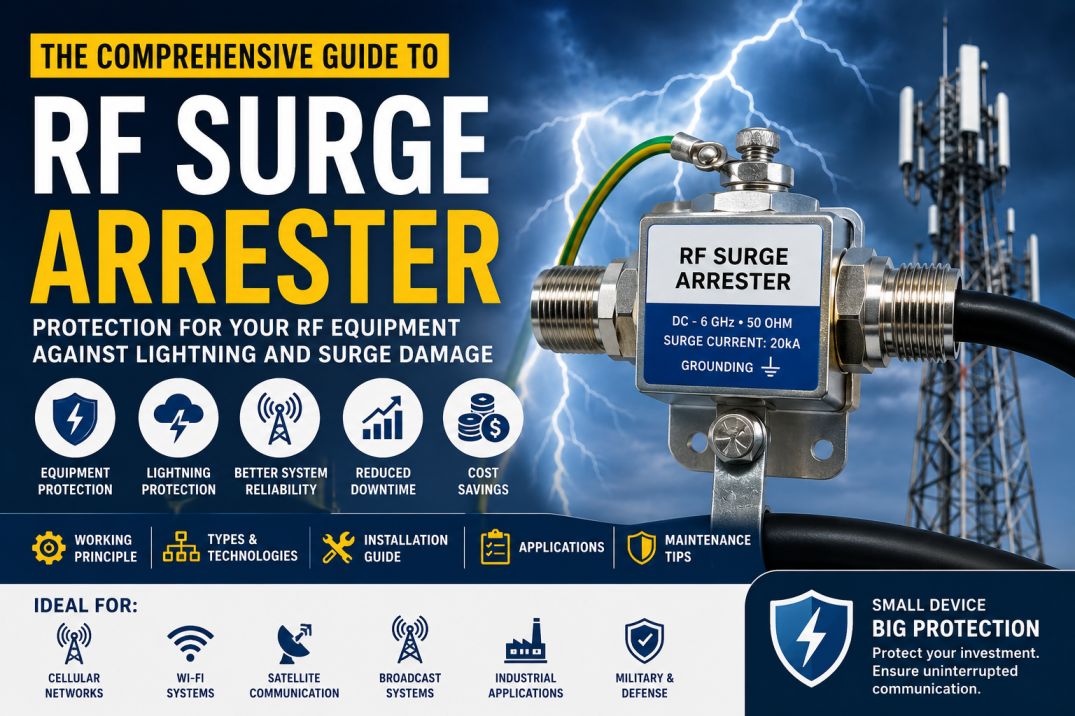
Modern communication networks rely heavily on sensitive RF (Radio Frequency) equipment such as antennas, repeaters, cellular base stations, Wi-Fi access points, satellite systems, and radio transceivers. While these systems are designed for efficient signal transmission and reception, they remain vulnerable to lightning strikes, electrical surges, electrostatic discharge (ESD), and induced voltage spikes.
An RF Surge Arrester serves as a critical line of defense by protecting valuable RF equipment from potentially damaging surge currents and overvoltage conditions. Whether deployed in telecom towers, cellular infrastructure, military communication systems, broadcasting stations, or industrial wireless networks, RF surge protectors play a vital role in ensuring system reliability and minimizing downtime.
This comprehensive guide explains everything you need to know about RF surge arresters, including their working principle, components, types, applications, installation procedures, advantages, and maintenance best practices.
What is an RF Surge Arrester?
An RF Surge Arrester, also known as an RF Lightning Arrestor or Coaxial Surge Protector, is a protective device installed in RF transmission lines to divert transient surge energy safely to ground before it reaches sensitive electronic equipment.
The device allows normal RF signals to pass with minimal insertion loss while blocking or redirecting dangerous surge voltages caused by:
- Lightning strikes
- Nearby lightning activity
- Switching surges
- Power line faults
- Electrostatic discharge (ESD)
- Electromagnetic interference (EMI)
The primary objective of an RF surge arrester is to protect transmitters, receivers, amplifiers, modems, routers, and communication equipment from catastrophic damage.
Why RF Surge Protection is Important
Communication systems often utilize outdoor antennas mounted on towers, rooftops, poles, and elevated structures.
These installations face significant exposure to:
Direct Lightning Strikes
A direct strike can generate extremely high current levels capable of destroying equipment instantly.
Induced Lightning Surges
Even when lightning does not strike directly, nearby strikes can induce damaging voltages in coaxial cables.
Static Electricity
Environmental conditions can create charge buildup on antennas and feed lines.
Switching Transients
Power grid operations and industrial equipment may generate harmful transient voltages.
Without proper surge protection, organizations may face:
- Equipment failures
- Network downtime
- Data loss
- Costly repairs
- Service interruptions
- Reduced equipment lifespan
How Does an RF Surge Arrester Work?
An RF surge arrester remains inactive during normal operation.
Normal Conditions
Under normal RF transmission:
- RF signals pass through the arrester
- Signal attenuation remains minimal
- System performance remains unaffected
Surge Conditions
When excessive voltage occurs:
- Surge voltage exceeds the protection threshold.
- Internal protection elements activate.
- Surge current is redirected to ground.
- Equipment remains isolated from dangerous voltages.
- Normal operation resumes after the surge event.
This process typically occurs within nanoseconds or microseconds.
Main Components of an RF Surge Arrester
RF Connectors
The device includes RF connectors compatible with system requirements.
Common connector types include:
- N Female
- N Male
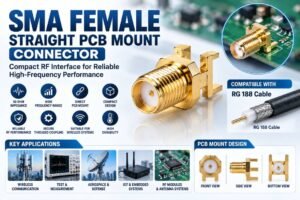
- SMA
- TNC
- BNC
- DIN 7/16
- UHF (PL-259)
Grounding Terminal
Provides a low-resistance path for surge current dissipation.
Proper grounding is essential for effective protection.
Surge Protection Element
The core protective component may include:
- Gas Discharge Tube (GDT)
- Quarter-Wave Stub
- Metal Oxide Varistor (MOV)
- Hybrid Protection Technology
Protective Housing
Typically constructed from:
- Brass
- Nickel-plated brass
- Stainless steel
- Aluminum alloy
The enclosure protects internal components from environmental conditions.
Types of RF Surge Arresters
Gas Discharge Tube (GDT) RF Surge Arresters
The most common type of RF surge protector.
How It Works
When voltage exceeds a predefined threshold:
- Gas inside the tube ionizes
- Conductive path forms
- Surge energy is diverted to ground
Advantages
- High surge handling capability
- Wide frequency support
- Cost-effective
- Long service life
Applications
- Cellular networks
- Wi-Fi systems
- Broadcast stations
- Two-way radio networks
Quarter-Wave RF Surge Arresters
Designed using transmission line principles.
How It Works
- Functions as an open circuit during normal operation
- Appears as a short circuit during surge events
Advantages
- Extremely low insertion loss
- Excellent RF performance
- High-frequency compatibility
Limitations
- Narrow frequency range
- Frequency-specific design
Applications
- Cellular base stations
- Microwave links
- Professional RF systems
Metal Oxide Varistor (MOV) Surge Arresters
MOV technology is widely used in electrical surge protection.
Benefits
- Fast response
- Good energy absorption
Limitations
- Limited lifespan under repeated surges
Hybrid RF Surge Arresters
Combine multiple technologies such as:
- GDT
- MOV
- Quarter-wave protection
Benefits
- Improved protection
- Broad frequency coverage
- Enhanced reliability
Key Technical Specifications
When selecting an RF surge arrester, several specifications must be evaluated.
Frequency Range
Defines operational RF bandwidth.
Examples:
- DC–3 GHz
- DC–6 GHz
- DC–18 GHz
Insertion Loss
Represents signal loss introduced by the arrester.
Typical values:
- Less than 0.2 dB
- Less than 0.5 dB
Lower insertion loss is preferred.
VSWR (Voltage Standing Wave Ratio)
Indicates impedance matching quality.
Typical values:
- 1.1:1
- 1.2:1
- 1.3:1
Lower VSWR improves system efficiency.
Surge Current Rating
Measures maximum surge current handling capability.
Typical ratings:
- 10 kA
- 20 kA
- 40 kA
- 100 kA
Connector Type
Must match existing RF infrastructure.
Impedance
Most RF systems use:
- 50 Ohm
- 75 Ohm
The arrester must match system impedance.
Applications of RF Surge Arresters
Cellular Networks
Protects:
- 4G LTE base stations
- 5G infrastructure
- Distributed antenna systems (DAS)
Wi-Fi Networks
Used in:
- Outdoor access points
- Wireless bridges
- Campus networks
Broadcast Systems
Protects:
- FM transmitters
- TV broadcasting equipment
- Studio-to-transmitter links
Satellite Communication
Used for:
- VSAT systems
- Satellite ground stations
- Remote communication terminals
Amateur Radio Systems
Provides protection for:
- HF antennas
- VHF antennas
- UHF antennas
Industrial Wireless Networks
Used in:
- SCADA systems
- Utility networks
- Oil and gas facilities
- Smart grid infrastructure
Military and Defense Communication
Protects mission-critical RF communication systems operating in harsh environments.
Advantages of RF Surge Arresters
Equipment Protection
Prevents expensive hardware damage.
Reduced Downtime
Maintains communication network availability.
Enhanced Reliability
Improves long-term system stability.
Cost Savings
Reduces replacement and repair costs.
Extended Equipment Life
Minimizes electrical stress on sensitive electronics.
Compliance with Industry Standards
Supports network safety requirements.
RF Surge Arrester Installation Guidelines
Install Near Equipment Entry Point
Place the surge protector where the coaxial cable enters the building or equipment shelter.
Use Proper Grounding
Grounding is the most important factor in surge protection effectiveness.
Ground connections should:
- Be short
- Be straight
- Have low resistance
Minimize Ground Lead Length
Long ground wires increase inductance and reduce protection performance.
Weatherproof Outdoor Installations
Use:
- Weatherproof connectors
- Waterproof sealing tape
- Outdoor-rated enclosures
Verify Connector Compatibility
Ensure connectors match system requirements.
Examples:
- N Female to N Male
- SMA Female to SMA Male
Common Installation Mistakes
Avoid the following errors:
Poor Grounding
The most common cause of surge protection failure.
Incorrect Frequency Selection
Using an arrester outside its designed frequency range.
Long Ground Conductors
Reduces surge diversion efficiency.
Mismatched Connectors
Can increase signal loss and VSWR.
Skipping Regular Inspection
May result in undetected damage after surge events.
Maintenance and Inspection
Regular maintenance helps ensure continued protection.
Visual Inspection
Check for:
- Corrosion
- Physical damage
- Loose connections
Ground System Inspection
Verify:
- Ground resistance
- Bonding integrity
- Connector condition
Post-Lightning Evaluation
Inspect surge arresters after significant lightning activity.
Replace units if damage is suspected.
RF Surge Arrester vs Lightning Arrester
Many people use these terms interchangeably.
| Feature | RF Surge Arrester | Lightning Arrester |
|---|---|---|
| Purpose | RF Equipment Protection | Electrical System Protection |
| Frequency Support | Yes | No |
| RF Signal Pass Through | Yes | Typically No |
| Connector Interfaces | RF Connectors | Power Connectors |
| Communication Systems | Yes | Limited |
How to Choose the Right RF Surge Arrester
Consider:
Frequency Range
Match the operational frequency.
Connector Type
Ensure compatibility.
Surge Rating
Choose based on environmental risk.
Installation Environment
Indoor or outdoor deployment.
Impedance
Match 50 Ohm or 75 Ohm systems.
Environmental Protection
Select weather-resistant models for outdoor use.
Future of RF Surge Protection
With the rapid expansion of:
- 5G networks
- IoT infrastructure
- Smart cities
- Industrial automation
- Wireless broadband
RF surge protection is becoming increasingly important.
Modern surge arresters now offer:
- Higher surge ratings
- Lower insertion loss
- Broader frequency coverage
- Improved environmental durability
Conclusion
RF Surge Arresters are essential components in modern communication systems. By safely diverting transient voltages and lightning-induced surges to ground, they protect valuable RF equipment from costly damage and operational disruptions.
Whether deployed in cellular networks, wireless broadband systems, satellite communications, broadcasting facilities, or industrial RF applications, a properly selected and installed RF surge arrester significantly improves system reliability, safety, and longevity. Investing in high-quality surge protection is a small cost compared to the potential losses caused by lightning and electrical surges, making RF surge arresters a critical part of every professional RF infrastructure.