RF cables are the backbone of modern communication systems, enabling the efficient transmission of radio frequency (RF) signals between electronic devices with minimal signal loss. Whether you are using a mobile phone, Wi-Fi router, satellite receiver, GPS system, television, radar, or 5G base station, RF cables play a vital role in ensuring reliable signal transmission.
As communication technologies continue to evolve toward higher frequencies and faster data transmission, the demand for high-quality RF cables has grown significantly. These specialized cables are designed to carry high-frequency signals while maintaining signal integrity, minimizing interference, and reducing power loss over long distances.
Unlike ordinary electrical cables, RF cables are engineered with precise impedance, advanced shielding, and high-quality dielectric materials to support frequencies ranging from a few megahertz (MHz) to several gigahertz (GHz). Their ability to preserve signal quality makes them essential in industries such as telecommunications, aerospace, defense, medical technology, broadcasting, industrial automation, and scientific research.
This comprehensive guide explains everything you need to know about RF cables, including their construction, working principles, types, specifications, applications, advantages, and selection criteria.
What Is an RF Cable?
An RF cable, also known as a Radio Frequency Cable or Coaxial RF Cable, is a specially designed electrical cable used to transmit high-frequency radio signals between electronic devices while minimizing signal loss and electromagnetic interference (EMI).
RF cables are built with multiple protective layers that help preserve signal quality across long distances. They are widely used to connect antennas, transmitters, receivers, amplifiers, test equipment, and communication devices.
The primary purpose of an RF cable is to transfer RF energy efficiently without allowing external electrical noise to interfere with the transmitted signal.
How Does an RF Cable Work?
An RF cable works by carrying radio frequency signals through its central conductor while the surrounding shielding prevents external electromagnetic interference.
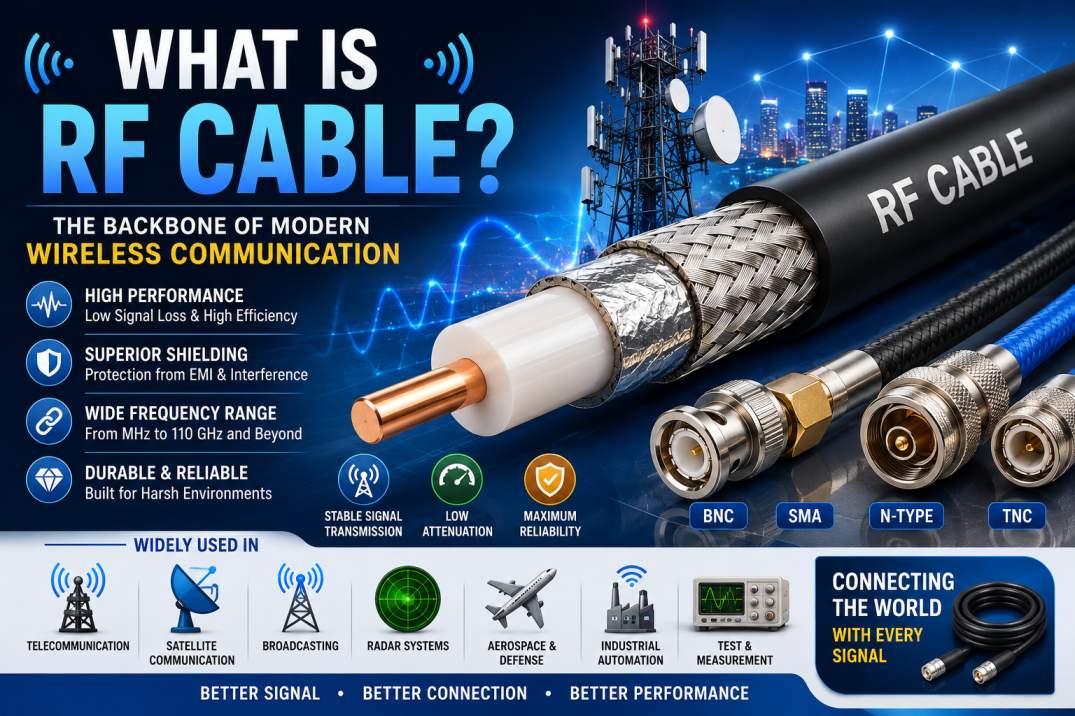
The cable consists of multiple layers that work together to maintain signal integrity:
The center conductor carries the RF signal.
The dielectric insulator keeps the conductor centered while maintaining electrical separation.
The metallic shield blocks external interference and prevents signal leakage.
The outer jacket protects the cable from mechanical damage, moisture, and environmental conditions.
Because RF signals operate at very high frequencies, even small impedance mismatches or poor shielding can result in signal reflections and transmission loss. High-quality RF cables are carefully engineered to minimize these problems.
Construction of an RF Cable
An RF cable consists of four major components.
Center Conductor
The center conductor carries the electrical RF signal.
Common materials include:
Copper
Silver-plated copper
Copper-clad steel
Solid copper
The conductor quality directly affects signal transmission efficiency.
Dielectric Insulator
The dielectric separates the center conductor from the outer shield.
Common dielectric materials include:
PTFE (Teflon)
Foam Polyethylene
Solid Polyethylene
Air-Spaced Dielectric
The dielectric influences impedance, capacitance, and signal velocity.
Metallic Shield
The shield protects the signal from electromagnetic interference.
Shield types include:
Copper braid
Aluminum foil
Double braid
Triple shield
Quad shield
Better shielding provides improved noise immunity and lower signal leakage.
Outer Jacket
The outer jacket protects the cable against environmental damage.
Common jacket materials include:
PVC
Polyethylene
LSZH (Low Smoke Zero Halogen)
TPE
Weather-resistant rubber
Types of RF Cables
Several RF cable types are available for different applications.
RG Series RF Cables
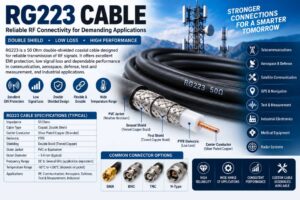
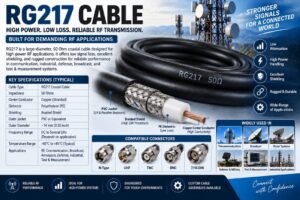
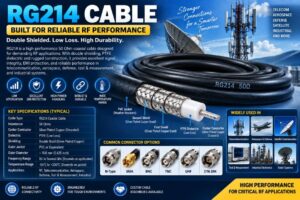
The RG (Radio Guide) series is among the most widely used RF cable families.
Popular models include:
RG58
RG59
RG6
RG8
RG11
RG174
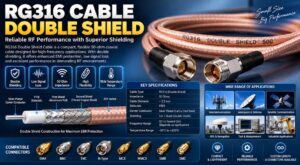
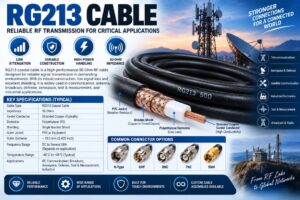
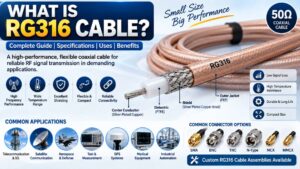
RG316
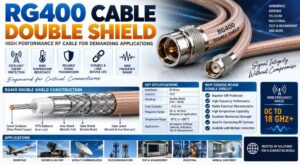
RG400
Each model offers different attenuation characteristics and frequency capabilities.
Flexible RF Cables
Flexible RF cables are designed for applications requiring frequent movement or installation in confined spaces.
Common applications include:
Robotics
Medical equipment
Portable communication devices
Laboratory testing
Military equipment
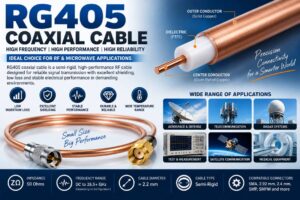
Semi-Rigid RF Cables
Semi-rigid cables provide excellent electrical performance and stable impedance.
They are commonly used in:
Microwave systems
Radar equipment
Military electronics
Satellite communication
Laboratory instruments
Low-Loss RF Cables
Low-loss RF cables are specifically designed to minimize signal attenuation over long distances.
Examples include:
LMR-195
LMR-240
LMR-400
LMR-600
These cables are widely used in cellular networks, Wi-Fi installations, and base stations.
High-Temperature RF Cables
These cables are designed to operate in harsh industrial and aerospace environments where temperatures may exceed 200°C.
Common RF Connector Types
RF cables can be terminated with different connector types depending on the application.
Popular connectors include:
SMA
N-Type
BNC
TNC
F-Type
UHF (PL259)
MCX
MMCX
7/16 DIN
4.3-10
2.92 mm
2.4 mm
1.85 mm
Each connector is designed for specific frequency ranges and power handling capabilities.
RF Cable Impedance
Impedance is one of the most important characteristics of an RF cable.
The most common impedance values are:
50 Ohm
75 Ohm
50 Ohm cables are used in:
Wireless communication
Radar
Military equipment
RF laboratories
5G infrastructure
Satellite communication
75 Ohm cables are commonly used in:
Cable television
Video transmission
Broadcasting
Home entertainment systems
Frequency Range of RF Cables
RF cables support a broad frequency spectrum.
Typical ranges include:
DC to 1 GHz
DC to 3 GHz
DC to 6 GHz
DC to 12 GHz
DC to 18 GHz
DC to 26.5 GHz
DC to 40 GHz
DC to 67 GHz
Advanced microwave cables can operate beyond 110 GHz.
Key Specifications of RF Cables
When selecting an RF cable, engineers consider several technical specifications.
Insertion Loss
Measures how much signal power is lost during transmission.
Lower insertion loss results in better performance.
Return Loss
Indicates how much signal is reflected back due to impedance mismatch.
Higher return loss indicates superior cable performance.
VSWR
Voltage Standing Wave Ratio measures impedance matching.
Lower VSWR means less reflected power.
Shielding Effectiveness
High shielding effectiveness protects against electromagnetic interference.
Power Handling
Determines the maximum RF power the cable can safely carry.
Velocity Factor
The velocity factor indicates how fast the signal travels through the cable relative to the speed of light.
Operating Temperature
Different RF cables are rated for different environmental conditions.
Applications of RF Cables
RF cables are used in nearly every modern communication system.
Telecommunications
Mobile networks
5G infrastructure
Cellular towers
Signal repeaters
Broadcasting
Radio stations
Television transmitters
Cable television
Satellite broadcasting
Satellite Communication
Ground stations
Satellite antennas
VSAT systems
Space communication
Military and Defense
Radar systems
Electronic warfare
Missile guidance
Secure communication
Naval communication
Aerospace
Aircraft communication
Navigation systems
Avionics
Flight control systems
Medical Equipment
MRI systems
RF diagnostic devices
Medical imaging
Wireless patient monitoring
Industrial Automation
Machine communication
Wireless control systems
Factory automation
IoT infrastructure
Consumer Electronics
Wi-Fi routers
GPS devices
Smart TVs
Wireless antennas
Bluetooth systems
Test and Measurement
Spectrum analyzers
Network analyzers
Oscilloscopes
Signal generators
RF laboratories
Advantages of RF Cables
Excellent signal quality
Low transmission loss
High-frequency compatibility
Strong EMI protection
Long service life
Reliable performance
Wide connector compatibility
Excellent impedance stability
High durability
Easy installation
Supports modern communication systems
Suitable for indoor and outdoor applications
Limitations of RF Cables
Higher-quality cables are more expensive
Long cable lengths increase attenuation
Improper installation reduces performance
Connector quality significantly affects signal integrity
Sharp bending can damage cable structure
How to Choose the Right RF Cable
Choosing the right RF cable depends on several important factors.
Determine the operating frequency.
Select the correct impedance.
Choose an appropriate connector type.
Consider cable flexibility.
Check attenuation specifications.
Evaluate shielding performance.
Verify environmental requirements.
Confirm power handling capability.
Choose a trusted manufacturer with certified products.
RF Cable vs Coaxial Cable
Although RF cables are commonly referred to as coaxial cables, not every coaxial cable is suitable for high-frequency RF applications.
RF cables are manufactured with tighter tolerances, better shielding, lower attenuation, and superior impedance control, making them ideal for microwave and communication systems.
Future Trends in RF Cable Technology
As wireless communication technologies continue to evolve, RF cable manufacturers are developing innovative solutions with lower signal loss, higher frequency capability, improved flexibility, enhanced shielding, and greater environmental resistance. Emerging technologies such as 5G, 6G, autonomous vehicles, satellite internet, aerospace communication, industrial IoT, and smart cities are driving the demand for advanced RF cables capable of supporting frequencies well above 100 GHz while maintaining exceptional electrical performance.
Conclusion
RF cables are indispensable components in modern communication systems, providing reliable transmission of high-frequency signals across countless industries. Their advanced construction, precision impedance, effective shielding, and low-loss performance make them essential for wireless communication, broadcasting, aerospace, defense, medical technology, industrial automation, and electronic testing. Selecting the right RF cable based on frequency, impedance, attenuation, shielding, connector type, and environmental conditions ensures maximum signal integrity and long-term reliability. As communication technologies continue advancing toward higher frequencies and faster data rates, RF cables will remain a critical foundation of global connectivity.
Frequently Asked Questions (FAQs)
1. What is an RF cable?
An RF cable is a specialized coaxial cable designed to transmit radio frequency signals with minimal loss and interference between RF devices.
2. What is the difference between an RF cable and a coaxial cable?
An RF cable is a type of coaxial cable specifically engineered for high-frequency applications with controlled impedance, superior shielding, and lower attenuation.
3. What are the common impedance values of RF cables?
The most common impedance values are 50 Ohms for communication systems and 75 Ohms for television and video applications.
4. What are RF cables used for?
RF cables are used in wireless communication, 5G networks, satellite systems, broadcasting, radar, aerospace, defense, medical equipment, industrial automation, and RF testing.
5. Which RF cable is best for long-distance signal transmission?
Low-loss RF cables such as LMR-400, LMR-600, and similar high-performance cables are commonly used for long-distance applications.
6. What connector types are used with RF cables?
Popular RF connectors include SMA, N-Type, BNC, TNC, F-Type, UHF, MCX, MMCX, 7/16 DIN, and 4.3-10 connectors.
7. How do I choose the right RF cable?
Consider the operating frequency, impedance, cable length, attenuation, shielding, connector type, flexibility, and environmental conditions before selecting an RF cable.
8. Can RF cables be used outdoors?
Yes. Many RF cables are designed with weather-resistant jackets and UV protection, making them suitable for outdoor installations.
9. What causes signal loss in RF cables?
Signal loss can result from long cable lengths, poor-quality connectors, impedance mismatches, inadequate shielding, and cable aging.
10. Why is shielding important in an RF cable?
Shielding prevents electromagnetic interference (EMI), reduces signal leakage, and helps maintain signal quality in high-frequency communication systems.