The N Connector is one of the most widely used RF connectors in the telecommunications, wireless communication, microwave, aerospace, defense, industrial, and broadcasting industries. Known for its rugged construction, excellent electrical performance, and weather-resistant design, the N Connector has become the industry standard for medium to high-power RF applications operating from DC to frequencies above 18 GHz.
As modern communication systems continue to expand with technologies such as 5G, satellite communication, Wi-Fi, IoT, radar, and microwave links, maintaining signal integrity has become increasingly important. A high-quality RF connector is essential to ensure minimal insertion loss, excellent impedance matching, and reliable signal transmission. The N Connector is specifically designed to meet these demanding requirements while offering exceptional durability in both indoor and outdoor environments.
Originally developed during the 1940s, the N Connector has evolved significantly over the years. Modern precision N Connectors now support frequencies up to 18 GHz, 26.5 GHz, and even higher in specialized versions, making them suitable for a wide variety of RF and microwave systems.
Whether connecting antennas, RF amplifiers, coaxial cables, test equipment, or wireless infrastructure, N Connectors deliver reliable performance across numerous industries.
What Is an N Connector?
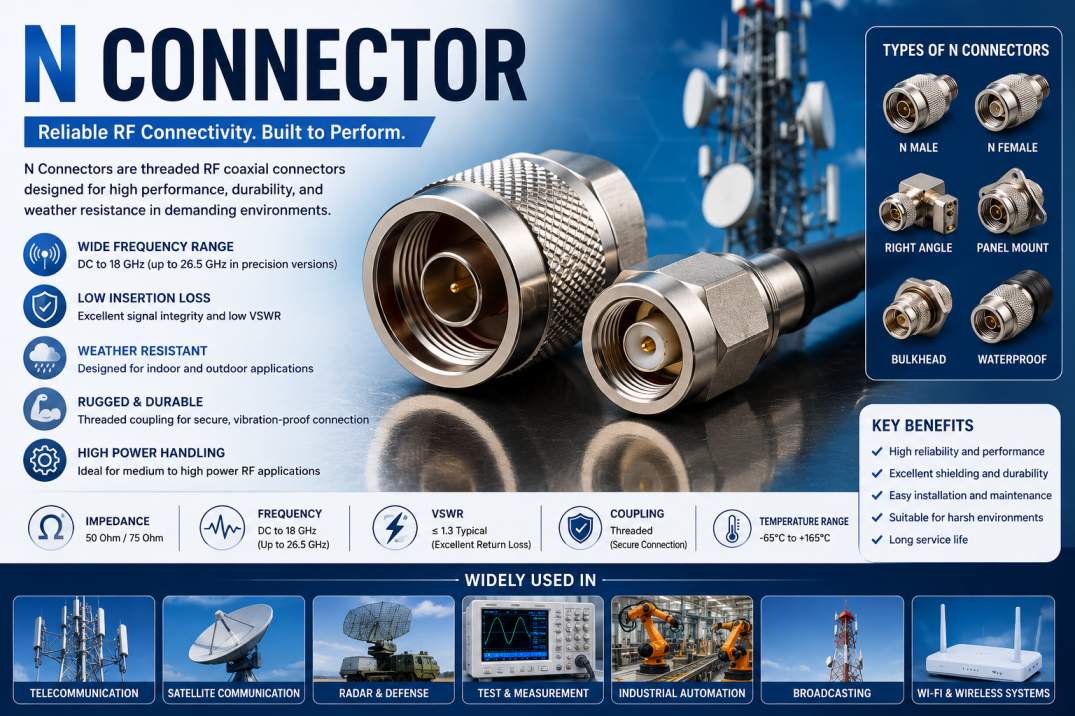
An N Connector is a threaded RF coaxial connector designed to provide secure, low-loss electrical connections for radio frequency and microwave transmission systems. It is available in both male (plug) and female (jack) configurations and is primarily used with 50 Ohm or 75 Ohm coaxial cable assemblies.
Unlike quick-connect RF connectors, the threaded coupling mechanism of an N Connector ensures a firm mechanical connection that resists vibration, moisture, and accidental disconnection.
The connector is widely recognized for its ability to transmit high-frequency signals with minimal insertion loss while maintaining excellent Voltage Standing Wave Ratio (VSWR) and return loss.
Its robust construction makes it suitable for harsh industrial and outdoor environments where reliability is critical.
History of the N Connector
The N Connector was invented by Paul Neill at Bell Labs during the 1940s. The “N” in its name comes from the inventor’s surname.
It was originally designed as a weatherproof RF connector capable of supporting microwave frequencies while handling higher power levels than earlier RF connector designs.
Over time, the N Connector became one of the most trusted connector standards in RF engineering due to its durability, versatility, and consistent electrical performance.
Today, it remains one of the most commonly specified RF connectors worldwide.
How Does an N Connector Work?
An N Connector joins two RF transmission lines while maintaining a constant characteristic impedance throughout the connection.
The center conductor transfers the RF signal, while the outer conductor provides shielding and acts as the ground connection. The threaded coupling mechanism tightly secures both connectors, ensuring excellent electrical contact and minimizing signal reflections.
This precise mechanical design helps reduce insertion loss, maintain impedance matching, and protect the connection from vibration, moisture, dust, and environmental contaminants.
Construction of an N Connector
An N Connector consists of several precision-engineered components.
Center Contact
The center pin carries the RF signal and is typically manufactured from gold-plated brass, beryllium copper, or phosphor bronze.
Dielectric Insulator
The dielectric separates the center conductor from the outer body while maintaining electrical insulation.
Common materials include PTFE (Teflon) and air dielectric designs for higher-frequency applications.
Outer Body
The connector body provides structural strength and electrical shielding.
It is usually manufactured from brass or stainless steel with nickel or silver plating for corrosion resistance.
Coupling Nut
The threaded coupling nut ensures secure mating between male and female connectors.
Unlike push-on connectors, the threaded mechanism prevents accidental disconnection.
Gasket or O-Ring
Outdoor-rated N Connectors often include weatherproof seals that prevent moisture and dust from entering the connection.
Key Features of N Connectors
Threaded locking mechanism
Excellent RF performance
Low insertion loss
High power handling
Weatherproof construction
Excellent impedance matching
Low VSWR
High return loss
Wide operating frequency range
Long service life
Excellent mechanical durability
Corrosion-resistant materials
Suitable for indoor and outdoor installations
Reliable vibration resistance
Types of N Connectors
N Male Connector
The N Male Connector features a center pin and threaded coupling nut. It is commonly installed on coaxial cables.
N Female Connector
The N Female Connector contains a center socket and internal threads that mate with an N Male Connector.
Straight N Connectors
Straight connectors provide direct cable-to-equipment connections.
Right Angle N Connectors
Right-angle connectors are used where installation space is limited or cable routing requires a 90-degree bend.
Panel Mount N Connectors
Panel mount connectors are installed directly into equipment enclosures and communication cabinets.
Bulkhead N Connectors
Bulkhead versions allow RF signals to pass through equipment walls while maintaining shielding.
Waterproof N Connectors
These connectors include sealing gaskets for outdoor telecommunications and antenna installations.
Crimp N Connectors
Crimp connectors are widely used in production environments because they provide reliable and repeatable cable termination.
Clamp N Connectors
Clamp connectors provide secure mechanical attachment without specialized crimping tools.Solder N Connectors
Solder connectors are preferred for laboratory prototypes and custom cable assemblies.
50 Ohm vs 75 Ohm N Connectors
50 Ohm N Connectors
Used in:
Wireless communication
Cellular networks
Military equipment
Radar systems
RF test laboratories
Microwave communication
Industrial automation
75 Ohm N Connectors
Used in:
Cable television
Broadcasting
Video transmission
Satellite television
Professional AV systems
Selecting the correct impedance ensures maximum power transfer and minimal signal reflection.
Operating Frequency Range
Modern N Connectors support various frequency ranges depending on design quality.
DC to 3 GHz
DC to 6 GHz
DC to 11 GHz
DC to 18 GHz
DC to 26.5 GHz (Precision N Connectors)
Higher frequency versions are available for specialized microwave systems.
Electrical Specifications
Important specifications include:
Characteristic impedance
Insertion loss
Return loss
VSWR
Operating frequency
Power handling
Contact resistance
Insulation resistance
Dielectric withstanding voltage
Temperature range
Mechanical durability
Mating cycles
Common Cable Types Compatible with N Connectors
LMR-195
LMR-240
LMR-300
LMR-400
LMR-600
RG-58
RG-142
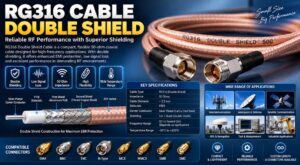
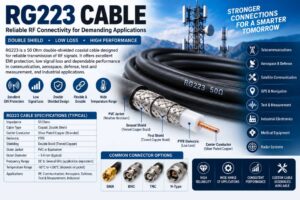
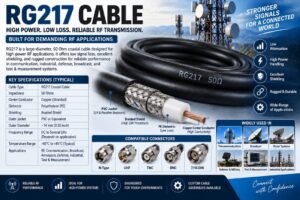
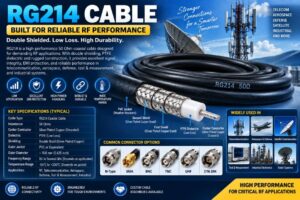
RG-214
RG-223
RG-400
Ecoflex cables
Times Microwave cables
Selecting the correct connector for the cable type ensures proper impedance matching and mechanical reliability.
Applications of N Connectors
Cellular Base Stations
N Connectors connect antennas, amplifiers, filters, and transmission lines in mobile communication networks.
5G Infrastructure
High-frequency 5G equipment uses precision N Connectors for reliable RF performance.
Satellite Communication
Satellite earth stations use N Connectors because of their excellent microwave characteristics.
Radar Systems
Military and aviation radar systems require rugged RF connectors capable of handling high power and harsh environments.
Broadcasting
FM radio, television broadcasting, and digital broadcasting systems commonly use N Connectors.
Aerospace
Aircraft communication equipment relies on high-quality RF connectors for dependable signal transmission.
Defense Systems
Electronic warfare equipment, secure communication systems, and surveillance equipment frequently use N Connectors.
Industrial Automation
Wireless automation systems use N Connectors for industrial antennas and communication equipment.
Test and Measurement
RF engineers use N Connectors extensively in network analyzers, spectrum analyzers, signal generators, and laboratory equipment.
Wi-Fi Infrastructure
Enterprise Wi-Fi access points, repeaters, and outdoor wireless bridges frequently use N Connectors.
Advantages of N Connectors
Excellent weather resistance
Reliable threaded locking
Low insertion loss
Excellent RF shielding
High-frequency capability
High power handling
Long operational lifespan
Corrosion resistance
Suitable for harsh environments
Wide compatibility
Easy installation
Excellent mechanical stability
Limitations
Larger than SMA connectors
Heavier construction
Not suitable for miniature devices
Requires threaded tightening
Precision versions are more expensive
How to Choose the Right N Connector
Determine operating frequency.
Select the correct impedance.
Choose the compatible cable type.
Verify connector gender.
Consider indoor or outdoor installation.
Evaluate environmental conditions.
Check power handling requirements.
Choose suitable connector plating.
Verify manufacturer quality standards.
Purchase connectors that meet industry certifications.
Installation Best Practices
Use proper cable stripping tools.
Avoid damaging the dielectric.
Maintain proper center conductor length.
Use recommended crimp tools.
Apply correct tightening torque.
Protect outdoor connections with weatherproof sealing.
Inspect connectors before installation.
Perform VSWR testing after assembly.
Maintenance Tips
Keep connectors clean.
Inspect for corrosion.
Avoid excessive cable bending.
Use protective dust caps.
Replace damaged connectors immediately.
Store unused connectors in dry environments.
Perform periodic RF performance testing.
Future Trends in N Connector Technology
As RF systems continue evolving toward higher frequencies and greater bandwidth, N Connectors are also advancing. Modern precision N Connectors now support frequencies beyond 26.5 GHz while offering improved VSWR, lower insertion loss, enhanced corrosion resistance, and superior environmental sealing. Innovations in connector plating, dielectric materials, and precision machining continue to improve long-term reliability. With the rapid expansion of 5G, satellite internet, smart cities, industrial IoT, aerospace systems, and next-generation wireless infrastructure, N Connectors will remain one of the most trusted and widely used RF interconnect solutions for years to come.
Conclusion
The N Connector is one of the most reliable and versatile RF coaxial connectors available for high-frequency communication systems. Its threaded coupling mechanism, low insertion loss, excellent impedance matching, and rugged weather-resistant construction make it the preferred choice for telecommunications, 5G infrastructure, satellite communication, broadcasting, aerospace, defense, industrial automation, and RF testing. By selecting the correct impedance, connector type, cable compatibility, and frequency rating, engineers can ensure dependable signal transmission and long-term system performance. As wireless communication technologies continue to advance, the N Connector will remain a fundamental component in delivering stable, efficient, and high-performance RF connectivity.
Frequently Asked Questions (FAQs)
1. What is an N Connector?
An N Connector is a threaded RF coaxial connector designed for transmitting radio frequency and microwave signals with low loss, excellent impedance matching, and secure mechanical connections.
2. Why is an N Connector used?
N Connectors are used to provide reliable RF signal transmission, high power handling, weather resistance, and low insertion loss in communication systems.
3. What is the difference between a 50 Ohm and a 75 Ohm N Connector?
A 50 Ohm N Connector is commonly used in RF communication, wireless, and test equipment, while a 75 Ohm version is designed for broadcasting, cable television, and video applications.
4. What frequency range does an N Connector support?
Standard N Connectors typically operate from DC up to 11 GHz or 18 GHz, while precision N Connectors can support frequencies up to 26.5 GHz.
5. Is an N Connector waterproof?
Many N Connectors are available in weatherproof versions with sealing gaskets and O-rings, making them suitable for outdoor installations.
6. What cables are compatible with N Connectors?
N Connectors are compatible with popular RF cables such as LMR-195, LMR-240, LMR-400, LMR-600, RG-58, RG-214, RG-223, RG-400, and other coaxial cables.
7. Where are N Connectors commonly used?
They are widely used in 5G networks, cellular base stations, satellite communication, Wi-Fi systems, radar, aerospace, broadcasting, defense, industrial automation, and RF laboratories.
8. What are the advantages of an N Connector?
Key advantages include low insertion loss, high power handling, excellent weather resistance, durable threaded locking, reliable impedance matching, and long service life.
9. Can N Connectors be used outdoors?
Yes. Outdoor-rated N Connectors are specifically designed to withstand moisture, dust, UV exposure, and harsh environmental conditions.
10. How do I choose the right N Connector?
Consider the operating frequency, impedance, cable type, connector gender, power handling, installation environment, and application requirements before selecting an N Connector.
11. What is VSWR in an N Connector?
VSWR (Voltage Standing Wave Ratio) measures how well the connector matches the system impedance. A lower VSWR indicates better signal transmission and lower reflection.
12. How long does an N Connector last?
High-quality N Connectors can last for many years with proper installation, maintenance, and environmental protection, making them a durable solution for RF and microwave applications.