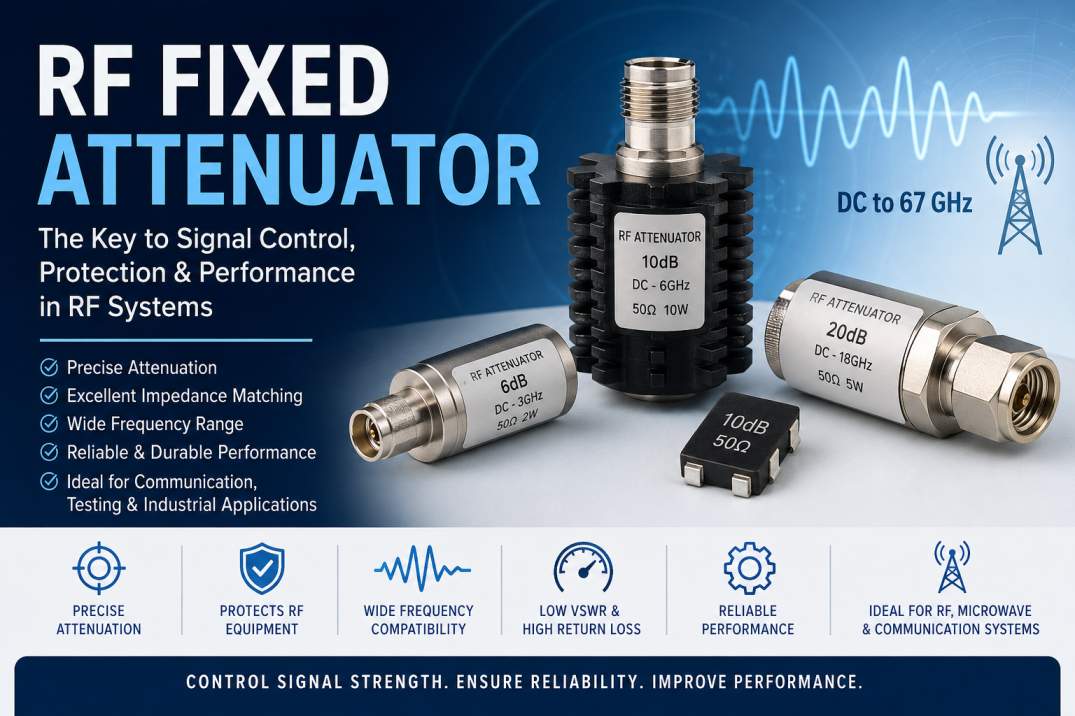
RF Fixed Attenuators are among the most essential passive components used in radio frequency and microwave communication systems. Whether it is a wireless communication network, satellite communication, military radar, laboratory testing, broadcasting station, or modern 5G infrastructure, RF fixed attenuators play a significant role in controlling signal strength without introducing significant distortion. These devices are specifically designed to reduce the power level of an RF signal while maintaining signal integrity and impedance matching across the transmission line.
In RF engineering, excessive signal power can damage expensive equipment, saturate sensitive receivers, increase measurement errors, or introduce unwanted interference. RF fixed attenuators solve these challenges by providing a predetermined amount of signal reduction that remains constant throughout operation. Unlike variable attenuators, which allow users to adjust attenuation levels, fixed attenuators offer a precise attenuation value that cannot be changed.
Modern RF systems demand high accuracy, low reflection, excellent frequency response, and minimal insertion loss beyond the designed attenuation value. RF fixed attenuators are engineered to meet these demanding requirements, making them indispensable in telecommunications, aerospace, defense, industrial automation, IoT devices, and electronic testing environments.
What Is an RF Fixed Attenuator?
An RF Fixed Attenuator is a passive electronic component designed to reduce the amplitude or power of a radio frequency signal by a fixed amount measured in decibels (dB). It introduces a predetermined loss into the signal path without significantly affecting the waveform, frequency characteristics, or impedance of the transmission system.
The primary purpose of an RF fixed attenuator is to protect sensitive equipment, improve impedance matching, isolate circuit stages, and maintain accurate signal levels during transmission or testing.
Unlike amplifiers that increase signal strength, attenuators intentionally reduce signal power while preserving signal quality. They do not require any external power source because they operate purely through passive resistive networks.
For example, if an RF signal has a power of 100 milliwatts and passes through a 10 dB fixed attenuator, the output power becomes approximately 10 milliwatts. The attenuation remains constant regardless of operating conditions within the device’s rated specifications.
How Does an RF Fixed Attenuator Work?
RF fixed attenuators work by converting a portion of the electrical signal into heat through carefully designed resistor networks. These resistor combinations are arranged to provide the required attenuation while maintaining a constant characteristic impedance throughout the signal path.
The resistor network is optimized so that both the input and output impedance remain matched to the system impedance, which is typically 50 Ohms or 75 Ohms.
When the RF signal enters the attenuator, part of its energy flows directly to the output while the remaining energy is dissipated inside precision resistors. Since the attenuation ratio is predetermined during manufacturing, the signal reduction remains constant over the operating frequency range.
Proper impedance matching minimizes signal reflections, standing waves, and transmission losses, ensuring maximum signal integrity.
Why RF Fixed Attenuators Are Important
Modern RF communication systems operate with highly sensitive receivers and powerful transmitters. Even a slight mismatch in signal levels can result in poor system performance or equipment damage.
RF fixed attenuators provide numerous operational benefits including:
Protection of expensive RF equipment
Prevention of receiver overload
Accurate signal level adjustment
Improved impedance matching
Reduction of signal reflections
Enhanced measurement accuracy
Isolation between circuit stages
Stabilization of RF test setups
Improved system reliability
Extended equipment lifespan
These advantages make RF fixed attenuators a standard component in almost every RF laboratory and communication system.
Types of RF Fixed Attenuators
RF fixed attenuators are available in several designs depending on application requirements.
Coaxial RF Fixed Attenuators
Coaxial attenuators are the most common type used in communication systems. They feature RF connectors such as SMA, N-Type, BNC, TNC, 7/16 DIN, or 2.92 mm connectors and can handle frequencies ranging from DC to over 67 GHz.
These attenuators are widely used in laboratory measurements, communication infrastructure, and aerospace applications.
Surface Mount RF Fixed Attenuators
Surface mount attenuators are designed for compact electronic circuits and printed circuit boards. They are commonly found in wireless modules, IoT devices, GPS receivers, RF front-end circuits, and consumer electronics.
Waveguide Fixed Attenuators
Waveguide attenuators are used for extremely high-frequency microwave applications where coaxial cables become inefficient. These attenuators are commonly installed in radar systems, satellite communication networks, and defense equipment.
Chip RF Attenuators
Chip attenuators are miniature passive components designed for high-density RF circuit boards. Their small size makes them suitable for smartphones, Wi-Fi routers, Bluetooth modules, wearable devices, and embedded communication systems.
Common Attenuation Values
RF fixed attenuators are manufactured in standardized attenuation values to meet diverse engineering requirements.
Some of the most commonly available attenuation values include:
1 dB
2 dB
3 dB
5 dB
6 dB
10 dB
15 dB
20 dB
30 dB
40 dB
50 dB
60 dB
Higher attenuation values provide greater signal reduction but also generate more heat due to increased power dissipation.
Standard Impedance Values
Maintaining impedance matching is one of the most critical requirements in RF systems.
The two most common impedance ratings are:
50 Ohms for RF communication systems, military electronics, laboratory equipment, microwave devices, and wireless infrastructure.
75 Ohms for cable television systems, broadcasting equipment, satellite television, and video transmission systems.
Using the correct impedance helps minimize return loss and standing wave ratio while maximizing power transfer.
Frequency Range
RF fixed attenuators are available for a wide range of operating frequencies.
Typical frequency ranges include:
DC to 1 GHz
DC to 3 GHz
DC to 6 GHz
DC to 12 GHz
DC to 18 GHz
DC to 26.5 GHz
DC to 40 GHz
DC to 50 GHz
DC to 67 GHz
Specialized microwave attenuators can support frequencies exceeding 100 GHz for advanced radar and aerospace applications.
Power Ratings
Power handling capability determines how much RF energy an attenuator can safely dissipate.
Common power ratings include:
0.25 Watt
0.5 Watt
1 Watt
2 Watts
5 Watts
10 Watts
20 Watts
50 Watts
100 Watts
250 Watts
500 Watts
1000 Watts
Selecting an attenuator with adequate power handling prevents overheating and ensures reliable operation.
RF Connector Types
RF fixed attenuators are manufactured with numerous connector options to match different systems.
Popular connector types include:
SMA
N-Type
BNC
TNC
2.92 mm
2.4 mm
7/16 DIN
4.3-10
F-Type
UHF
MCX
MMCX
Each connector type is optimized for specific frequency ranges and power levels.
Key Specifications of RF Fixed Attenuators
Selecting the right RF fixed attenuator requires evaluating several important specifications.
Attenuation Accuracy
This indicates how closely the actual attenuation matches the rated value. High-quality attenuators typically provide accuracy within ±0.2 dB or better.
Frequency Response
The attenuation should remain consistent across the specified frequency range.
Return Loss
High return loss indicates excellent impedance matching and minimal signal reflection.
VSWR
Voltage Standing Wave Ratio measures impedance matching performance. Lower VSWR values indicate better matching.
Power Rating
This specifies the maximum RF power the attenuator can safely dissipate.
Temperature Stability
High-performance attenuators maintain consistent performance over wide temperature ranges.
Connector Quality
Precision connectors reduce insertion loss and improve measurement accuracy.
Internal Attenuator Networks
RF fixed attenuators typically use one of three resistor network configurations.
Pi Network
The Pi network provides excellent impedance matching over a broad frequency range.
T Network
The T network offers balanced performance and is commonly used in precision RF applications.
Bridged-T Network
This design is often selected for specialized attenuation requirements where extremely low reflection is needed.
Applications of RF Fixed Attenuators
RF fixed attenuators are used across numerous industries.
Wireless Communication
They help optimize transmitter output power and protect receivers in cellular base stations.
5G Infrastructure
Modern 5G networks require precise signal level control for massive MIMO antennas and beamforming systems.
Satellite Communication
Satellite uplink and downlink systems use attenuators to protect sensitive RF equipment.
Radar Systems
Military and aviation radar systems rely on fixed attenuators for calibration and signal conditioning.
RF Test Laboratories
Engineers use attenuators during testing, calibration, and verification of RF equipment.
Broadcast Systems
Television and radio broadcasting systems employ attenuators for transmitter alignment and maintenance.
Aerospace and Defense
Aircraft communication systems, electronic warfare equipment, and missile guidance systems frequently incorporate RF attenuators.
Medical Equipment
MRI systems and specialized RF diagnostic equipment use precision attenuators for signal conditioning.
Industrial Automation
Wireless industrial control systems use RF attenuators to optimize communication reliability.
Research and Development
Universities and research laboratories depend on fixed attenuators for repeatable RF experiments.
Advantages of RF Fixed Attenuators
RF fixed attenuators provide many operational benefits.
Highly accurate attenuation
Excellent signal integrity
No external power required
Long operational life
Low maintenance
Wide frequency compatibility
Excellent impedance matching
Improved measurement accuracy
Protection of sensitive equipment
Reliable long-term performance
Compact design
Cost-effective solution
Limitations of RF Fixed Attenuators
Although highly reliable, RF fixed attenuators have some limitations.
Attenuation value cannot be adjusted
High attenuation generates additional heat
Power rating limits must be observed
Connector wear may occur after repeated use
Performance depends on proper impedance matching
How to Choose the Right RF Fixed Attenuator
Selecting the appropriate attenuator requires evaluating several engineering parameters.
Determine the required attenuation value.
Verify operating frequency range.
Confirm system impedance.
Choose the appropriate connector type.
Check power handling capability.
Review attenuation accuracy.
Evaluate return loss specifications.
Consider environmental operating conditions.
Select a reputable manufacturer with certified quality standards.
Difference Between Fixed and Variable RF Attenuators
A fixed attenuator provides one permanent attenuation value throughout its lifetime. Once manufactured, the attenuation cannot be changed.
A variable attenuator allows engineers to adjust signal reduction according to application requirements. Variable attenuators offer flexibility but generally have more complex construction and higher cost.
Fixed attenuators are preferred where stable, repeatable performance is required, while variable attenuators are ideal for laboratories and systems requiring adjustable signal levels.
Maintenance and Best Practices
Although RF fixed attenuators require minimal maintenance, proper handling significantly improves their lifespan.
Avoid exceeding the rated power.
Keep RF connectors clean.
Prevent mechanical stress on connectors.
Store in dry environments.
Inspect connectors regularly.
Use torque wrenches when tightening precision RF connectors.
Replace damaged connectors immediately.
Verify attenuation periodically in calibration-critical applications.
Future Trends in RF Fixed Attenuators
The rapid growth of wireless communication technologies continues to drive innovation in RF attenuator design. Future developments include ultra-wideband attenuators, higher frequency compatibility for millimeter-wave communication, lower insertion loss, compact chip-scale packaging, improved thermal management, enhanced power handling, and advanced materials that deliver greater performance stability.
Emerging technologies such as 6G networks, autonomous vehicles, satellite internet, aerospace communication, and high-speed industrial automation will continue increasing the demand for high-performance RF fixed attenuators.
Conclusion
cAttenuators are fundamental passive components that ensure reliable performance, signal integrity, and equipment protection in modern radio frequency and microwave systems. By reducing signal power by a predetermined amount while maintaining impedance matching and minimal signal distortion, these devices contribute significantly to the efficiency and stability of communication networks, laboratory measurements, aerospace systems, military electronics, broadcasting infrastructure, satellite communication, and industrial RF applications.
Choosing the correct attenuation value, impedance, connector type, frequency range, and power rating is essential for achieving optimal system performance. As wireless technology continues evolving toward higher frequencies and more complex communication architectures, RF fixed attenuators will remain indispensable components supporting accurate, stable, and dependable RF signal management across virtually every advanced electronic system.
Frequently Asked Questions (FAQs)
1. What is an RF Fixed Attenuator?
An RF Fixed Attenuator is a passive electronic device that reduces the power of a radio frequency (RF) signal by a fixed amount while maintaining the system’s characteristic impedance. It helps protect sensitive equipment and ensures accurate signal levels.
2. How does an RF Fixed Attenuator work?
An RF Fixed Attenuator works by dissipating a portion of the RF signal as heat through precision resistor networks. It reduces signal strength without significantly affecting the signal quality or frequency characteristics.
3. What is the purpose of an RF Fixed Attenuator?
The primary purpose of an RF Fixed Attenuator is to lower signal power, protect receivers and test equipment, improve impedance matching, reduce signal reflections, and maintain accurate RF measurements.
4. What are the common attenuation values available?
Common RF Fixed Attenuator values include 1 dB, 2 dB, 3 dB, 5 dB, 6 dB, 10 dB, 15 dB, 20 dB, 30 dB, 40 dB, 50 dB, and 60 dB.
5. What is the difference between a fixed and a variable attenuator?
A fixed attenuator provides a permanent attenuation value that cannot be changed, whereas a variable attenuator allows users to adjust the attenuation level according to application requirements.
6. What impedance values are commonly used in RF Fixed Attenuators?
The two most common impedance values are 50 Ohms for RF communication and wireless systems, and 75 Ohms for television broadcasting and cable network applications.
7. Where are RF Fixed Attenuators used?
RF Fixed Attenuators are widely used in wireless communication, 5G networks, satellite communication, radar systems, aerospace, defense, RF laboratories, broadcasting, medical equipment, and industrial automation.
8. What connector types are available for RF Fixed Attenuators?
RF Fixed Attenuators are available with connectors such as SMA, N-Type, BNC, TNC, 2.92 mm, 2.4 mm, 7/16 DIN, 4.3-10, F-Type, MCX, and MMCX.
9. How do I choose the right RF Fixed Attenuator?
Choose an attenuator based on attenuation value, operating frequency, power rating, impedance, connector type, return loss, VSWR, and environmental operating conditions.
10. Can an RF Fixed Attenuator improve signal quality?
Yes. Although it reduces signal power, it helps improve overall system performance by preventing receiver overload, minimizing reflections, maintaining impedance matching, and increasing measurement accuracy.
11. What power ratings are available for RF Fixed Attenuators?
RF Fixed Attenuators are available in power ratings ranging from 0.25 W to 1000 W, depending on the application and operating frequency.
12. Why is impedance matching important in RF systems?
Proper impedance matching minimizes signal reflections, reduces VSWR, maximizes power transfer, and ensures stable performance throughout the RF transmission system.