In the world of television broadcasting, satellite communication, cable TV networks, broadband internet services, and residential RF installations, one connector has become the industry standard for reliable signal transmission: the F Connector.
The F Connector is one of the most widely used coaxial RF connectors worldwide. Known for its simple design, low cost, excellent performance at high frequencies, and ease of installation, the F connector is commonly found in homes, commercial buildings, cable television systems, satellite installations, internet networks, and telecommunications infrastructure.
Whether you’re connecting a satellite dish, cable modem, television receiver, antenna system, or broadband network equipment, chances are you’re using an F connector.
In this comprehensive guide, we will explore what an F connector is, how it works, its construction, types, applications, advantages, specifications, installation methods, and how to choose the right F connector for your RF system.
What Is an F Connector?
An F Connector is a coaxial RF connector commonly used for connecting coaxial cables in television, satellite, cable broadband, and RF communication systems.
Unlike many RF connectors that require a separate center contact pin, the F connector uses the cable’s center conductor itself as the male contact.
This unique design offers several benefits:
- Lower manufacturing cost
- Reduced signal loss
- Simpler installation
- Reliable RF performance
F connectors are most commonly used with:
- RG6 Cable
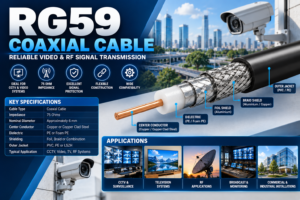
- RG59 Cable
- RG11 Cable
The connector is designed primarily for 75-ohm impedance systems, making it ideal for television and broadband communication networks.
History of the F Connector
The F connector was developed in the 1950s by engineer Eric E. Winston while working for the cable television industry.
The goal was to create a connector that was:
- Economical
- Easy to install
- Reliable for high-frequency applications
- Suitable for mass deployment
The resulting design became one of the most successful RF connector standards ever created.
Today, billions of F connectors are used globally in residential and commercial communication networks.
How Does an F Connector Work?
An F connector transfers RF signals through a coaxial cable connection.
Signal Transmission
The center conductor carries the RF signal.
Grounding and Shielding
The outer metal body connects to the cable shield.
Threaded Coupling
The threaded interface creates a secure mechanical and electrical connection.
Impedance Matching
The connector maintains the system’s 75-ohm impedance, minimizing reflections and signal loss.
This design enables efficient signal transmission across a wide frequency range.
Construction of an F Connector
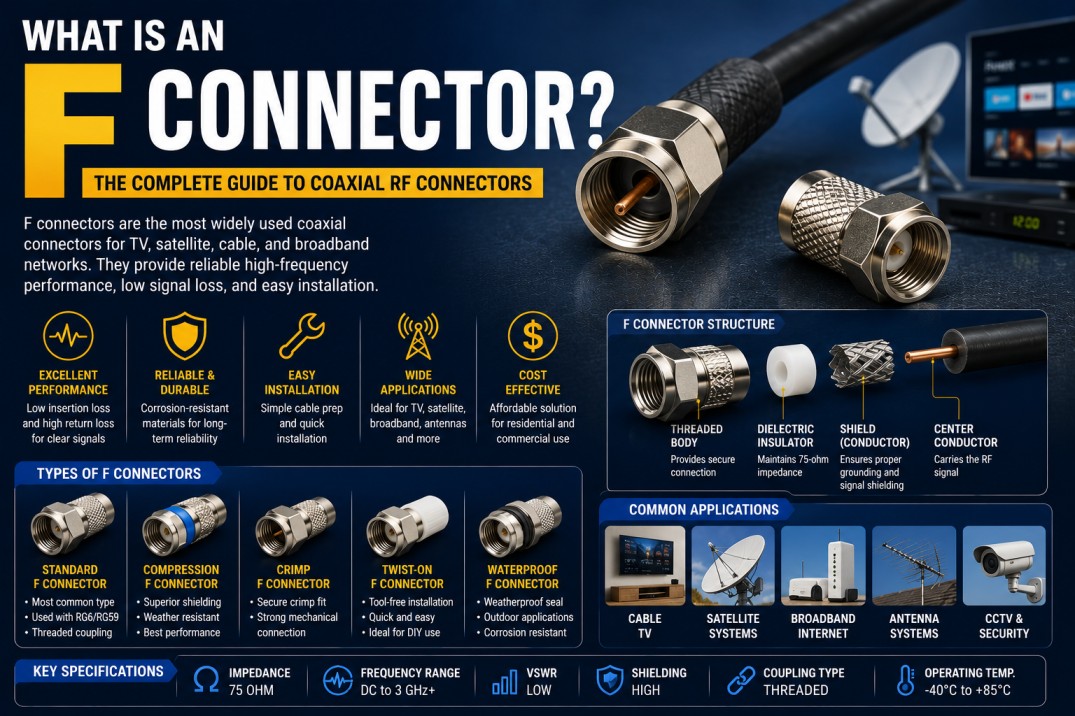
An F connector consists of several important components.
Center Conductor
Unlike many RF connectors, the cable’s center conductor acts as the connector pin.
Benefits include:
- Reduced insertion loss
- Simplified design
- Lower manufacturing cost
Connector Body
The metal body provides:
- Mechanical strength
- Grounding continuity
- Shielding protection
Materials commonly include:
- Brass
- Nickel-plated brass
- Zinc alloys
Threaded Coupling Nut
The threaded interface ensures secure attachment to devices.
Advantages:
- Stable connection
- Reduced signal interruption
- Long-term reliability
Compression Sleeve
Many modern F connectors utilize compression technology for enhanced performance and weather resistance.
Key Features of F Connectors
75-Ohm Impedance
F connectors are specifically designed for:
- Cable television systems
- Satellite systems
- Broadband networks
Wide Frequency Range
Most F connectors support frequencies from:
- DC
- Up to 1 GHz
- Up to 3 GHz
- Up to 6 GHz (advanced versions)
Low Signal Loss
The direct center conductor design minimizes insertion loss.
Cost-Effective Design
F connectors are among the most economical RF connectors available.
Easy Installation
Can be installed quickly using common cable preparation tools.
Types of F Connectors
Different applications require different F connector styles.
Standard F Male Connector
The most common type.
Features:
- External threads
- Cable center conductor as the pin
Applications:
- TV systems
- Satellite receivers
- Cable modems
F Female Connector
Found on:
- Television sets
- Set-top boxes
- Wall plates
- Broadband equipment
Compression F Connector
Uses compression technology for superior reliability.
Benefits:
- Better shielding
- Improved weather resistance
- Enhanced pull strength
Crimp F Connector
Installed using a crimping tool.
Advantages:
- Fast installation
- Reliable connection
Twist-On F Connector
Can be installed without specialized tools.
Benefits:
- Easy installation
- Low cost
Limitations:
- Lower reliability compared to compression connectors
Waterproof F Connector
Designed for outdoor installations.
Protection against:
- Rain
- Moisture
- Corrosion
Ideal for satellite systems and outdoor antenna installations.
Electrical Specifications of F Connectors
Typical specifications include:
| Parameter | Typical Value |
|---|---|
| Impedance | 75 Ohm |
| Frequency Range | DC to 3 GHz+ |
| Coupling Type | Threaded |
| Return Loss | Excellent |
| Insertion Loss | Low |
| Shielding Effectiveness | High |
These characteristics make F connectors ideal for broadband and video applications.
Advantages of F Connectors
Cost-Effective Solution
F connectors are inexpensive compared to many RF connector types.
Excellent High-Frequency Performance
Suitable for:
- Satellite TV
- Broadband internet
- Digital television
Easy Installation
Can be installed with minimal training.
Wide Industry Adoption
Used worldwide in residential and commercial systems.
Reliable Signal Transmission
Provides stable RF performance when properly installed.
Applications of F Connectors
Cable Television Networks
One of the most common applications.
Used for:
- Cable TV distribution
- Set-top boxes
- Television receivers
Satellite Television Systems
Connects:
- Satellite dishes
- LNBs
- Satellite receivers
Broadband Internet Networks
Used in:
- Cable modems
- Internet gateways
- ISP infrastructure
Antenna Installations
Supports:
- TV antennas
- RF distribution systems
- Signal amplifiers
Security Systems
Found in:
- CCTV systems
- Video distribution networks
Residential Communication Systems
Used throughout homes for:
- Television
- Internet
- Multimedia networking
F Connector vs BNC Connector
| Feature | F Connector | BNC Connector |
|---|---|---|
| Impedance | 75 Ohm | 50/75 Ohm |
| Cost | Low | Higher |
| Installation | Easy | Moderate |
| Television Systems | Excellent | Limited |
| Test Equipment | Limited | Excellent |
| Coupling Method | Threaded | Bayonet |
F Connector vs N-Type Connector
| Feature | F Connector | N-Type Connector |
|---|---|---|
| Frequency Range | Moderate | Higher |
| Cost | Lower | Higher |
| Power Handling | Moderate | High |
| Residential Use | Excellent | Limited |
| Outdoor RF Systems | Good | Excellent |
F Connector vs SMA Connector
| Feature | F Connector | SMA Connector |
|---|---|---|
| Size | Larger | Smaller |
| Frequency Capability | Moderate | High |
| Residential Applications | Excellent | Limited |
| RF Precision Applications | Limited | Excellent |
| Cost | Lower | Higher |
How to Choose the Right F Connector
Identify Cable Type
Ensure compatibility with:
- RG6
- RG59
- RG11
Consider Installation Environment
Outdoor installations may require:
- Waterproof connectors
- Corrosion-resistant materials
Select Installation Method
Options include:
- Compression
- Crimp
- Twist-On
Compression connectors generally provide the best performance.
Verify Frequency Requirements
Modern broadband and satellite systems may require higher-frequency-rated connectors.
Evaluate Shielding Performance
High-quality shielding improves signal integrity.
Installation Best Practices
Use Proper Cable Preparation Tools
Correct stripping ensures optimal performance.
Avoid Damaging the Center Conductor
The center conductor acts as the connector pin.
Ensure Proper Compression
Compression connectors should be fully secured.
Inspect Connections
Check for:
- Loose fittings
- Improper shielding
- Damaged conductors
Weatherproof Outdoor Installations
Use weather boots or sealing tape when necessary.
Future Trends in F Connector Technology
Expansion of Broadband Services
Higher-speed internet networks continue utilizing F connectors.
Advanced Satellite Systems
Modern satellite communications require improved connector performance.
Smart Home Infrastructure
Connected homes continue driving demand for reliable coaxial connectivity.
Improved Shielding Designs
Manufacturers are developing connectors with enhanced EMI protection.
Key Takeaways
- F Connectors are the standard RF connectors for television and broadband systems.
- Designed primarily for 75-ohm coaxial cable networks.
- Widely used with RG6, RG59, and RG11 cables.
- Offer low cost and easy installation.
- Commonly found in cable TV, satellite TV, and broadband internet systems.
- Available in compression, crimp, twist-on, and waterproof versions.
- Provide reliable signal transmission with low insertion loss.
- Remain one of the most widely used RF connectors globally.
Conclusion
The F Connector is one of the most successful and widely deployed RF connector designs in the history of telecommunications and broadcasting. Its combination of affordability, ease of installation, reliable performance, and compatibility with 75-ohm coaxial systems has made it the preferred connector for television, satellite, and broadband networks worldwide.
From residential cable TV installations and satellite dishes to broadband internet services and multimedia distribution systems, F connectors continue to play a critical role in modern communication infrastructure.
As broadband networks expand and digital communication technologies continue evolving, the F connector remains a dependable and cost-effective solution for high-quality RF signal transmission.
FAQ About F Connectors
What is an F connector used for?
F connectors are primarily used for cable TV, satellite TV, broadband internet, and RF signal distribution systems.
What impedance does an F connector use?
Most F connectors are designed for 75-ohm coaxial systems.
What cables work with F connectors?
Common cables include RG6, RG59, and RG11 coaxial cables.