
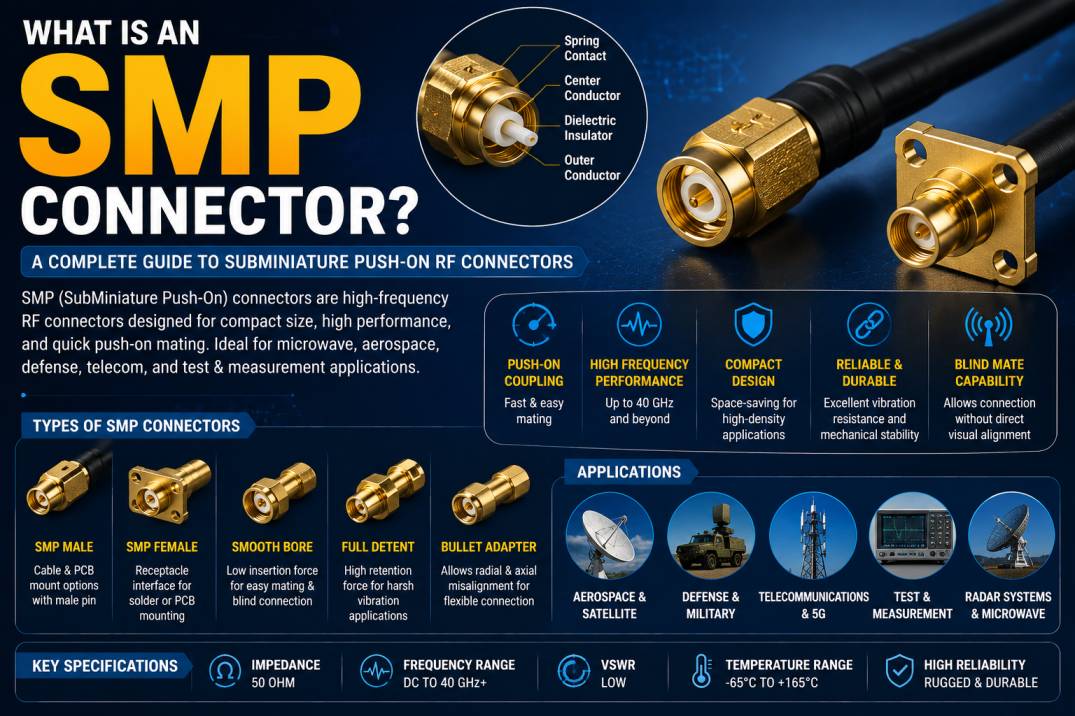
As RF and microwave technologies continue to evolve, the demand for compact, high-frequency, and high-density interconnect solutions has grown significantly. Modern applications such as 5G networks, aerospace systems, radar platforms, satellite communications, military electronics, and test equipment require RF connectors capable of delivering exceptional performance in increasingly smaller spaces.
One of the most widely used solutions for these demanding applications is the SMP Connector.
The SMP (SubMiniature Push-On) Connector is a high-frequency RF connector designed to provide reliable signal transmission in compact environments where traditional RF connectors may be too large or impractical. Featuring a push-on coupling mechanism, excellent microwave performance, and the ability to support frequencies up to 40 GHz and beyond, SMP connectors have become a preferred choice for engineers working with advanced communication and electronic systems.
In this comprehensive guide, we will explore what an SMP connector is, how it works, its construction, types, applications, advantages, technical specifications, and how to select the right SMP connector for your RF system.
What Is an SMP Connector?
An SMP Connector is a miniature RF coaxial connector designed for high-frequency signal transmission in applications requiring compact size, high reliability, and excellent electrical performance.
The term SMP stands for:
SubMiniature Push-On Connector
Unlike threaded RF connectors such as SMA or TNC, SMP connectors utilize a push-on mating mechanism that enables quick connection and disconnection while maintaining excellent RF characteristics.
SMP connectors are commonly used in:
- Aerospace systems
- Defense electronics
- Satellite communication
- Radar equipment
- Microwave modules
- High-density RF assemblies
- Test and measurement equipment
Because of their compact design and superior frequency performance, SMP connectors are particularly valuable in applications where space and weight are critical considerations.
History and Development of SMP Connectors
The increasing demand for smaller and more efficient RF systems led to the development of miniature microwave connectors.
Traditional connectors such as:
- SMA
- N-Type
- TNC
- BNC
provided excellent RF performance but occupied significant space within high-density electronic assemblies.
To address this challenge, manufacturers developed SMP connectors to offer:
- Smaller form factors
- Faster mating
- High-frequency capability
- Reliable blind-mate functionality
Today, SMP connectors are widely used in advanced RF and microwave systems across multiple industries.
How Does an SMP Connector Work?
An SMP connector operates using a push-on coupling mechanism.
Signal Transmission
The center conductor transfers RF energy between connected devices.
Shielding Continuity
The outer conductor maintains grounding and EMI shielding.
Push-On Coupling
Instead of threaded locking, the connector snaps securely into place.
Precision Contact System
Internal spring contacts maintain reliable electrical continuity even under vibration and movement.
This design allows engineers to quickly connect and disconnect RF assemblies without sacrificing performance.
Construction of an SMP Connector
SMP connectors consist of several precision-engineered components.
Center Contact
The center contact carries RF signals.
Typically manufactured from:
- Beryllium copper
- Gold-plated copper alloys
Benefits include:
- High conductivity
- Corrosion resistance
- Reliable signal transmission
Dielectric Insulator
The dielectric maintains separation between conductors.
Common materials include:
- PTFE (Teflon)
- Advanced engineering polymers
Functions:
- Electrical insulation
- Impedance control
- Signal stability
Outer Conductor
The outer conductor provides:
- Shielding
- Mechanical support
- Grounding continuity
Materials include:
- Stainless steel
- Brass
- Gold-plated alloys
Spring Mechanism
One of the most unique features of SMP connectors is their spring-based mating design.
Benefits include:
- Secure engagement
- Blind mating capability
- High vibration tolerance
Key Features of SMP Connectors
Compact Design
SMP connectors are significantly smaller than SMA connectors.
Benefits include:
- Space savings
- Higher circuit density
- Lightweight assemblies
Push-On Coupling
The push-on interface enables:
- Quick installation
- Easy maintenance
- Reduced assembly time
High Frequency Performance
Most SMP connectors support frequencies up to:
- 18 GHz
- 26.5 GHz
- 40 GHz
- 50 GHz
- 65 GHz (specialized designs)
Excellent Return Loss
Provides:
- Low VSWR
- Reduced signal reflection
- Improved signal integrity
Blind Mate Capability
Allows connectors to mate without direct visual alignment.
Ideal for:
- Modular systems
- Rack-mounted equipment
- Aerospace electronics
Types of SMP Connectors
SMP Male Connector
Features:
- Male interface
- Spring-loaded design
Commonly used in cable assemblies and RF modules.
SMP Female Connector
Provides receptacle mating interface.
Used in:
- RF equipment
- Test systems
- Microwave assemblies
Smooth Bore SMP Connector
Offers maximum mating flexibility.
Benefits:
- Easier alignment
- Blind mating support
Limited Detent SMP Connector
Provides moderate retention force.
Advantages:
- Easy disconnect
- Reliable engagement
Full Detent SMP Connector
Provides maximum retention strength.
Applications:
- Military systems
- Aerospace equipment
- High-vibration environments
Bullet Adapter SMP Connector
Allows misalignment compensation between connectors.
Supports:
- Axial misalignment
- Radial misalignment
- Angular misalignment
Electrical Specifications of SMP Connectors
Although specifications vary by manufacturer, typical SMP connector characteristics include:
| Parameter | Typical Value |
|---|---|
| Impedance | 50 Ohm |
| Frequency Range | DC to 40 GHz |
| VSWR | Low |
| Return Loss | Excellent |
| Coupling Method | Push-On |
| Operating Temperature | -65°C to +165°C |
These specifications make SMP connectors suitable for demanding RF applications.
Advantages of SMP Connectors
Space-Saving Design
SMP connectors occupy significantly less space than traditional RF connectors.
High-Density Installation
Allows multiple RF connections within compact equipment.
Excellent Microwave Performance
Supports advanced microwave and millimeter-wave systems.
Fast Installation
Push-on coupling reduces assembly time.
Blind Mating Capability
Ideal for modular systems where direct access is limited.
High Reliability
Designed for harsh environments.
Applications of SMP Connectors
Aerospace Industry
SMP connectors are extensively used in:
Their lightweight design makes them particularly attractive for aerospace applications.
- Aircraft communication systems
- Avionics equipment
- Satellite payloads
- Navigation systems
Defense and Military
Military systems require reliable RF connectivity.
Applications include:
- Radar systems
- Electronic warfare equipment
- Tactical communication systems
- Missile guidance systems
Satellite Communication
Used in:
- Ground stations
- Satellite transponders
- Space communication systems
Telecommunications
Modern telecom equipment uses SMP connectors in:
- Microwave backhaul systems
- Small cells
- 5G infrastructure
Test and Measurement
Frequently found in:
- Spectrum analyzers
- Signal generators
- Network analyzers
- Microwave test equipment
Medical Electronics
Applications include:
- Diagnostic equipment
- Imaging systems
- Wireless medical devices
SMP Connector vs SMA Connector
| Feature | SMP Connector | SMA Connector |
|---|---|---|
| Size | Smaller | Larger |
| Coupling Method | Push-On | Threaded |
| Frequency Capability | Up to 40 GHz+ | Up to 18-26.5 GHz |
| Blind Mating | Yes | No |
| Installation Speed | Fast | Moderate |
| Space Efficiency | Excellent | Good |
For compact microwave systems, SMP connectors often provide significant advantages.
SMP Connector vs SSMP Connector
| Feature | SMP | SSMP |
|---|---|---|
| Size | Small | Ultra-small |
| Frequency Range | Up to 40 GHz+ | Up to 65 GHz+ |
| Applications | General microwave systems | High-density microwave systems |
| Handling | Easier | More delicate |
SSMP connectors are essentially a smaller version of SMP connectors.
How to Choose the Right SMP Connector
Determine Frequency Requirements
Choose connectors rated for your operating frequency.
Examples:
- 18 GHz
- 26.5 GHz
- 40 GHz
- 65 GHz
Evaluate Retention Force
Options include:
- Smooth bore
- Limited detent
- Full detent
Consider Environmental Conditions
Applications may require:
- Corrosion resistance
- Vibration tolerance
- Temperature stability
Verify Mating Cycles
Select connectors capable of handling expected connection frequency.
Assess Space Constraints
High-density designs benefit from compact SMP solutions.
Installation Best Practices
Avoid Excessive Force
Push-on connectors should mate smoothly.
Keep Interfaces Clean
Dust and contamination can degrade RF performance.
Protect Connector Surfaces
Use protective caps when not in use.
Perform Regular Inspection
Check for:
- Contact wear
- Mechanical damage
- Corrosion
Follow Manufacturer Specifications
Always use recommended mating procedures.
Future Trends in SMP Connector Technology
Growth of 5G and 6G Networks
Increasing frequencies require compact, high-performance RF connectors.
Expansion of Satellite Constellations
Modern satellite systems continue driving SMP connector demand.
Advanced Radar Systems
Military and automotive radar technologies rely on miniature microwave interconnects.
Miniaturization of Electronics
Smaller devices require increasingly compact RF solutions.
High-Speed Data Systems
Future communication infrastructure will continue adopting SMP technology.
Key Takeaways
- SMP stands for SubMiniature Push-On Connector.
- Designed for high-frequency RF and microwave applications.
- Supports frequencies up to 40 GHz and beyond.
- Provides quick push-on mating.
- Ideal for aerospace, defense, telecom, and satellite systems.
- Supports blind-mate installations.
- Offers compact size and high-density connectivity.
- Delivers excellent RF performance and reliability.
Conclusion
The SMP Connector has become one of the most important RF interconnect solutions in modern microwave and high-frequency communication systems. Its compact size, excellent electrical performance, push-on coupling mechanism, and blind-mate capability make it ideal for advanced applications where space, reliability, and frequency performance are critical.
From aerospace and defense systems to satellite communications, telecom infrastructure, radar platforms, and RF testing environments, SMP connectors continue to play a crucial role in enabling next-generation connectivity solutions.
As industries move toward higher frequencies, denser electronic packaging, and more sophisticated communication technologies, SMP connectors will remain an essential component of future RF and microwave system designs.
FAQ About SMP Connectors
What does SMP stand for?
SMP stands for SubMiniature Push-On Connector.
What frequency range do SMP connectors support?
Most SMP connectors support frequencies up to 40 GHz, with specialized versions supporting even higher frequencies.
What is the advantage of SMP connectors over SMA connectors?
SMP connectors are smaller, faster to connect, and support blind mating capabilities.
Where are SMP connectors commonly used?
They are widely used in aerospace, defense, telecommunications, satellite communication, radar systems, and RF testing equipment.
Are SMP connectors suitable for high-vibration environments?
Yes. Full-detent SMP connectors provide excellent retention and vibration resistance.