
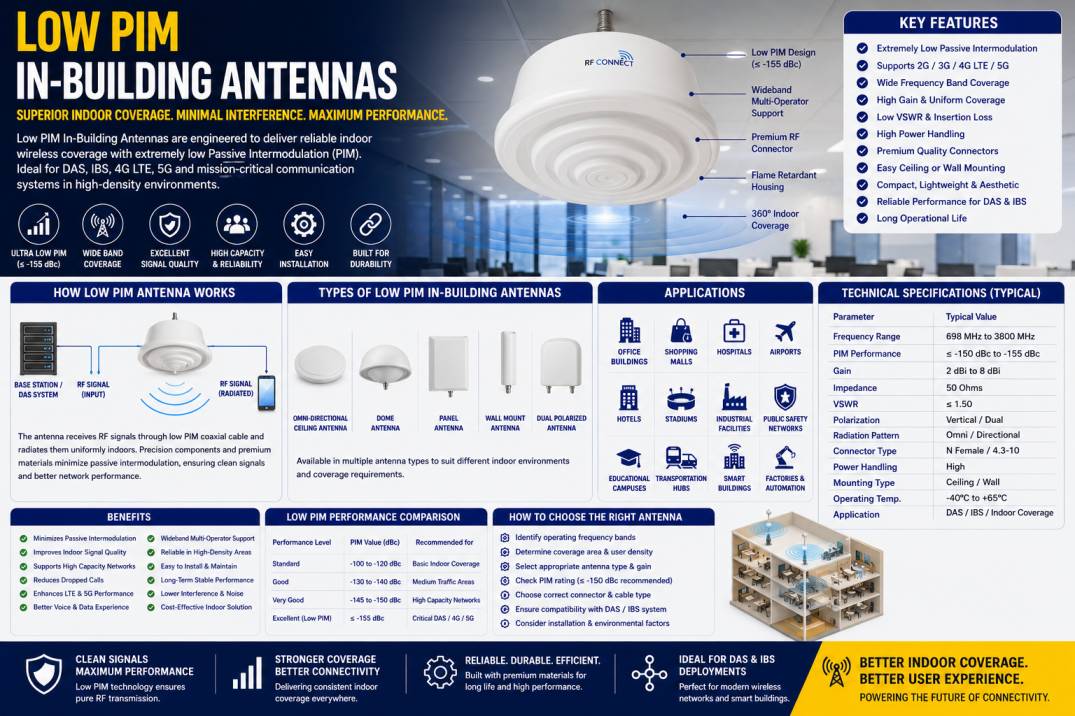
Low PIM In-Building Antennas are specially designed radio frequency (RF) antennas that minimize Passive Intermodulation (PIM) while delivering reliable indoor wireless coverage for modern communication networks. These antennas play a critical role in Distributed Antenna Systems (DAS), In-Building Solutions (IBS), 4G LTE, 5G networks, public safety communication systems, hospitals, airports, shopping malls, office buildings, stadiums, hotels, factories, and other large commercial facilities.
As mobile network operators continue deploying high-capacity wireless networks, indoor coverage has become more important than ever. More than 80% of mobile data traffic is generated indoors, making high-performance indoor antennas essential for delivering strong signal quality and uninterrupted connectivity.
Standard antennas can introduce Passive Intermodulation when exposed to high-power RF signals. This unwanted interference reduces network efficiency, lowers data throughput, increases dropped calls, and negatively affects user experience. Low PIM In-Building Antennas are specifically engineered using premium materials, precision manufacturing, and advanced connector technology to eliminate these issues and maintain superior RF performance.
This comprehensive guide explains everything about Low PIM In-Building Antennas, including their construction, working principle, specifications, applications, benefits, installation considerations, and selection criteria.
What Are Low PIM In-Building Antennas?
Low PIM In-Building Antennas are indoor RF antennas designed to distribute wireless signals while generating extremely low levels of Passive Intermodulation. These antennas provide consistent coverage throughout buildings and support multiple wireless technologies from a single antenna system.
They are commonly integrated into Distributed Antenna Systems (DAS) and In-Building Solutions (IBS) to improve indoor mobile network performance.
Unlike conventional indoor antennas, Low PIM models use precision-machined components, premium metal alloys, and high-quality RF connectors to maintain excellent signal purity even under high-power transmission conditions.
Most professional Low PIM antennas provide Passive Intermodulation performance of -150 dBc, -153 dBc, -155 dBc, or better, depending on the product specification.
What Is Passive Intermodulation (PIM)?
Passive Intermodulation is unwanted RF interference created when multiple high-power signals pass through passive RF components that contain nonlinear electrical characteristics.
Common causes include:
- Loose RF connectors
- Inferior metal surfaces
- Corrosion
- Dirt or dust
- Oxidation
- Poor manufacturing quality
- Damaged connectors
- Mechanical vibration
These imperfections generate unwanted frequencies that interfere with the desired communication signals.
Low PIM antennas significantly reduce these unwanted products, improving overall wireless network performance.
How Do Low PIM In-Building Antennas Work?
Low PIM In-Building Antennas receive RF signals from a base station or Distributed Antenna System through low-loss coaxial cables.
The antenna radiates RF energy uniformly throughout the building while maintaining stable impedance and minimizing nonlinear signal generation.
The communication process includes:
- RF signals arrive through the feeder cable.
- The antenna distributes wireless signals indoors.
- Mobile devices connect to the antenna.
- Precision antenna construction minimizes Passive Intermodulation.
- Clean RF signals improve communication quality.
- The wireless network operates with greater efficiency.
Construction of Low PIM In-Building Antennas
Radiating Element
The radiating element distributes RF energy evenly throughout the coverage area.
Common designs include:
- Patch element
- Dipole element
- Omni-directional element
RF Connector
Most Low PIM antennas use premium RF connectors such as:
- N-Type Female
- 4.3-10 Connector
- DIN 7/16
Precision connectors reduce signal distortion and improve long-term reliability.
Dielectric Material
The dielectric provides electrical insulation while maintaining stable impedance.
Typical materials include:
- PTFE
- High-performance polymers
- Low-loss dielectric compounds
Protective Housing
Indoor antenna housings are commonly manufactured from:
- ABS Plastic
- UV-resistant Polycarbonate
- Flame-retardant materials
The housing protects internal RF components while maintaining an attractive appearance.
Mounting Hardware
Includes ceiling mounts, wall brackets, or suspended mounting systems for flexible installation.
Technical Specifications
| Specification | Typical Value |
|---|---|
| Frequency Range | 698 MHz to 3800 MHz |
| Network Support | 2G, 3G, 4G LTE, 5G |
| PIM Performance | ≤ -150 dBc to -155 dBc |
| Gain | 2 dBi to 8 dBi |
| Impedance | 50 Ohms |
| VSWR | ≤ 1.50 |
| Polarization | Vertical or Dual Polarized |
| Connector Type | N Female / 4.3-10 |
| Mounting Type | Ceiling or Wall |
| Operating Temperature | -40°C to +65°C |
Key Features of Low PIM In-Building Antennas
- Extremely low Passive Intermodulation
- Wide frequency coverage
- Multi-band operation
- Excellent indoor signal distribution
- Low VSWR
- Stable impedance
- High reliability
- Compact design
- Lightweight construction
- Fire-resistant housing
- Easy installation
- Long operational life
Types of Low PIM In-Building Antennas
Omni-Directional Ceiling Antenna
Provides 360-degree indoor wireless coverage and is the most common antenna used in DAS installations.
Panel Antenna
Designed for directional indoor coverage in corridors, tunnels, and long hallways.
Wall Mount Antenna
Installed on walls where ceiling installation is impractical.
Dome Antenna
Offers an aesthetically pleasing design for offices, shopping malls, hotels, and commercial buildings.
Dual Polarized Antenna
Supports advanced MIMO communication and improved 4G LTE and 5G network performance.
Wideband Indoor Antenna
Supports multiple frequency bands using a single antenna, reducing installation complexity.
Applications of Low PIM In-Building Antennas
Office Buildings
Provide consistent mobile coverage across workspaces, meeting rooms, and common areas.
Shopping Malls
Support thousands of simultaneous users while maintaining excellent signal quality.
Hospitals
Ensure reliable communication for healthcare professionals, patients, and connected medical devices.
Airports
Deliver uninterrupted mobile service throughout terminals, boarding gates, and baggage areas.
Hotels
Improve guest experience with strong indoor voice and data connectivity.
Stadiums
Handle high user density during sporting events and concerts.
Educational Institutions
Provide seamless wireless connectivity across classrooms, laboratories, and campuses.
Industrial Facilities
Support wireless communication for automation, monitoring, and Industrial IoT applications.
Public Safety Networks
Enable dependable communication for emergency response personnel inside buildings.
Transportation Hubs
Enhance mobile connectivity in railway stations, metro systems, and bus terminals.
Advantages of Low PIM In-Building Antennas
- Reduced Passive Intermodulation
- Improved indoor signal quality
- Higher network capacity
- Better voice quality
- Faster mobile data speeds
- Lower dropped call rates
- Improved LTE and 5G performance
- Enhanced user experience
- Reliable multi-band support
- Easy integration with DAS systems
- Long-term durability
- Lower maintenance requirements
Limitations of Low PIM In-Building Antennas
- Higher initial investment than standard antennas
- Professional installation recommended
- Requires compatible Low PIM RF components
- Improper installation may reduce performance
- Premium connectors increase product cost
How to Choose the Right Low PIM In-Building Antenna
Before selecting an antenna, evaluate the following:
- Supported frequency bands
- Required coverage area
- Antenna gain
- Polarization
- PIM rating
- Connector type
- Mounting location
- Building layout
- User density
- Compatibility with DAS and IBS systems
Low PIM In-Building Antenna vs Standard Indoor Antenna
| Feature | Low PIM In-Building Antenna | Standard Indoor Antenna |
|---|---|---|
| Passive Intermodulation | Extremely Low | Higher |
| Signal Quality | Excellent | Moderate |
| LTE & 5G Performance | Superior | Standard |
| Network Capacity | Higher | Lower |
| Material Quality | Premium | Standard |
| Installation | Professional | Standard |
| Long-Term Reliability | Excellent | Good |
Industries Using Low PIM In-Building Antennas
Low PIM In-Building Antennas are widely used in:
- Telecommunications
- Healthcare
- Hospitality
- Retail
- Transportation
- Government Buildings
- Education
- Industrial Manufacturing
- Public Safety
- Smart Cities
Installation and Maintenance Tips
To maximize antenna performance:
- Use only certified Low PIM RF cables and connectors.
- Follow the recommended connector torque specifications.
- Avoid contaminating connector interfaces.
- Keep connectors clean and dry.
- Inspect mounting hardware regularly.
- Test PIM levels after installation.
- Replace damaged RF components immediately.
Future Trends of Low PIM In-Building Antennas
As 5G Advanced, private 5G networks, Open RAN, smart buildings, and future 6G technologies continue to expand, demand for Low PIM In-Building Antennas will increase significantly. Manufacturers are introducing compact multi-band antennas with wider frequency coverage, improved MIMO performance, enhanced beam control, and lower PIM values. Future designs will support AI-driven network optimization, higher user densities, and advanced wireless applications while delivering superior indoor connectivity with minimal interference.
Conclusion
Low PIM In-Building Antennas are essential components for delivering high-quality indoor wireless coverage in modern communication networks. Their ability to minimize Passive Intermodulation, improve signal quality, support multiple frequency bands, and enhance LTE and 5G performance makes them the preferred choice for Distributed Antenna Systems and In-Building Solutions. By selecting the appropriate antenna type, gain, frequency range, and PIM rating, organizations can achieve reliable indoor coverage, increased network capacity, and an exceptional user experience across commercial, industrial, and public environments.
Frequently Asked Questions (FAQs)
1. What is a Low PIM In-Building Antenna?
A Low PIM In-Building Antenna is an indoor RF antenna designed to provide wireless coverage while minimizing Passive Intermodulation for improved network performance.
2. What is the purpose of a Low PIM antenna?
Its primary purpose is to reduce RF interference, improve signal quality, and support reliable 4G LTE and 5G indoor communication.
3. Where are Low PIM In-Building Antennas used?
They are widely used in offices, hospitals, airports, shopping malls, hotels, stadiums, factories, universities, public safety facilities, and transportation hubs.
4. What frequency bands do Low PIM In-Building Antennas support?
Most models support 698 MHz to 3800 MHz, covering 2G, 3G, 4G LTE, and 5G frequency bands.
5. What is a typical PIM rating?
Professional Low PIM In-Building Antennas typically provide -150 dBc, -153 dBc, or -155 dBc Passive Intermodulation performance.
6. What are the advantages of using a Low PIM antenna?
They improve indoor coverage, reduce signal interference, increase network capacity, enhance voice quality, support high-speed data, and reduce dropped calls.
7. What types of Low PIM In-Building Antennas are available?
Common types include omni-directional ceiling antennas, panel antennas, wall-mounted antennas, dome antennas, dual-polarized antennas, and wideband indoor antennas.
8. Can Low PIM In-Building Antennas support multiple operators?
Yes. They are commonly used in DAS and IBS deployments that support multiple mobile network operators and multiple wireless technologies simultaneously.
9. What factors should I consider before purchasing a Low PIM In-Building Antenna?
Consider the operating frequency, coverage area, gain, polarization, PIM rating, connector type, installation environment, and compatibility with your DAS or IBS network.
10. How can I maintain Low PIM performance?
Maintain clean RF connectors, use certified Low PIM components, follow the correct installation torque, inspect the antenna regularly, and perform periodic PIM testing to ensure long-term performance.