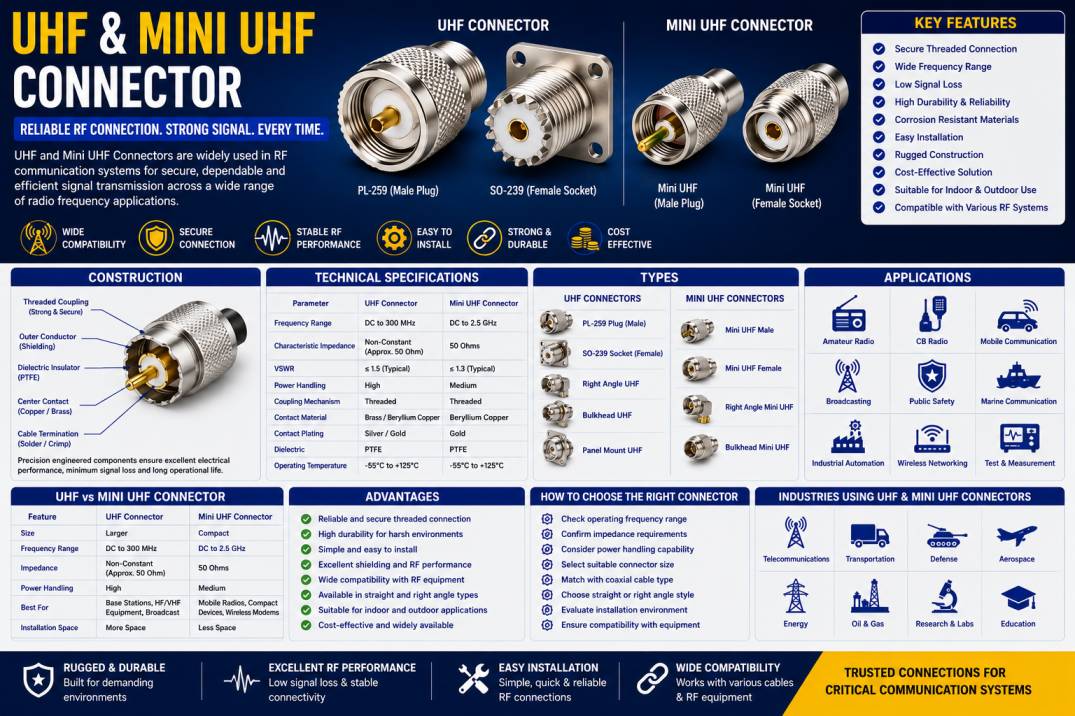
UHF and Mini UHF Connectors are among the most widely used RF (Radio Frequency) coaxial connectors for transmitting radio signals between communication equipment, antennas, coaxial cables, and wireless devices. These connectors are designed to provide reliable electrical performance, secure mechanical connections, and efficient signal transmission across a broad range of radio frequency applications.
Originally developed for Ultra High Frequency (UHF) communication, the standard UHF connector has become a trusted solution in amateur radio, CB radio, broadcasting, industrial communication, public safety systems, and wireless networking. The Mini UHF Connector was later introduced as a compact alternative, offering similar electrical performance while occupying significantly less installation space, making it ideal for modern mobile communication equipment.
Although newer RF connector families such as SMA, N-Type, and 4.3-10 connectors dominate high-frequency applications, UHF and Mini UHF connectors remain widely used because of their rugged construction, affordability, easy installation, and compatibility with many legacy RF systems.
This comprehensive guide explains everything about UHF and Mini UHF Connectors, including their construction, working principle, specifications, types, applications, advantages, limitations, and selection criteria.
What Is a UHF Connector?
A UHF Connector is a threaded RF coaxial connector originally developed for radio communication systems operating in the Ultra High Frequency spectrum. It provides a secure mechanical connection between coaxial cables and RF equipment while allowing efficient transmission of radio signals.
The UHF connector is commonly identified by its PL-259 plug and SO-239 socket configuration. These connectors are widely used in HF, VHF, and moderate UHF frequency applications where cost-effective and durable RF connections are required.
Although originally intended for UHF frequencies, the connector performs best at lower frequencies due to impedance variations at higher frequencies.
What Is a Mini UHF Connector?
A Mini UHF Connector is a smaller version of the traditional UHF connector designed for compact communication equipment where installation space is limited.
Mini UHF connectors maintain similar electrical characteristics while reducing connector size, making them ideal for:
- Mobile radios
- Vehicle communication systems
- GPS equipment
- Wireless modems
- Compact RF devices
The threaded coupling mechanism provides a secure connection while supporting reliable RF performance.
How Do UHF & Mini UHF Connectors Work?
Both connectors transmit RF energy through a center conductor while the outer metal body provides shielding against electromagnetic interference.
The operation includes:
- RF signal enters the connector.
- Center conductor transfers the signal.
- Outer conductor maintains grounding and shielding.
- Threaded coupling secures the mechanical connection.
- Signal travels through the connected coaxial cable.
- RF energy reaches the connected antenna or communication equipment.
The shield prevents signal leakage while reducing electromagnetic interference.
Construction of UHF & Mini UHF Connectors
Center Contact
The center contact carries the RF signal.
Common materials include:
- Brass
- Beryllium Copper
- Phosphor Bronze
Most contacts are gold-plated or silver-plated to improve conductivity.
Dielectric Insulator
The dielectric isolates the center conductor from the outer body.
Common materials include:
- PTFE
- Teflon
- Polyethylene
These materials provide stable electrical insulation and excellent temperature resistance.
Connector Body
The body provides mechanical protection and electrical shielding.
Common materials include:
- Brass
- Nickel-Plated Brass
- Stainless Steel
Threaded Coupling
Both connector types use threaded coupling to provide secure and vibration-resistant connections.
Cable Termination
The connector is attached to coaxial cables through soldering, crimping, or clamp-style termination depending on the connector design.
Technical Specifications
| Specification | UHF Connector | Mini UHF Connector |
|---|---|---|
| Characteristic Impedance | Non-Constant (Approx. 50 Ohms) | 50 Ohms |
| Frequency Range | DC to 300 MHz (Typical) | DC to 2.5 GHz |
| Coupling Method | Threaded | Threaded |
| VSWR | Moderate | Low |
| Power Handling | High | Medium |
| Contact Material | Brass / Beryllium Copper | Beryllium Copper |
| Contact Plating | Silver / Gold | Gold |
| Dielectric | PTFE | PTFE |
| Operating Temperature | -55°C to +125°C | -55°C to +125°C |
Key Features of UHF & Mini UHF Connectors
- Rugged mechanical construction
- Secure threaded connection
- Reliable RF signal transmission
- Easy installation
- Corrosion-resistant materials
- Long operational life
- Cost-effective design
- High durability
- Wide compatibility
- Good shielding performance
- Suitable for indoor and outdoor applications
- Multiple cable termination options
Types of UHF Connectors
PL-259 Plug
The most common UHF male connector used on coaxial cables.
SO-239 Socket
The matching female panel-mount connector used on communication equipment.
Right-Angle UHF Connector
Designed for installations with limited space.
Panel Mount UHF Connector
Installed directly onto communication equipment or enclosures.
Bulkhead UHF Connector
Provides RF connections through equipment panels.
Types of Mini UHF Connectors
Mini UHF Male
Used on RF cables and mobile communication equipment.
Mini UHF Female
Commonly mounted on wireless devices and communication hardware.
Right-Angle Mini UHF Connector
Ideal for compact mobile installations.
Bulkhead Mini UHF Connector
Provides secure panel-mounted RF connections.
Applications of UHF & Mini UHF Connectors
Amateur Radio
Used in HF, VHF, and UHF amateur radio equipment.
CB Radio
Provides reliable antenna connections for citizen band radios.
Mobile Communication
Supports vehicle-mounted communication systems.
Broadcasting
Used in radio transmission equipment.
Public Safety Communication
Supports emergency communication networks.
Wireless Networking
Used in legacy wireless communication equipment.
Industrial Automation
Provides RF connectivity for industrial communication systems.
Marine Communication
Supports VHF marine radio systems.
Test and Measurement
Used in RF laboratories and communication testing.
Military Communication
Supports tactical communication and field radio systems.
Advantages of UHF & Mini UHF Connectors
- Strong mechanical connection
- High durability
- Affordable pricing
- Easy installation
- Excellent vibration resistance
- Reliable signal transmission
- Wide availability
- Long service life
- Suitable for high-power applications
- Multiple mounting options
- Compact Mini UHF design
- Proven industry reliability
Limitations of UHF & Mini UHF Connectors
- Standard UHF connectors do not maintain constant impedance.
- Performance decreases at higher microwave frequencies.
- Larger than SMA connectors.
- Heavier than miniature RF connectors.
- Not recommended for precision microwave systems.
How to Choose the Right UHF or Mini UHF Connector
Before selecting a connector, consider:
- Operating frequency
- Connector size
- Cable compatibility
- Power handling
- Installation space
- Environmental conditions
- Connector plating
- Mounting style
- Mechanical durability
- Application requirements
UHF Connector vs Mini UHF Connector
| Feature | UHF Connector | Mini UHF Connector |
|---|---|---|
| Size | Larger | Compact |
| Frequency Range | Up to 300 MHz | Up to 2.5 GHz |
| Installation Space | Larger | Smaller |
| Mobile Equipment | Moderate | Excellent |
| Power Handling | Higher | Moderate |
| Modern RF Systems | Limited | Better |
| Typical Applications | Base Radios | Mobile Radios |
Industries Using UHF & Mini UHF Connectors
These connectors are widely used in:
- Telecommunications
- Broadcasting
- Amateur Radio
- Public Safety
- Transportation
- Industrial Automation
- Marine Communication
- Defense
- Wireless Communication
- RF Testing Laboratories
Maintenance Tips
To maximize connector performance:
- Keep connectors clean.
- Avoid over-tightening.
- Inspect threads regularly.
- Protect connectors from corrosion.
- Use weatherproof boots for outdoor installations.
- Verify cable termination periodically.
- Replace worn connectors immediately.
Future Trends of UHF & Mini UHF Connectors
Although advanced RF connectors such as SMA, N-Type, and 4.3-10 connectors are increasingly used in modern wireless systems, UHF and Mini UHF connectors continue to remain relevant in legacy communication networks, industrial RF systems, and mobile radio applications. Manufacturers are improving corrosion resistance, precision machining, plating quality, and connector durability while maintaining compatibility with existing communication infrastructure. These enhancements ensure that UHF and Mini UHF connectors continue to provide dependable performance for radio communication, transportation, industrial automation, and public safety networks.
Conclusion
UHF and Mini UHF Connectors remain trusted RF interconnection solutions for a wide range of communication systems. Their rugged construction, secure threaded coupling, affordability, and dependable electrical performance make them ideal for amateur radio, CB radio, broadcasting, industrial communication, public safety, transportation, and mobile wireless equipment. While newer connector technologies offer superior microwave performance, UHF and Mini UHF connectors continue to provide reliable service in many RF applications where durability and compatibility are essential.
Frequently Asked Questions (FAQs)
1. What is a UHF Connector?
A UHF Connector is a threaded RF coaxial connector used to connect antennas, coaxial cables, and communication equipment for reliable radio frequency signal transmission.
2. What is a Mini UHF Connector?
A Mini UHF Connector is a compact version of the standard UHF connector designed for mobile communication equipment and space-constrained RF installations.
3. What is the difference between UHF and Mini UHF Connectors?
The Mini UHF Connector is smaller, supports higher frequencies (up to approximately 2.5 GHz), and is better suited for compact devices, while the standard UHF Connector is larger and typically performs best below 300 MHz.
4. What are UHF Connectors used for?
They are commonly used in amateur radio, CB radio, broadcasting, industrial communication, public safety systems, marine communication, and RF testing.
5. What are Mini UHF Connectors used for?
Mini UHF Connectors are used in mobile radios, vehicle communication systems, wireless modems, GPS equipment, and compact RF devices.
6. What materials are commonly used in UHF and Mini UHF Connectors?
These connectors are typically manufactured using brass or stainless steel bodies, gold- or silver-plated beryllium copper contacts, and PTFE dielectric insulation.
7. Are UHF Connectors waterproof?
Standard UHF Connectors are not inherently waterproof, but weatherproof boots and sealing accessories can be used for outdoor installations.
8. What are the advantages of UHF and Mini UHF Connectors?
They provide secure threaded connections, high durability, easy installation, good RF performance, long service life, and cost-effective connectivity for many communication systems.
9. Which industries commonly use UHF and Mini UHF Connectors?
They are widely used in telecommunications, broadcasting, amateur radio, transportation, marine communication, industrial automation, defense, public safety, and RF laboratories.
10. How do I choose the right UHF or Mini UHF Connector?
Choose a connector based on operating frequency, cable type, available installation space, power handling requirements, connector size, environmental conditions, and compatibility with your RF communication equipment.