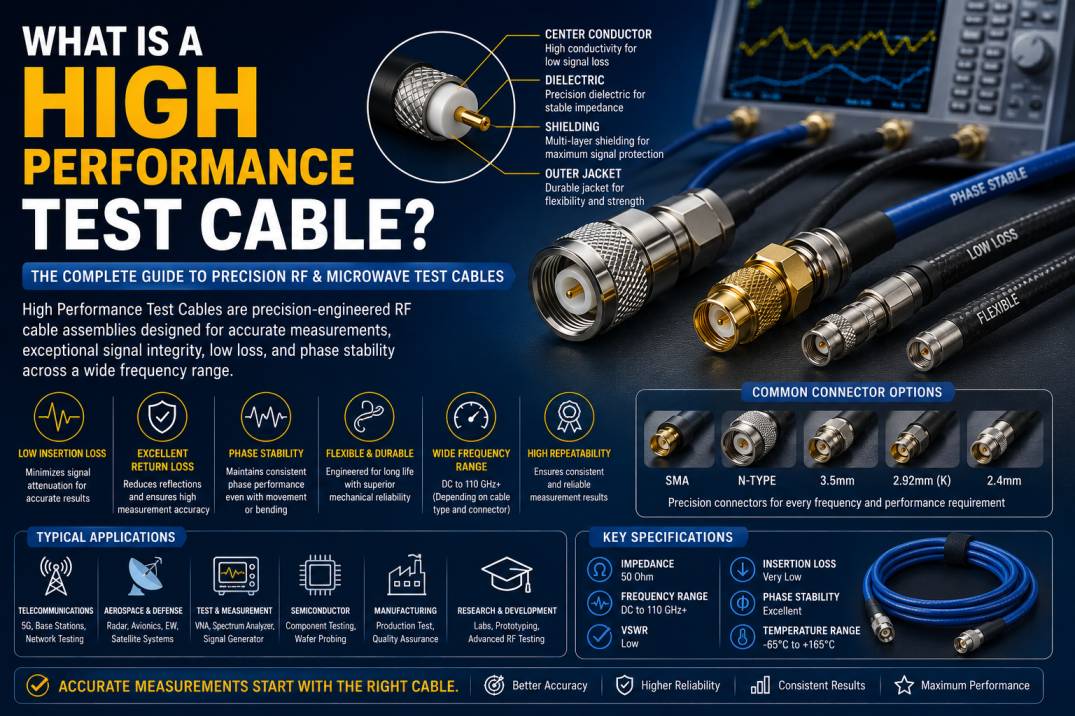
In the world of RF (Radio Frequency), microwave engineering, telecommunications, aerospace, defense, semiconductor testing, and electronic manufacturing, measurement accuracy is critical. Engineers invest heavily in advanced testing equipment such as Vector Network Analyzers (VNAs), Spectrum Analyzers, Signal Generators, Oscilloscopes, and RF Power Meters to ensure the performance of communication systems and electronic components. However, even the most sophisticated instruments can produce inaccurate results if the wrong test cables are used.
This is where High Performance Test Cables become essential.
A High Performance Test Cable is a precision-engineered RF cable assembly designed to deliver exceptional signal integrity, low loss, superior phase stability, and repeatable measurement accuracy across a wide frequency range. These cables are specifically manufactured for demanding test and measurement applications where even minor signal variations can significantly affect results.
Whether testing antennas, RF filters, amplifiers, 5G equipment, satellite communication systems, radar modules, or microwave components, high performance test cables play a vital role in ensuring reliable and repeatable measurements.
In this comprehensive guide, we will explore what high performance test cables are, how they work, their construction, types, advantages, applications, specifications, and best practices for selecting the right cable for your RF testing environment.
What Is a High Performance Test Cable?
A High Performance Test Cable is a specialized RF cable assembly designed for precision measurement applications where signal quality and measurement accuracy are critical.
Unlike standard RF cables, these assemblies are engineered to provide:
- Low insertion loss
- Excellent return loss
- High phase stability
- Superior shielding
- Exceptional repeatability
- Minimal signal distortion
High performance test cables are commonly used with:
- Vector Network Analyzers (VNA)
- Spectrum Analyzers
- RF Signal Generators
- Oscilloscopes
- Power Meters
- RF Test Systems
- Automated Test Equipment (ATE)
Their purpose is to ensure that test results accurately reflect the performance of the device under test rather than introducing errors caused by the cable itself.
Why High Performance Test Cables Matter
Many engineers focus on the accuracy of their test instruments but underestimate the impact of cable quality.
A poor-quality cable can introduce:
- Signal attenuation
- Phase instability
- Impedance mismatch
- Measurement drift
- Inconsistent results
High performance test cables help eliminate these issues by maintaining electrical stability even under repeated movement, bending, and environmental changes.
Benefits include:
- Greater measurement confidence
- Improved repeatability
- Reduced calibration errors
- Enhanced testing efficiency
For high-frequency RF and microwave systems, cable quality is often just as important as the test equipment itself.
How Does a High Performance Test Cable Work?
A high performance test cable acts as a precision transmission line between the test instrument and the Device Under Test (DUT).
Signal Generation
The test instrument generates an RF signal.
Signal Transfer
The cable transports the signal to the DUT with minimal loss.
Signal Response
The DUT processes the signal and returns a response.
Measurement Analysis
The response travels back through the cable to the measuring instrument.
Throughout this process, the cable must maintain:
- Stable impedance
- Low attenuation
- Consistent phase response
- Minimal reflections
This ensures highly accurate test results.
Construction of a High Performance Test Cable
High performance test cables use premium materials and advanced manufacturing techniques.
Center Conductor
The center conductor carries RF energy.
Common materials include:
- Silver-plated copper
- Copper alloy
- High-purity copper
Benefits:
- Low resistance
- Improved conductivity
- Reduced signal loss
Dielectric Layer
The dielectric separates conductors and controls impedance.
Materials include:
- PTFE (Teflon)
- Foam PTFE
- Air dielectric structures
Advantages:
- Stable electrical properties
- Low dielectric loss
- Excellent high-frequency performance
Shielding System
Multiple shielding layers protect signals from interference.
Typical shielding includes:
- Foil shields
- Braided shields
- Multi-layer protection
Benefits:
- EMI suppression
- Reduced signal leakage
- Improved measurement integrity
Outer Jacket
The outer jacket provides mechanical protection.
Materials include:
- Polyurethane
- FEP
- TPE
- High-flex polymers
These materials improve durability and flexibility.
Key Characteristics of High Performance Test Cables
Phase Stability
One of the most important cable specifications.
Phase-stable cables maintain consistent electrical performance when:
- Bent
- Twisted
- Repositioned
This is essential for accurate RF measurements.
Low Insertion Loss
Insertion loss measures how much signal is lost while traveling through the cable.
Lower insertion loss means:
- Better signal integrity
- Higher measurement accuracy
- Improved dynamic range
Excellent Return Loss
Return loss measures signal reflections caused by impedance mismatches.
Benefits include:
- Lower VSWR
- Reduced measurement errors
- Better system performance
High Flexibility
Many testing environments require frequent cable movement.
High-performance cables provide:
- Mechanical durability
- Consistent electrical behavior
- Long service life
Wide Frequency Range
Modern test cables support frequencies ranging from:
- DC to 6 GHz
- DC to 18 GHz
- DC to 26.5 GHz
- DC to 40 GHz
- DC to 67 GHz
- DC to 110 GHz
Depending on application requirements.
Types of High Performance Test Cables
Flexible Test Cables
Designed for routine laboratory use.
Advantages:
- Easy handling
- Good performance
- Cost-effective
Applications:
- General RF testing
- Production environments
Phase-Stable Test Cables
Designed to minimize phase variations during movement.
Applications:
- Calibration laboratories
- Aerospace testing
- Precision RF measurements
Armored Test Cables
Include protective metal armor.
Benefits:
- Increased durability
- Crush resistance
- Longer lifespan
Ideal for field testing.
High-Frequency Microwave Test Cables
Engineered for microwave and millimeter-wave applications.
Common frequencies:
- 40 GHz
- 50 GHz
- 67 GHz
- 110 GHz
Used in advanced communication systems.
Low-Loss Test Cables
Optimized for minimal attenuation.
Suitable for:
- Long cable runs
- High-frequency testing
- Sensitive measurements
Common Connector Types Used
Connector quality directly impacts overall performance.
SMA Connectors
Widely used in RF testing.
Benefits:
- High-frequency capability
- Precision mating
- Compact design
N-Type Connectors
Known for durability and reliability.
Used in:
- Telecom systems
- Outdoor testing
- RF laboratories
3.5 mm Connectors
Provide excellent microwave performance.
Applications:
- Calibration labs
- High-accuracy measurements
2.92 mm (K) Connectors
Support frequencies up to 40 GHz.
Used in:
- 5G testing
- Radar systems
- Aerospace applications
2.4 mm and 1.85 mm Connectors
Designed for ultra-high-frequency testing.
Applications of High Performance Test Cables
Telecommunications
Telecom engineers use high-performance test cables for:
- Base station testing
- Antenna measurements
- Network optimization
- 5G deployment
Aerospace and Defense
Used for:
- Radar testing
- Electronic warfare systems
- Satellite communications
- Avionics validation
Research and Development
Essential for:
- Prototype testing
- Product development
- RF component characterization
Manufacturing
Supports quality control testing of:
- Filters
- Amplifiers
- Antennas
- RF modules
Semiconductor Industry
Used in advanced chip testing and microwave characterization.
High Performance Test Cable vs Standard RF Cable
| Feature | High Performance Test Cable | Standard RF Cable |
|---|---|---|
| Phase Stability | Excellent | Moderate |
| Measurement Accuracy | Very High | Limited |
| Return Loss | Superior | Standard |
| Repeatability | Excellent | Moderate |
| Frequency Range | Extended | Limited |
| Durability | High | Moderate |
For precision measurements, high performance test cables are the preferred choice.
How to Choose the Right High Performance Test Cable
Determine Frequency Requirements
Choose a cable rated for your maximum operating frequency.
Examples:
- 18 GHz
- 26.5 GHz
- 40 GHz
- 67 GHz
- 110 GHz
Evaluate Phase Stability
Applications involving repeated movement require phase-stable cables.
Check Connector Compatibility
Ensure compatibility with:
- Test equipment
- Calibration kits
- DUT interfaces
Consider Cable Flexibility
Flexible cables improve usability in laboratory environments.
Review Loss Specifications
Lower insertion loss improves measurement quality.
Assess Environmental Conditions
Field applications may require:
- Armored cables
- Rugged connectors
- Weather-resistant assemblies
Best Practices for Handling Test Cables
Avoid Excessive Bending
Sharp bends can damage cable geometry.
Use Torque Wrenches
Proper connector torque ensures consistent performance.
Keep Connectors Clean
Contamination can degrade measurements.
Inspect Regularly
Check for:
- Wear
- Connector damage
- Shielding issues
Store Properly
Use cable hangers or large-radius storage methods.
Future Trends in High Performance Test Cables
5G and 6G Expansion
Higher frequencies require improved cable technology.
Millimeter-Wave Testing
Growing demand for frequencies above 40 GHz.
Automated Testing
Manufacturers increasingly rely on repeatable cable assemblies for production environments.
Satellite Communication Growth
Next-generation satellite systems require advanced RF testing solutions.
Quantum and Advanced Research
Emerging technologies continue pushing cable performance requirements higher.
Key Takeaways
- High Performance Test Cables are designed for precision RF and microwave measurements.
- They offer superior phase stability and low insertion loss.
- Widely used in telecom, aerospace, defense, and research laboratories.
- Support frequencies from DC to 110 GHz and beyond.
- Improve measurement accuracy and repeatability.
- Available in flexible, armored, phase-stable, and low-loss designs.
- Essential for advanced RF testing applications.
Conclusion
A High Performance Test Cable is far more than a simple RF interconnect. It is a critical measurement component that directly affects the accuracy, repeatability, and reliability of RF and microwave testing systems.
By providing exceptional phase stability, low insertion loss, excellent return loss, and superior shielding, these cables enable engineers to achieve precise measurement results in demanding environments.
Whether testing antennas, filters, amplifiers, radar systems, satellite communication equipment, or next-generation 5G and 6G infrastructure, investing in high-quality test cables ensures that measurements remain accurate and dependable.
As wireless technologies continue evolving toward higher frequencies and greater complexity, high performance test cables will remain indispensable tools in modern RF engineering and testing environments.
FAQ About High Performance Test Cables
What is a high performance test cable?
A high performance test cable is a precision RF cable assembly designed for accurate RF and microwave measurements.
Why are phase-stable test cables important?
They maintain consistent electrical performance even when bent or moved, improving measurement accuracy.
What frequencies do high performance test cables support?
Depending on the design, they can support frequencies from DC up to 110 GHz or higher.
What industries use high performance test cables?
Telecommunications, aerospace, defense, semiconductor manufacturing, research laboratories, and satellite communication industries.
Can high performance test cables improve measurement accuracy?
Yes. They reduce signal loss, reflections, and phase variations, resulting in more reliable measurements.