Introduction
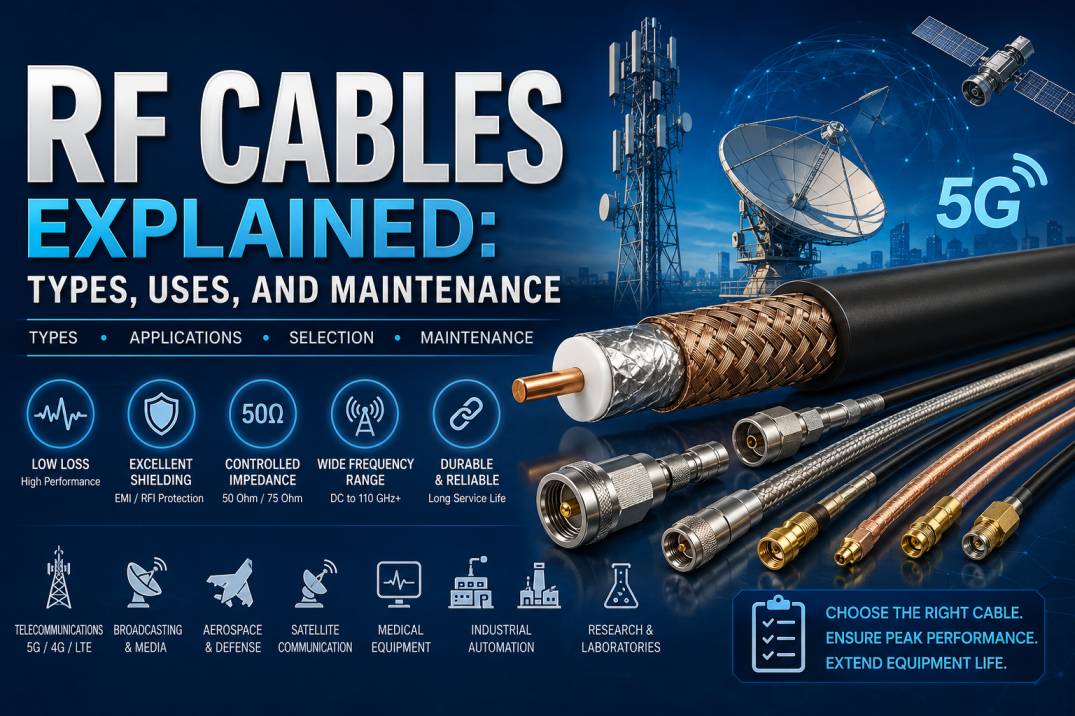
RF cables are the backbone of modern communication systems. They carry high-frequency radio signals between devices with minimal signal loss, making them essential for telecommunications, broadcasting, military, aerospace, medical equipment, satellite communication, and wireless networking. Choosing the right RF cable improves signal quality, system performance, and long-term reliability.
This guide explains RF cables, their working principle, different types, applications, maintenance, and how to select the right cable for your requirements.
What is an RF Cable?
An RF (Radio Frequency) cable is a specially designed coaxial or twinaxial cable that transmits radio frequency signals ranging from a few kilohertz (kHz) to several gigahertz (GHz). Unlike standard electrical cables, RF cables maintain controlled impedance to minimize signal reflection and transmission loss.
RF cables are commonly used with connectors such as SMA, N Type, TNC, BNC, 2.92mm, 2.4mm, 1.85mm, MMCX, and SMP connectors.
Key Features
- Low insertion loss
- Controlled impedance (50 Ohm or 75 Ohm)
- Excellent shielding
- Wide frequency range
- High flexibility or semi-rigid construction
- Superior signal integrity
Working Principle of RF Cable
RF cables transmit electromagnetic signals through a center conductor while the outer shield protects the signal from electromagnetic interference (EMI).
The center conductor carries the RF signal, while the dielectric insulation maintains the correct spacing and impedance. The outer conductor or braided shield prevents external noise from affecting the transmitted signal.
A properly designed RF cable ensures:
- Low VSWR
- Low return loss
- Low attenuation
- High shielding effectiveness
- Stable phase performance
What are the Main Structures of RF Cables?
Every RF cable consists of four important layers.
1. Center Conductor
Usually made from copper or silver-plated copper, it carries the RF signal.
2. Dielectric Insulation
PTFE, FEP, or Foam PE insulation maintains constant impedance and minimizes signal loss.
3. Shielding
Braided copper, aluminum foil, or double shielding protects against EMI and RFI interference.
4. Outer Jacket
PVC, TPE, or FEP jackets provide mechanical protection and environmental resistance.
What are the Types of RF Cables? How are they Different from Normal Cables?
Normal electrical cables transfer electrical power, whereas RF cables are specifically designed for transmitting high-frequency radio signals.
| Feature | RF Cable | Normal Cable |
|---|---|---|
| Purpose | RF Signal Transmission | Electrical Power |
| Frequency | Up to 110 GHz+ | Low Frequency |
| Impedance | Controlled (50Ω/75Ω) | Not Controlled |
| Shielding | Heavy Shielding | Limited Shielding |
| Signal Loss | Very Low | Higher |
| Applications | Telecom, Radar, Satellite | Household Wiring |
How to Choose the Right RF Cables?
Choosing the correct RF cable depends on several technical factors.
Frequency Range
Higher frequencies require lower-loss cables.
Cable Length
Longer cables increase attenuation.
Impedance
Choose 50 Ohm for RF communication systems and 75 Ohm for television and video systems.
Flexibility
- Flexible cables for moving equipment
- Semi-rigid cables for stable installations
Power Handling
High-power transmitters require larger cables.
Environmental Conditions
Outdoor applications require UV-resistant and waterproof jackets.
Connector Compatibility
Ensure compatibility with SMA, N Type, BNC, TNC, SMP, MMCX, or custom RF connectors.
Types of RF Cables
Coaxial Cable
The most widely used RF cable featuring a center conductor surrounded by dielectric insulation and shielding.
Common examples include:
- RG58
- RG59
- RG174
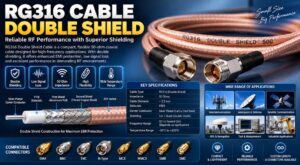
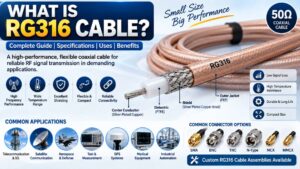
- RG316
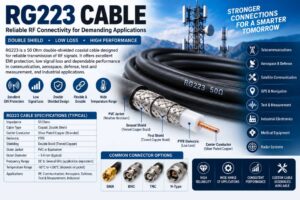
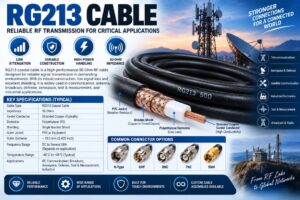
- RG213
- LMR400
- HLF Series
Applications
- Wireless communication
- CCTV
- GPS
- Cellular networks
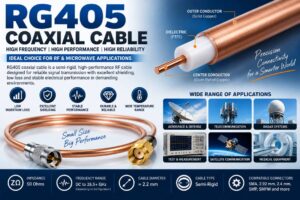
Semi-Rigid RF Cable
Constructed using a solid copper outer conductor.
Advantages
- Excellent shielding
- Low loss
- High frequency capability
- Stable phase performance
Applications
- Aerospace
- Radar
- Military systems
- Test laboratories
Semi-Flexible Cable
Offers improved flexibility while maintaining low attenuation.
Applications
- Microwave assemblies
- Instrumentation
- RF modules
Flexible RF Cable
Designed for repeated bending.
Advantages
- Easy routing
- Lightweight
- Long service life
Applications
- Mobile communication
- Base stations
- Test equipment
Low Loss RF Cable
Specially designed to reduce attenuation over long distances.
Applications
- Cellular towers
- DAS
- Wi-Fi infrastructure
- Broadcasting
Twinaxial Cable
Twinax cables contain two insulated conductors instead of one center conductor.
Applications
- High-speed data communication
- Data centers
- Networking equipment
Applications of RF Cables
RF cables are widely used across multiple industries.
Telecommunications
- 4G
- 5G
- Base stations
- Distributed Antenna Systems (DAS)
Broadcasting
- Radio stations
- Television transmitters
Aerospace
- Aircraft communication
- Satellite systems
Defense
- Radar systems
- Electronic warfare
- Secure military communication
Medical Equipment
- MRI systems
- Diagnostic equipment
Research Laboratories
- RF measurement
- Calibration systems
Industrial Automation
- Wireless monitoring
- Remote sensors
Choosing the Right RF Cable
Before purchasing an RF cable, consider:
- Operating frequency
- Cable length
- Connector type
- Power rating
- Installation environment
- Flexibility requirements
- Shielding performance
- Budget
Selecting the wrong cable may lead to excessive signal loss, poor communication quality, and equipment failure.
Comparison: Coaxial Cables vs. Twinaxial Cables
| Feature | Coaxial Cable | Twinaxial Cable |
|---|---|---|
| Conductors | One | Two |
| Impedance | 50Ω / 75Ω | 100Ω Typical |
| Shielding | Excellent | Excellent |
| Frequency | Very High | Moderate |
| Primary Use | RF Communication | High-Speed Data |
| Signal Loss | Low | Low |
| Applications | Wireless Networks | Servers & Data Centers |
RF Testing
Proper RF testing ensures cable performance before installation.
Common tests include:
VSWR Testing
Measures signal reflection.
Insertion Loss Test
Determines signal attenuation.
Return Loss Test
Evaluates impedance matching.
Continuity Test
Checks electrical continuity.
Phase Stability Test
Ensures consistent signal phase during movement.
Shielding Effectiveness Test
Measures resistance against EMI and RFI.
Maintaining and Storing RF Cables
Proper maintenance significantly extends cable life.
Best Practices
- Avoid sharp bends.
- Do not exceed the minimum bend radius.
- Keep connectors clean.
- Use protective caps.
- Store cables in a dry environment.
- Avoid excessive pulling force.
- Inspect connectors regularly.
- Replace damaged cables immediately.
- Coil cables properly after use.
- Protect outdoor cables from moisture and UV exposure.
Routine inspection helps maintain signal quality and reduces downtime.
Benefits of High-Quality RF Solutions
Investing in premium RF cables provides several advantages.
- Lower insertion loss
- Better signal quality
- Higher bandwidth
- Longer service life
- Improved shielding
- Reduced maintenance costs
- Stable electrical performance
- Better durability
- Increased network reliability
- Higher return on investment
For mission-critical applications such as aerospace, defense, and telecommunications, high-quality RF cables are essential for ensuring uninterrupted performance.
Conclusion
RF cables are essential components in modern communication and high-frequency systems. Their specialized construction enables efficient transmission of radio frequency signals with minimal loss and excellent shielding. Whether used in 5G networks, aerospace, defense, medical equipment, or laboratory testing, selecting the appropriate RF cable improves system efficiency, reliability, and longevity.
Understanding cable types, impedance, frequency range, connector compatibility, and maintenance practices helps organizations make informed purchasing decisions while maximizing network performance.
Frequently Asked Questions about RF Cables
What is an RF cable used for?
RF cables transmit radio frequency signals between antennas, transmitters, receivers, RF instruments, and communication equipment.
What is the difference between RF cable and coaxial cable?
Coaxial cable is the most common type of RF cable. RF cable is a broader category that includes coaxial, semi-rigid, semi-flexible, flexible, and twinaxial cables.
Which impedance is better, 50 Ohm or 75 Ohm?
50 Ohm cables are ideal for RF communication, wireless networks, aerospace, and defense, while 75 Ohm cables are commonly used for television, video, and broadcasting.
Which RF cable has the lowest signal loss?
Low-loss cables such as LMR, HLF, and premium PTFE-based RF cables provide significantly lower attenuation over long distances.
How long do RF cables last?
With proper installation and maintenance, high-quality RF cables can last more than 10 years, depending on environmental conditions and usage.
How do I reduce RF cable signal loss?
Use shorter cable lengths, select low-loss cables, maintain proper impedance matching, install quality connectors, and avoid sharp bends.
Can RF cables be used outdoors?
Yes. Outdoor RF cables with UV-resistant jackets and waterproof construction are designed for harsh weather conditions.
What industries use RF cables?
RF cables are widely used in telecommunications, 5G infrastructure, satellite communication, broadcasting, aerospace, defense, medical equipment, industrial automation, and research laboratories.