Global Positioning System technology has become an essential part of modern communication, navigation, transportation, defense, agriculture, and industrial operations. From vehicle tracking systems and smartphones to aircraft navigation and precision farming, GPS technology plays a major role in providing accurate positioning and timing information.
At the center of every GPS system is a GPS antenna. A GPS antenna is a specialized antenna designed to receive signals transmitted by GPS satellites orbiting the Earth. These antennas are engineered to capture weak satellite signals accurately and deliver reliable positioning data to GPS receivers.
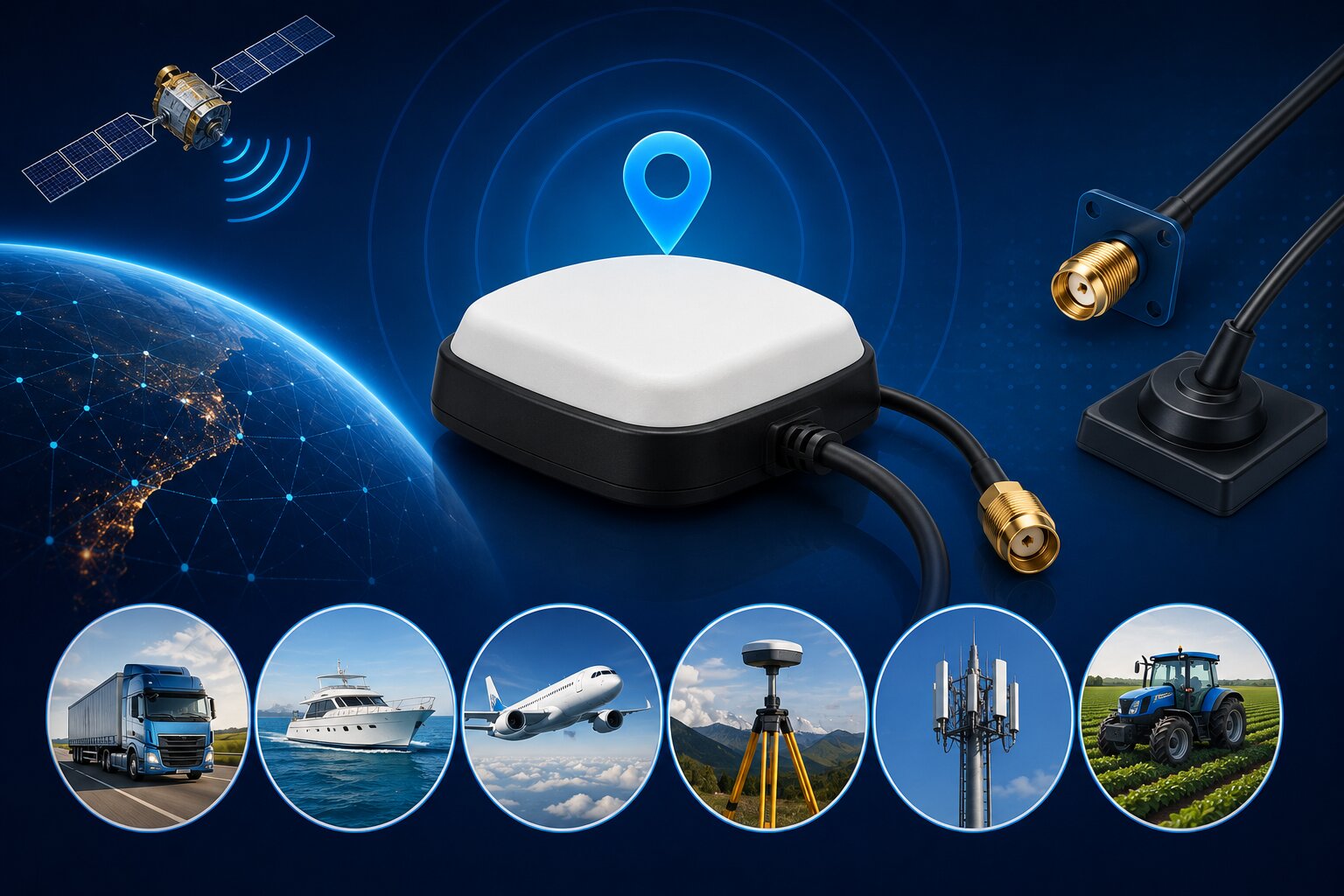
GPS antennas are widely used in automotive systems, marine navigation, aviation, military applications, telecom infrastructure, IoT devices, and surveying equipment because they ensure stable and accurate signal reception even in challenging environments.
Understanding the working principle, types, applications, and installation methods of GPS antennas is important for selecting the right antenna for specific communication and navigation requirements.
Introduction to GPS Antenna
A GPS antenna is an antenna specifically designed to receive radio frequency signals from Global Positioning System satellites. These satellites continuously transmit location and timing information toward Earth.
The GPS antenna captures these satellite signals and transfers them to a GPS receiver. The receiver then processes the information to determine:
- Exact geographic location
- Speed
- Altitude
- Direction
- Time synchronization
GPS antennas are highly sensitive because satellite signals reaching the Earth are extremely weak. Therefore, antenna design, gain, polarization, and placement play a critical role in system accuracy.
GPS antennas are commonly integrated with:
- Vehicle tracking systems
- Navigation systems
- Fleet management systems
- Telecom timing systems
- Aviation equipment
- Marine navigation devices
- Agricultural automation systems
- Drones and UAVs
- Surveying equipment
Modern GPS antennas are also compatible with multiple satellite navigation systems such as:
- GPS
- GLONASS
- Galileo
- BeiDou
- QZSS
This improves positioning accuracy and signal reliability.
How Does a GPS Antenna Work?
The working principle of a GPS antenna is based on receiving radio frequency signals transmitted by navigation satellites.
GPS satellites orbit approximately 20,200 kilometers above Earth and continuously broadcast signals on specific frequencies.
The GPS antenna performs the following functions:
- Receives satellite signals from space
- Filters unwanted interference and noise
- Amplifies weak GPS signals
- Transfers signals to the GPS receiver
- Enables accurate positioning calculations
The GPS receiver calculates location by measuring the travel time of signals received from multiple satellites.
To determine accurate coordinates, signals from at least four satellites are generally required.
GPS antennas are designed to receive Right-Hand Circularly Polarized (RHCP) signals because GPS satellites transmit circularly polarized signals for reliable communication.
GPS Frequency Bands
GPS antennas operate across several standard frequency bands.
L1 Frequency
- Frequency: 1575.42 MHz
- Most commonly used GPS frequency
- Used in consumer navigation systems
L2 Frequency
- Frequency: 1227.60 MHz
- Used for professional surveying and military applications
L5 Frequency
- Frequency: 1176.45 MHz
- Designed for high-precision and safety-critical applications
Modern multi-band GPS antennas can receive signals across multiple frequency ranges simultaneously, improving positioning accuracy and reducing signal errors.
Construction of GPS Antenna
A GPS antenna contains several important components.
Radiating Element
The radiating element receives satellite signals.
Common designs include:
- Patch antennas
- Helical antennas
- Ceramic antennas
Ground Plane
The ground plane improves signal reception and reduces interference from nearby surfaces.
Low Noise Amplifier
A Low Noise Amplifier (LNA) strengthens weak satellite signals before transmission to the GPS receiver.
Filter Circuit
Filters remove unwanted frequencies and electromagnetic interference.
Protective Housing
The outer enclosure protects the antenna from:
- Moisture
- Dust
- UV radiation
- Temperature changes
- Mechanical damage
Outdoor GPS antennas often include waterproof and weather-resistant designs for harsh environmental conditions.
Types of GPS Antennas
Different GPS antenna types are designed for different applications and environments.
Passive GPS Antenna
Passive GPS antennas do not contain internal amplification circuits.
Features include:
- Simple design
- Lower cost
- No external power requirement
Passive antennas are suitable for short cable runs where signal loss is minimal.
Applications include:
- Portable devices
- Compact GPS systems
- Embedded navigation equipment
Active GPS Antenna
Active GPS antennas include an integrated Low Noise Amplifier.
Advantages include:
- Improved signal strength
- Better long-distance cable performance
- Reduced signal degradation
Active antennas require external power supplied through the coaxial cable.
Applications include:
- Vehicle tracking systems
- Telecom systems
- Outdoor navigation systems
- Industrial GPS installations
Patch GPS Antenna
Patch antennas are one of the most commonly used GPS antenna types.
They feature a flat ceramic patch structure mounted above a ground plane.
Advantages include:
- Compact size
- Good directional performance
- Excellent RHCP signal reception
Patch antennas are widely used in:
- Automotive navigation
- GPS trackers
- Smartphones
- IoT devices
Helical GPS Antenna
Helical antennas use a spiral conductor design.
Benefits include:
- Better satellite visibility
- Improved low-angle signal reception
- Excellent circular polarization
These antennas are suitable for:
- Aviation
- Military systems
- Marine navigation
- Surveying equipment
Embedded GPS Antenna
Embedded antennas are integrated directly into electronic devices.
Applications include:
- Smartphones
- Wearable devices
- Compact GPS modules
External GPS Antenna
External antennas are mounted outside devices for better signal reception.
Applications include:
- Vehicles
- Industrial systems
- Telecom towers
- Outdoor communication systems
Multi-Band GPS Antenna
Multi-band antennas support multiple satellite frequencies simultaneously.
Advantages include:
- Higher positioning accuracy
- Reduced signal errors
- Better performance in difficult environments
These antennas are commonly used in:
- Precision agriculture
- Surveying
- Geospatial mapping
- Scientific research
GPS Antenna Polarization
GPS antennas use Right-Hand Circular Polarization because GPS satellites transmit RHCP signals.
Advantages of RHCP include:
- Better signal reliability
- Reduced multipath interference
- Improved satellite tracking
Circular polarization allows the antenna to receive signals regardless of satellite orientation.
Applications of GPS Antenna
GPS antennas are used in a wide range of industries and technologies.
Vehicle Tracking Systems
GPS antennas are essential for vehicle tracking and fleet management systems.
Applications include:
- Logistics tracking
- Taxi management
- Delivery vehicle monitoring
- School bus tracking
Benefits include:
- Real-time location monitoring
- Route optimization
- Improved fleet efficiency
Automotive Navigation
Modern vehicles use GPS antennas for navigation systems.
Functions include:
- Route guidance
- Traffic monitoring
- Emergency assistance
- Vehicle location services
Aviation Industry
Aircraft use GPS antennas for navigation, flight management, and positioning systems.
GPS technology improves:
- Flight safety
- Navigation accuracy
- Air traffic coordination
Marine Navigation
Ships and boats rely on GPS antennas for accurate positioning and route planning.
Marine GPS systems support:
- Navigation
- Fishing operations
- Emergency communication
- Vessel tracking
Telecommunications
Telecom towers use GPS antennas for precise timing synchronization.
GPS timing is critical for:
- Cellular networks
- 4G systems
- 5G infrastructure
- Base station synchronization
Surveying and Mapping
Survey-grade GPS antennas provide highly accurate location data for:
- Land surveying
- Construction projects
- GIS mapping
- Infrastructure planning
Agriculture
Precision agriculture uses GPS antennas for automated farming equipment.
Applications include:
- Tractor guidance
- Field mapping
- Crop monitoring
- Precision spraying
Military and Defense
Military GPS systems require secure and highly accurate positioning.
Applications include:
- Tactical navigation
- Missile guidance
- Surveillance systems
- Military vehicles
IoT and Smart Devices
GPS antennas are widely used in IoT systems for asset tracking and monitoring.
Applications include:
- Smart logistics
- Asset management
- Remote monitoring
- Smart city infrastructure
Drones and UAVs
Unmanned aerial vehicles use GPS antennas for:
- Flight stabilization
- Navigation
- Mapping
- Surveillance
Advantages of GPS Antennas
GPS antennas provide several important advantages.
Accurate Positioning
GPS antennas enable precise location tracking and navigation.
Reliable Signal Reception
High-quality antennas improve signal stability even in difficult environments.
Wide Coverage
GPS satellites provide global positioning coverage worldwide.
Compact Design
Modern GPS antennas are small, lightweight, and easy to integrate.
Multi-System Compatibility
Advanced antennas support multiple satellite navigation systems.
Improved Navigation Safety
GPS technology enhances transportation and aviation safety.
Real-Time Tracking
GPS antennas enable instant location monitoring and route management.
Better Timing Synchronization
Telecom and industrial systems use GPS timing for network accuracy.
Challenges of GPS Antennas
Despite their advantages, GPS antennas face several challenges.
Weak Satellite Signals
GPS signals are extremely weak when reaching Earth.
Signal Obstruction
Buildings, tunnels, and dense trees can block satellite signals.
Multipath Interference
Signals reflected from surfaces may reduce positioning accuracy.
Electromagnetic Interference
Nearby electronic equipment can affect GPS performance.
Weather Conditions
Heavy rain and atmospheric conditions may slightly impact signal quality.
GPS Antenna vs Standard Antenna
| Feature | GPS Antenna | Standard RF Antenna |
|---|---|---|
| Purpose | Satellite navigation | General communication |
| Frequency Range | GPS frequency bands | Wide RF bands |
| Polarization | RHCP | Various |
| Signal Type | Satellite signals | Radio signals |
| Accuracy Requirement | Very high | Moderate |
| Applications | Navigation and timing | Communication systems |
GPS Antenna Gain
Gain measures the antenna’s ability to receive weak signals.
Higher gain provides:
- Better satellite signal reception
- Improved positioning performance
- Enhanced sensitivity
Typical GPS antenna gain ranges from:
- 2 dBi to 5 dBi for passive antennas
- 20 dB to 40 dB amplification for active antennas
GPS Antenna Connector Types
GPS antennas use different RF connector types depending on the application.
Common connector types include:
- SMA Connector
- TNC Connector
- BNC Connector
- FAKRA Connector
- N Type Connector
Proper connector selection ensures low signal loss and reliable connectivity.
Installation Guide for GPS Antenna
Correct installation is essential for optimal GPS performance.
Choose an Open Location
Install the antenna in a location with a clear view of the sky.
Avoid areas blocked by:
- Buildings
- Trees
- Metal structures
Maintain Proper Orientation
Most GPS antennas perform best when mounted horizontally facing upward.
Reduce Signal Interference
Keep the antenna away from:
- High-voltage cables
- RF transmitters
- Electrical motors
Use Quality Coaxial Cable
Low-loss coaxial cables help minimize signal attenuation.
Ensure Waterproof Installation
Outdoor antennas should have weatherproof sealing for long-term reliability.
Maintain Proper Ground Plane
Patch antennas often require a proper ground plane for best performance.
Test Signal Strength
After installation, verify signal quality using GPS monitoring equipment.
GPS Antenna Maintenance Tips
Regular maintenance helps ensure long-term performance.
Inspect Cable Connections
Loose connectors can cause signal loss.
Check for Physical Damage
Inspect the antenna housing for cracks or water ingress.
Clean the Antenna Surface
Remove dirt and debris that may affect performance.
Verify Signal Quality
Periodic testing ensures stable operation.
Replace Damaged Components
Worn cables and connectors should be replaced immediately.
Future of GPS Antenna Technology
GPS antenna technology continues evolving with advanced navigation systems.
Future developments include:
- Multi-constellation support
- 5G integration
- AI-based positioning systems
- Miniaturized antennas
- High-precision RTK systems
- Autonomous vehicle navigation
- Smart infrastructure integration
Advanced antennas are being designed to deliver centimeter-level positioning accuracy for autonomous systems and industrial automation.
Choosing the Right GPS Antenna
Selecting the correct GPS antenna depends on several factors.
Application Type
Determine whether the antenna is for automotive, industrial, telecom, or surveying use.
Frequency Support
Choose antennas compatible with required GPS frequency bands.
Environmental Conditions
Outdoor installations require weather-resistant designs.
Gain Requirement
Long cable runs may require active antennas with higher gain.
Mounting Method
Consider magnetic mount, adhesive mount, panel mount, or pole mount options.
Connector Compatibility
Ensure connector compatibility with GPS receivers.
Conclusion
GPS antennas are essential components of modern navigation and positioning systems. They play a critical role in receiving weak satellite signals accurately and enabling reliable communication between GPS satellites and receivers.
From automotive navigation and telecom synchronization to aviation, agriculture, surveying, and industrial automation, GPS antennas support a wide range of critical applications across industries.
Different GPS antenna types such as passive, active, patch, helical, embedded, and multi-band antennas are designed to meet specific operational requirements. Proper antenna selection, installation, and maintenance significantly improve positioning accuracy and signal reliability.
As technology advances toward smart transportation, autonomous systems, IoT infrastructure, and precision navigation, GPS antennas will continue to become more sophisticated and essential for global communication and positioning networks.