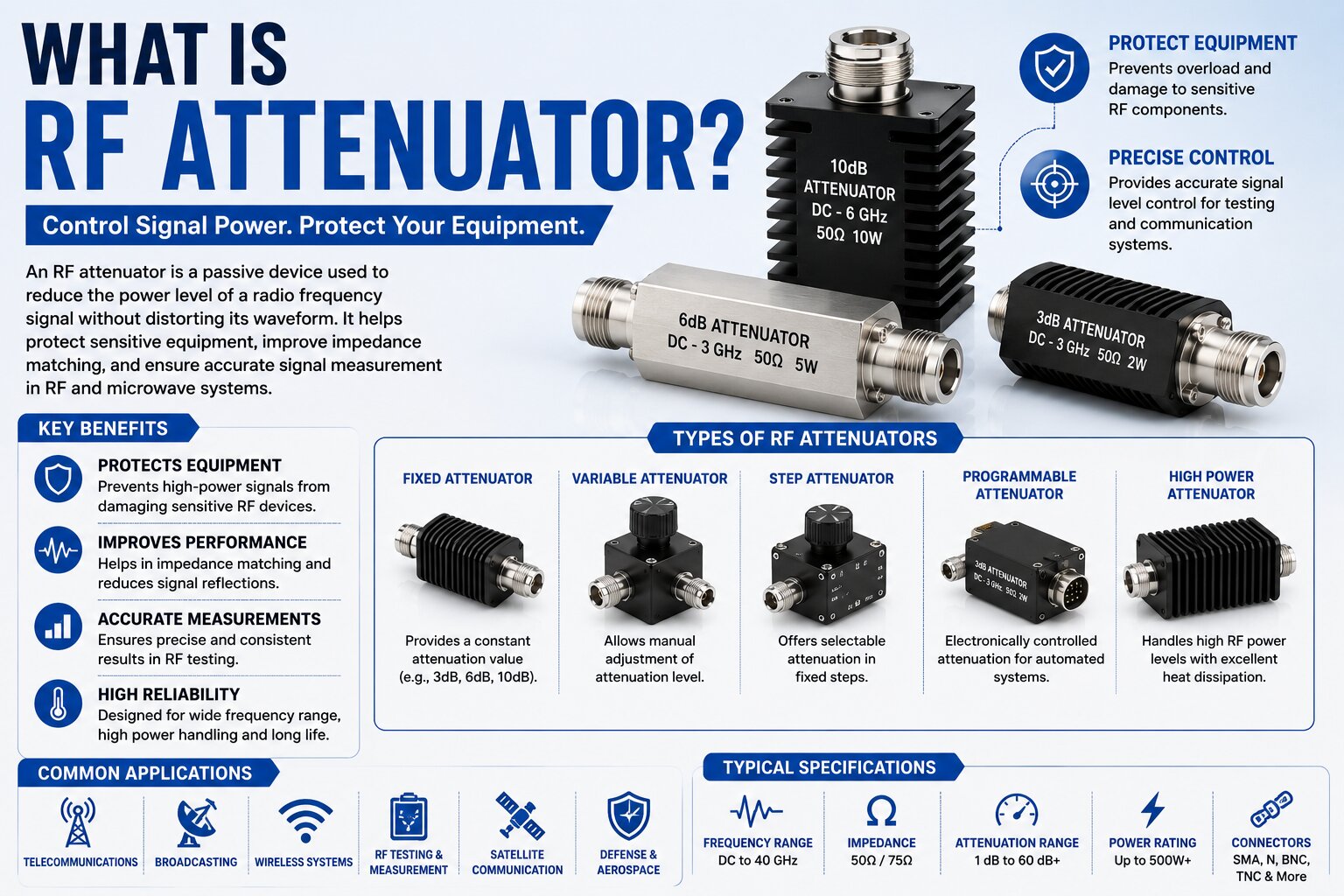
An RF attenuator is an important radio frequency component used to reduce signal power in RF and microwave communication systems without significantly affecting signal quality. RF attenuators are widely used in telecommunications, broadcasting, wireless communication, laboratory testing, aerospace systems, military applications, and RF measurement equipment.
These devices help control signal strength, prevent overload in sensitive electronic components, improve impedance matching, and maintain stable communication performance. RF attenuators are designed to decrease signal levels while preserving waveform integrity and minimizing signal reflection.
Modern RF communication systems rely heavily on RF attenuators for accurate signal management in antennas, RF amplifiers, signal generators, testing instruments, wireless devices, and microwave systems. They are available in multiple configurations such as fixed attenuators, variable attenuators, programmable attenuators, and high-power attenuators.
As communication technologies continue to advance, RF attenuators remain essential components in high-frequency networking and signal control applications.
What is an RF Attenuator?
An RF attenuator is an electronic device used to reduce the amplitude or power level of a radio frequency signal. It absorbs part of the signal energy and allows the remaining signal to pass through at a lower power level.
RF attenuators are commonly used to:
- Reduce signal strength
- Protect sensitive RF equipment
- Improve impedance matching
- Prevent signal distortion
- Control communication levels
These devices are specially designed for RF and microwave frequencies where accurate signal management is critical.
RF attenuators are commonly used in:
- RF communication systems
- Wireless networking
- Telecom infrastructure
- Broadcasting equipment
- Testing laboratories
- Microwave communication systems
Importance of RF Attenuators
High-power RF signals can damage communication equipment or create distortion in electronic systems. RF attenuators are important because they help maintain proper signal levels and protect RF devices from overload conditions.
RF attenuators help:
- Improve signal stability
- Prevent equipment damage
- Reduce signal distortion
- Maintain communication quality
- Support accurate RF testing
Because of these advantages, RF attenuators are widely used in professional communication and measurement systems.
How Does an RF Attenuator Work?
An RF attenuator works by dissipating a portion of the incoming RF signal energy as heat while allowing the remaining signal to pass through at a controlled lower level.
The attenuator contains resistive networks designed to maintain impedance matching and minimize signal reflection.
The working process includes:
- Signal input
- Controlled power reduction
- Impedance matching
- Signal output
High-quality RF attenuators ensure accurate attenuation with minimal signal distortion and low VSWR.
Components of an RF Attenuator
An RF attenuator contains several important components that support RF signal reduction and communication stability.
Resistive Network
The resistive circuit controls signal attenuation levels.
RF Connectors
Connectors provide input and output RF interfaces.
Shielded Housing
The metal housing protects against EMI and RF interference.
Dielectric Materials
Dielectric insulation maintains impedance stability and electrical isolation.
Heat Dissipation Structure
Some attenuators include heat management designs for handling high RF power.
Types of RF Attenuators
RF attenuators are available in different configurations depending on application requirements.
Fixed RF Attenuator
A fixed attenuator provides a constant attenuation value.
Applications
- RF testing
- Signal reduction
- Equipment protection
Common attenuation values include:
- 3 dB
- 6 dB
- 10 dB
- 20 dB
Variable RF Attenuator
Variable attenuators allow adjustable signal reduction levels.
Uses
- Signal tuning
- RF calibration
- Laboratory testing
Programmable RF Attenuator
Programmable attenuators provide digitally controlled attenuation.
Applications
- Automated testing systems
- Communication laboratories
- Advanced RF systems
Step RF Attenuator
Step attenuators provide selectable attenuation levels in predefined steps.
High Power RF Attenuator
High-power attenuators are designed to handle large RF power levels safely.
Applications
- Broadcast systems
- RF transmitters
- Microwave communication
Specifications of RF Attenuators
RF attenuator specifications determine their communication performance and compatibility.
Frequency Range
RF attenuators support frequencies from MHz to GHz ranges depending on design.
Attenuation Value
Attenuation is measured in:
- dB (decibels)
Common values include:
- 1 dB
- 3 dB
- 6 dB
- 10 dB
- 20 dB
Impedance
Most RF attenuators are designed with:
- 50 ohm impedance
- 75 ohm impedance
Power Rating
Power handling capacity determines the maximum RF power the attenuator can safely manage.
VSWR
VSWR measures impedance matching quality.
Lower VSWR values indicate better RF performance.
Connector Types
RF attenuators support various connector interfaces such as:
- SMA
- N Type
- BNC
- TNC
- 2.4mm connectors
Operating Temperature
Industrial-grade attenuators can operate under harsh environmental conditions.
Applications of RF Attenuators
RF attenuators are used across numerous communication and RF industries.
Telecommunications Industry
Telecom systems use RF attenuators for signal control and equipment protection.
Applications
- Base stations
- RF amplifiers
- Wireless communication systems
RF Testing Laboratories
Testing equipment uses attenuators for precise signal calibration.
Equipment
- Spectrum analyzers
- Signal generators
- Network analyzers
Broadcasting Systems
Broadcasting systems use RF attenuators for signal level management.
Aerospace and Defense
Military communication systems require precision RF attenuation.
Benefits
- Stable signal control
- High-frequency support
- Reliable performance
Satellite Communication
Satellite systems use RF attenuators for microwave signal management.
Wireless Networking
Wireless communication systems use attenuators to optimize RF signal levels.
Advantages of RF Attenuators
RF attenuators provide several important communication benefits.
Signal Protection
They protect sensitive RF equipment from excessive signal power.
Improved Signal Quality
Attenuators help reduce distortion and maintain stable communication.
Accurate RF Testing
They provide controlled signal levels for precise testing applications.
Better Impedance Matching
Proper impedance reduces signal reflection.
Wide Frequency Support
RF attenuators support high-frequency microwave communication systems.
Reliable Performance
High-quality attenuators provide stable long-term operation.
Technical Specifications of RF Attenuators
RF attenuator performance depends on multiple technical parameters.
Insertion Loss
Insertion loss refers to signal reduction introduced by the attenuator.
Return Loss
Return loss measures reflected signal energy caused by impedance mismatch.
Power Dissipation
Power dissipation indicates how much signal energy is converted into heat.
Mechanical Durability
Professional RF attenuators support repeated connector mating cycles.
Difference Between RF Attenuator and RF Amplifier
Although both are used in RF systems, they perform opposite functions.
RF Attenuator
- Reduces signal power
- Controls signal strength
- Protects RF equipment
RF Amplifier
- Increases signal power
- Boosts communication range
- Enhances transmission strength
RF attenuators decrease RF signal levels, while amplifiers increase them.
Common Problems with RF Attenuators
Improper usage or low-quality components may affect performance.
Excessive Heat Generation
High-power signals may create overheating issues.
Signal Reflection
Poor impedance matching can increase reflection loss.
Connector Damage
Improper installation may damage RF interfaces.
Incorrect Attenuation Selection
Using incorrect attenuation values may affect communication quality.
Tips for Choosing the Right RF Attenuator
Selecting the correct RF attenuator improves signal control and communication reliability.
Verify Frequency Compatibility
Choose attenuators suitable for operating frequency ranges.
Check Power Requirements
Ensure the attenuator supports required RF power levels.
Select Proper Attenuation Values
Choose attenuation levels based on application requirements.
Verify Connector Compatibility
Ensure compatibility with RF equipment and cables.
Choose Low VSWR Devices
Low VSWR improves communication efficiency.
Future of RF Attenuators
Modern RF communication systems continue to demand advanced signal management technologies.
Recent developments include:
- High-frequency microwave attenuators
- 5G communication systems
- Precision programmable attenuators
- Low-loss RF components
- Automated RF testing solutions
As wireless networking, satellite communication, and microwave technologies continue to evolve, RF attenuators will remain essential components in RF communication infrastructure.
Conclusion
An RF attenuator is a critical RF component used to reduce signal power while maintaining stable communication performance and signal quality. These devices are widely used in telecommunications, broadcasting, wireless networking, aerospace systems, RF testing, and microwave communication applications.
From fixed and variable attenuators to programmable and high-power designs, RF attenuators provide reliable signal management solutions for modern communication systems.
Understanding RF attenuator types, specifications, applications, advantages, and installation requirements helps engineers and communication professionals select the right attenuator for efficient and stable RF system performance.