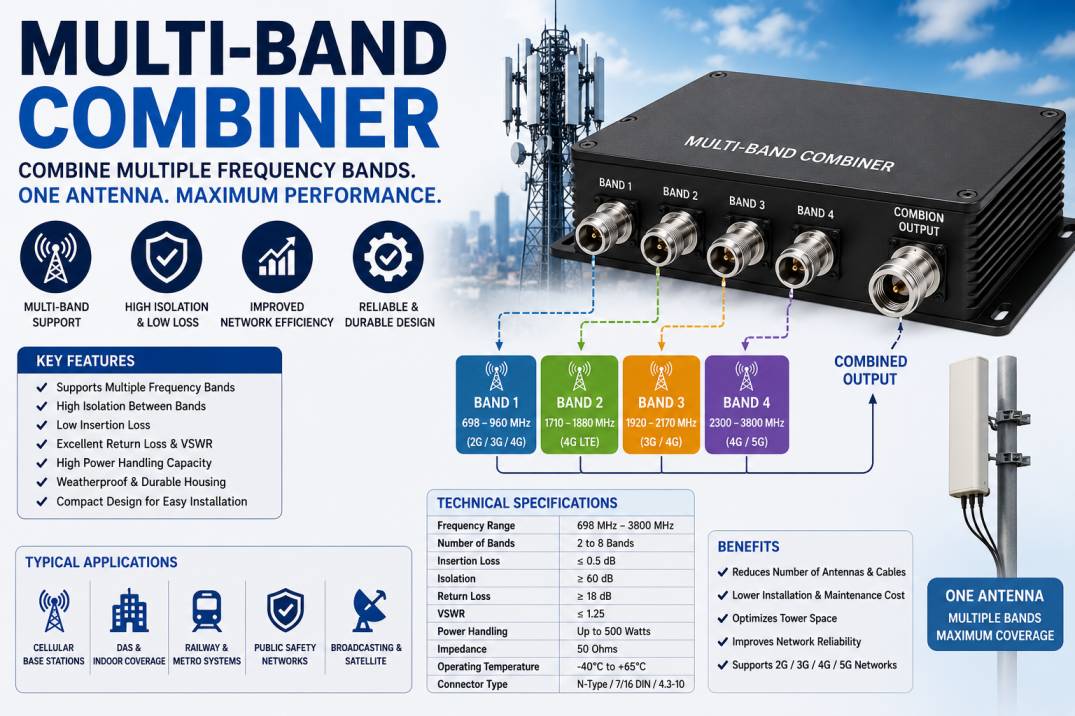
A Multi-Band Combiner is an advanced RF passive component designed to combine multiple frequency bands into a single transmission path while maintaining excellent signal integrity and minimal insertion loss. As wireless communication technologies continue to evolve, network operators require efficient methods to support multiple frequency bands using shared antennas and transmission lines. Multi-Band Combiners provide the ideal solution by enabling several RF signals operating on different frequency ranges to coexist without interfering with one another.
Modern cellular infrastructure relies heavily on Multi-Band Combiners to reduce installation costs, improve spectrum utilization, simplify antenna systems, and minimize the number of feeder cables required at base stations. These devices are widely deployed in 2G, 3G, 4G LTE, 5G NR, public safety communication, broadcasting, distributed antenna systems (DAS), and private wireless networks.
Manufactured using precision RF filter technology, Multi-Band Combiners provide high isolation between frequency bands, low insertion loss, excellent return loss, and outstanding power handling capabilities. Their robust construction and reliable electrical performance make them essential components in telecom towers, indoor coverage solutions, airports, metro rail systems, stadiums, industrial facilities, hospitals, and smart city communication networks.
This comprehensive guide explains everything about Multi-Band Combiners, including their construction, working principle, types, specifications, applications, advantages, and selection criteria.
What Is a Multi-Band Combiner?
A Multi-Band Combiner is a passive RF device that combines signals from multiple frequency bands into one common output without allowing interference between the individual frequency channels.
Instead of installing separate antennas and feeder cables for each wireless service, engineers can combine several frequency bands into a single transmission line, reducing equipment complexity and infrastructure costs.
A Multi-Band Combiner typically supports combinations of cellular frequency bands such as:
- 700 MHz
- 800 MHz
- 900 MHz
- 1800 MHz
- 2100 MHz
- 2300 MHz
- 2600 MHz
- 3500 MHz (5G)
The internal filtering network ensures that each frequency band passes with minimal attenuation while rejecting unwanted signals.
How Does a Multi-Band Combiner Work?
A Multi-Band Combiner works by using highly selective RF filters that allow only specific frequency bands to pass through each input port.
Each connected transmitter operates on a unique frequency range. The combiner merges these signals into one common RF output while maintaining high isolation between the input channels.
The combined signal is then transmitted through a single feeder cable to the antenna, where multiple wireless services are radiated simultaneously.
This design reduces cable losses, minimizes tower loading, and simplifies overall network architecture.
Construction of a Multi-Band Combiner
A Multi-Band Combiner consists of several precision RF components designed for high-performance signal management.
RF Filter Network
The filter network is the heart of the combiner.
It separates and combines different frequency bands using technologies such as:
- Cavity filters
- Ceramic filters
- Dielectric filters
- Microstrip filters
Input Ports
Each input port receives an RF signal from a different transmitter or base station.
Output Port
The combined RF signal exits through a common output port connected to a shared antenna system.
Metallic Housing
The enclosure is manufactured from aluminum or other corrosion-resistant materials to provide mechanical strength, thermal stability, and EMI shielding.
RF Connectors
Common connector types include:
- N-Type
- 7/16 DIN
- 4.3-10
- SMA
Key Features of Multi-Band Combiners
- Low insertion loss
- High isolation between bands
- Excellent return loss
- High power handling
- Wide frequency coverage
- Compact design
- Low VSWR
- Reliable RF performance
- Weather-resistant construction
- Long operational life
- Supports multiple wireless technologies
- Reduces feeder cable requirements
Technical Specifications
| Specification | Typical Value |
| Frequency Range | 698 MHz to 3800 MHz |
| Number of Bands | 2 to 8 Bands |
| Insertion Loss | ≤ 0.5 dB |
| Isolation | ≥ 60 dB |
| Return Loss | ≥ 18 dB |
| VSWR | ≤ 1.25 |
| Impedance | 50 Ohms |
| Power Handling | Up to 500 Watts |
| Connector Type | N-Type / 4.3-10 / 7-16 DIN |
| Operating Temperature | -40°C to +65°C |
Types of Multi-Band Combiners
Dual Band Combiner
Supports two independent RF frequency bands.
Common in LTE and GSM installations.
Triple Band Combiner
Combines three wireless services into one feeder line.
Ideal for multi-operator networks.
Quad Band Combiner
Supports four cellular frequency bands simultaneously.
Widely used in modern telecom towers.
Five Band Combiner
Designed for advanced LTE and 5G deployments requiring multiple carrier aggregation bands.
Custom Multi-Band Combiner
Engineered according to customer-specific frequency combinations and network requirements.
Frequency Bands Supported
Typical supported frequency bands include:
- 698–806 MHz
- 824–960 MHz
- 1710–1880 MHz
- 1920–2170 MHz
- 2300–2400 MHz
- 2490–2690 MHz
- 3300–3800 MHz
Common Connector Types
Multi-Band Combiners are available with:
- N Female
- N Male
- 7/16 DIN Female
- 7/16 DIN Male
- 4.3-10 Female
- SMA Female
Applications of Multi-Band Combiners
Cellular Base Stations
Combine multiple cellular frequency bands into one antenna system.
5G Networks
Support sub-6 GHz multi-band communication infrastructure.
Distributed Antenna Systems (DAS)
Improve indoor wireless coverage in large buildings.
Public Safety Communication
Support emergency communication systems using shared antennas.
Broadcasting
Combine multiple broadcast RF channels efficiently.
Airports
Provide reliable communication coverage across terminals.
Railway Communication
Support GSM-R and LTE-R wireless infrastructure.
Industrial Automation
Enable private LTE and industrial wireless communication.
Hospitals
Provide uninterrupted indoor wireless connectivity.
Smart Cities
Support integrated communication infrastructure for IoT and public networks.
Advantages of Multi-Band Combiners
- Reduced antenna count
- Lower installation costs
- Fewer feeder cables
- Improved tower aesthetics
- Excellent signal isolation
- High reliability
- Easy network expansion
- Reduced maintenance
- Better spectrum utilization
- Supports multi-operator deployments
- Excellent RF performance
- Long service life
Limitations of Multi-Band Combiners
- Higher initial investment
- Requires precise frequency planning
- Not suitable for overlapping frequency bands without proper filtering
- Installation requires professional RF expertise
How to Choose the Right Multi-Band Combiner
Before selecting a Multi-Band Combiner, evaluate:
- Supported frequency bands
- Number of input ports
- Power handling capacity
- Connector type
- Isolation requirements
- Insertion loss
- Return loss
- VSWR
- Environmental protection
- Mounting requirements
Multi-Band Combiner vs RF Power Combiner
| Feature | Multi-Band Combiner | RF Power Combiner |
| Frequency | Multiple Bands | Same Frequency |
| Filtering | Built-in Filters | Minimal Filtering |
| Isolation | High | Moderate |
| Application | Cellular Networks | RF Power Combining |
| Antenna Sharing | Yes | Limited |
| Signal Interference | Very Low | Depends on Design |
Industries Using Multi-Band Combiners
Multi-Band Combiners are widely used in:
- Telecommunications
- Mobile Network Operators
- Public Safety Networks
- Broadcasting
- Transportation
- Airports
- Defense Communication
- Industrial Automation
- Healthcare
- Smart City Infrastructure
Maintenance Tips
To ensure long-term reliability:
- Inspect RF connectors regularly
- Keep connectors clean and dry
- Verify VSWR periodically
- Tighten connectors using proper torque
- Protect outdoor units from moisture
- Perform routine RF performance testing
Future Trends of Multi-Band Combiners
The growing deployment of 5G, private LTE, Open RAN, and future 6G communication networks is increasing the demand for advanced Multi-Band Combiners. New designs focus on lower insertion loss, wider frequency support, compact footprints, higher power handling, improved thermal management, and support for carrier aggregation. These innovations help telecom operators maximize network capacity while reducing infrastructure costs and improving energy efficiency.
Conclusion
Multi-Band Combiners are essential passive RF components that enable multiple wireless frequency bands to share a single antenna system without compromising signal quality. Their low insertion loss, high isolation, robust construction, and compatibility with modern cellular technologies make them indispensable in telecom infrastructure, distributed antenna systems, broadcasting, industrial wireless networks, and smart city deployments. By selecting the appropriate combiner based on supported frequency bands, power handling, connector type, and RF performance, network operators can significantly improve efficiency, reduce installation costs, and simplify network architecture.
Frequently Asked Questions (FAQs)
1. What is a Multi-Band Combiner?
A Multi-Band Combiner is an RF passive device that combines multiple frequency bands into a single transmission path while maintaining high isolation and low signal loss.
2. What is a Multi-Band Combiner used for?
It is used in cellular base stations, 4G and 5G networks, distributed antenna systems (DAS), broadcasting, public safety communication, and industrial wireless networks.
3. How does a Multi-Band Combiner work?
It uses precision RF filters to combine different frequency bands into one output while preventing interference between individual channels.
4. What frequency bands can a Multi-Band Combiner support?
Typical models support frequency ranges from 698 MHz to 3800 MHz, including GSM, LTE, and 5G bands.
5. What are the benefits of using a Multi-Band Combiner?
Benefits include reduced antenna count, lower installation costs, fewer feeder cables, improved spectrum utilization, and simplified network infrastructure.
6. What connector types are available?
Common connector options include N-Type, 7/16 DIN, 4.3-10, and SMA.
7. Can a Multi-Band Combiner support 5G networks?
Yes. Many modern Multi-Band Combiners are specifically designed to support 5G NR frequency bands alongside existing 2G, 3G, and 4G networks.
8. What is insertion loss in a Multi-Band Combiner?
Insertion loss is the amount of signal power lost when passing through the combiner. High-quality combiners typically have an insertion loss of 0.5 dB or less.
9. How do I choose the right Multi-Band Combiner?
Choose based on supported frequency bands, number of ports, insertion loss, isolation, power handling, connector type, VSWR, and environmental requirements.
10. Why are Multi-Band Combiners important in telecom infrastructure?
They enable multiple wireless services to operate through a single antenna system, reducing equipment costs, simplifying installations, and improving overall RF network efficiency.