A High Gain Yagi Antenna, also known as a Yagi-Uda Antenna, is one of the most widely used directional antennas for long-range radio frequency (RF) communication. Designed to provide high gain, excellent directivity, and superior signal reception, this antenna is commonly used in television broadcasting, amateur radio, cellular communication, wireless networking, satellite communication, industrial automation, and military applications.
The Yagi antenna was invented by Japanese engineers Shintaro Uda and Hidetsugu Yagi, and it has remained one of the most efficient directional antennas for decades. Unlike omnidirectional antennas that radiate signals equally in all directions, a High Gain Yagi Antenna focuses RF energy into a narrow beam, significantly improving communication distance and reducing signal interference.
Modern High Gain Yagi Antennas support multiple frequency bands, including VHF, UHF, LTE, 4G, 5G, Wi-Fi, ISM, and industrial communication frequencies. Their lightweight construction, rugged design, and high-performance characteristics make them suitable for both commercial and industrial installations.
This comprehensive guide explains everything about High Gain Yagi Antennas, including their construction, working principle, specifications, types, applications, advantages, disadvantages, and selection criteria.
What Is a High Gain Yagi Antenna?
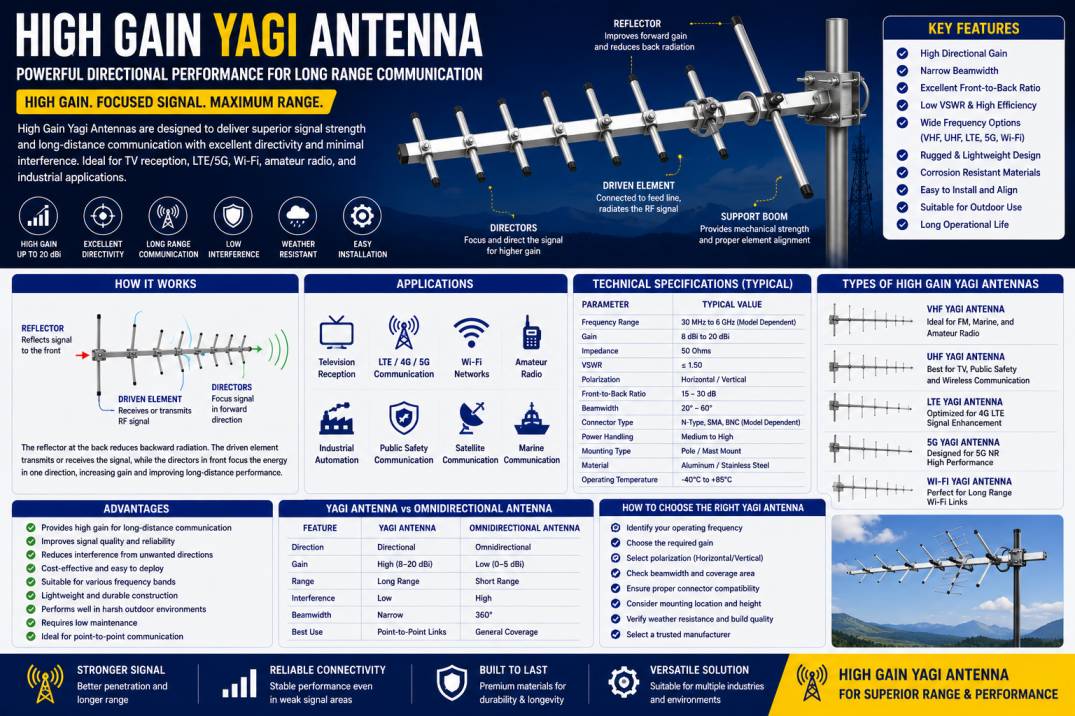
A High Gain Yagi Antenna is a directional antenna consisting of multiple parallel metallic elements mounted on a supporting boom. It includes one driven element connected to the RF source, one reflector positioned behind the driven element, and several directors placed in front of the driven element.
The reflector redirects RF energy toward the forward direction, while the directors focus the electromagnetic waves into a narrow beam. This arrangement increases antenna gain, improves signal strength, and extends communication range.
Because of its focused radiation pattern, a High Gain Yagi Antenna is ideal for point-to-point communication, long-distance signal transmission, and high-performance wireless networks.
How Does a High Gain Yagi Antenna Work?
A High Gain Yagi Antenna works by concentrating radio frequency energy in one specific direction.
The operating process includes:
- RF signals enter the driven element.
- The reflector redirects energy toward the front of the antenna.
- Director elements focus the RF signal into a narrow beam.
- Signal strength increases in the forward direction.
- Unwanted rear radiation is minimized.
- High-gain directional communication is achieved.
This directional design enables efficient long-distance communication while reducing interference from surrounding signals.
Construction of a High Gain Yagi Antenna
Driven Element
The driven element is connected directly to the transmitter or receiver.
It converts electrical energy into electromagnetic waves and vice versa.
Reflector
The reflector is positioned behind the driven element.
Its primary function is to reflect RF energy forward, improving antenna gain and reducing rear radiation.
Directors
Multiple director elements are installed in front of the driven element.
The directors focus the RF signal, increasing gain and narrowing the beamwidth.
More directors generally result in higher gain.
Support Boom
The boom provides mechanical support for all antenna elements while maintaining accurate spacing.
It is commonly manufactured from:
- Aluminum
- Fiberglass
- Stainless Steel
Mounting Bracket
The mounting system enables secure installation on poles, towers, rooftops, and communication masts.
Working Principle of a High Gain Yagi Antenna
The antenna operates based on electromagnetic coupling between its passive and active elements.
The sequence includes:
- RF energy enters the driven element.
- Passive reflector redirects backward radiation.
- Directors reinforce forward radiation.
- Electromagnetic waves combine constructively.
- The antenna produces a highly directional beam.
- Long-distance communication becomes possible.
This design delivers excellent signal concentration with minimal side radiation.
Technical Specifications
| Specification | Typical Value |
| Frequency Range | 30 MHz to 6 GHz (Depending on Model) |
| Gain | 8 dBi to 20 dBi |
| Impedance | 50 Ohms |
| VSWR | ≤ 1.50 |
| Polarization | Vertical or Horizontal |
| Front-to-Back Ratio | 15–30 dB |
| Beamwidth | 20°–60° |
| Connector Type | N-Type, SMA, BNC |
| Power Handling | Medium to High |
| Mounting Type | Pole or Mast Mount |
Key Features of High Gain Yagi Antennas
- High directional gain
- Long communication range
- Narrow beamwidth
- Excellent signal reception
- High front-to-back ratio
- Stable impedance
- Lightweight construction
- Weather-resistant materials
- Low wind loading
- Easy installation
- High efficiency
- Long service life
Types of High Gain Yagi Antennas
VHF Yagi Antenna
Designed for Very High Frequency communication.
Common applications include FM radio, marine communication, and amateur radio.
UHF Yagi Antenna
Supports Ultra High Frequency applications such as television broadcasting and public safety communication.
LTE Yagi Antenna
Optimized for 4G LTE cellular communication and signal boosting.
5G Yagi Antenna
Designed for modern broadband wireless communication systems.
Wi-Fi Yagi Antenna
Used for long-distance wireless networking and point-to-point Wi-Fi links.
Dual Polarized Yagi Antenna
Supports both horizontal and vertical polarization for improved communication flexibility.
Applications of High Gain Yagi Antennas
Television Broadcasting
Receives high-quality TV signals in rural and remote locations.
Cellular Networks
Improves LTE and 5G signal strength for fixed wireless communication.
Wireless Internet
Supports point-to-point Wi-Fi bridges and long-range internet connectivity.
Amateur Radio
Provides long-distance communication for HAM radio operators.
Industrial Automation
Used for remote monitoring, telemetry, and industrial wireless communication.
Public Safety Communication
Supports police, fire, ambulance, and emergency communication systems.
Military Communication
Provides secure directional communication in tactical operations.
Scientific Research
Used in research laboratories for RF experiments and antenna testing.
Agriculture
Supports wireless communication for smart farming applications.
Marine Communication
Provides reliable communication for boats and coastal stations.
Advantages of High Gain Yagi Antennas
- Excellent long-distance communication
- High directional gain
- Reduced interference
- Low installation cost
- Stable performance
- Lightweight construction
- High efficiency
- Improved signal quality
- Excellent front-to-back ratio
- Rugged outdoor design
- Easy maintenance
- Long operational life
Limitations of High Gain Yagi Antennas
- Narrow coverage area
- Requires precise alignment
- Limited bandwidth compared to LPDA antennas
- Performance decreases if misaligned
- Larger antennas are needed for lower frequencies
How to Choose the Right High Gain Yagi Antenna
When selecting a High Gain Yagi Antenna, consider the following:
- Operating frequency
- Required gain
- Polarization
- Beamwidth
- Connector type
- Mounting location
- Wind resistance
- Environmental conditions
- Cable compatibility
- Installation height
High Gain Yagi Antenna vs LPDA Antenna
| Feature | High Gain Yagi | LPDA Antenna |
| Frequency Range | Narrow Band | Wide Band |
| Gain | Higher | Moderate |
| Directivity | Excellent | Very Good |
| Bandwidth | Limited | Wide |
| Beamwidth | Narrow | Wider |
| Best Use | Long Distance | Multi-Band Applications |
Industries Using High Gain Yagi Antennas
High Gain Yagi Antennas are widely used in:
- Telecommunications
- Broadcasting
- Defense
- Industrial Automation
- Agriculture
- Public Safety
- Scientific Research
- Wireless Internet Providers
- Transportation
- Marine Communication
Maintenance Tips
To maximize antenna performance:
- Check mounting hardware regularly.
- Inspect antenna elements for damage.
- Keep RF connectors clean.
- Protect connectors from moisture.
- Verify antenna alignment after storms.
- Inspect cables for wear.
- Perform periodic VSWR testing.
Future Trends of High Gain Yagi Antennas
The expansion of fixed wireless access (FWA), rural broadband, Industrial IoT, private LTE, and 5G networks is increasing demand for advanced High Gain Yagi Antennas. Manufacturers are developing lightweight aluminum designs, corrosion-resistant coatings, dual-polarized configurations, and optimized multi-band models to improve performance and durability. Future Yagi antennas will support broader frequency coverage, enhanced beam control, and higher efficiency to meet the evolving requirements of next-generation wireless communication systems.
Conclusion
High Gain Yagi Antennas continue to be one of the most reliable solutions for long-distance directional RF communication. Their high gain, focused radiation pattern, excellent front-to-back ratio, and robust construction make them ideal for television broadcasting, LTE and 5G communication, wireless internet, industrial automation, amateur radio, and defense applications. Choosing the correct antenna based on frequency, gain, polarization, and installation environment ensures optimal communication performance and dependable long-term operation.
Frequently Asked Questions (FAQs)
1. What is a High Gain Yagi Antenna?
A High Gain Yagi Antenna is a directional antenna that uses a driven element, reflector, and multiple directors to concentrate RF energy into a narrow beam for long-distance communication.
2. What is a High Gain Yagi Antenna used for?
It is used for television reception, LTE and 5G communication, Wi-Fi bridges, amateur radio, industrial automation, public safety communication, and military applications.
3. How does a High Gain Yagi Antenna work?
The reflector redirects RF energy while the directors focus it into a narrow forward beam, increasing gain and improving communication distance.
4. What frequency range does a High Gain Yagi Antenna support?
Depending on the design, High Gain Yagi Antennas typically operate from 30 MHz to 6 GHz, including VHF, UHF, LTE, and 5G frequency bands.
5. What are the advantages of a High Gain Yagi Antenna?
It provides high gain, long communication range, excellent directivity, reduced interference, improved signal quality, and reliable outdoor performance.
6. What is the difference between a Yagi Antenna and an LPDA Antenna?
A Yagi Antenna offers higher gain over a narrow frequency range, while an LPDA Antenna provides broadband coverage across multiple frequency bands.
7. Which materials are commonly used to manufacture High Gain Yagi Antennas?
Most Yagi antennas are made from aluminum, stainless steel, or fiberglass to provide durability, corrosion resistance, and lightweight construction.
8. Can High Gain Yagi Antennas be used outdoors?
Yes. They are specifically designed for outdoor installations and are built to withstand harsh environmental conditions.
9. Which industries commonly use High Gain Yagi Antennas?
They are widely used in telecommunications, broadcasting, agriculture, industrial automation, public safety, defense, wireless internet services, and scientific research.
10. How do I choose the right High Gain Yagi Antenna?
Choose a High Gain Yagi Antenna based on operating frequency, gain, polarization, beamwidth, connector type, installation environment, mounting method, and communication distance requirements.