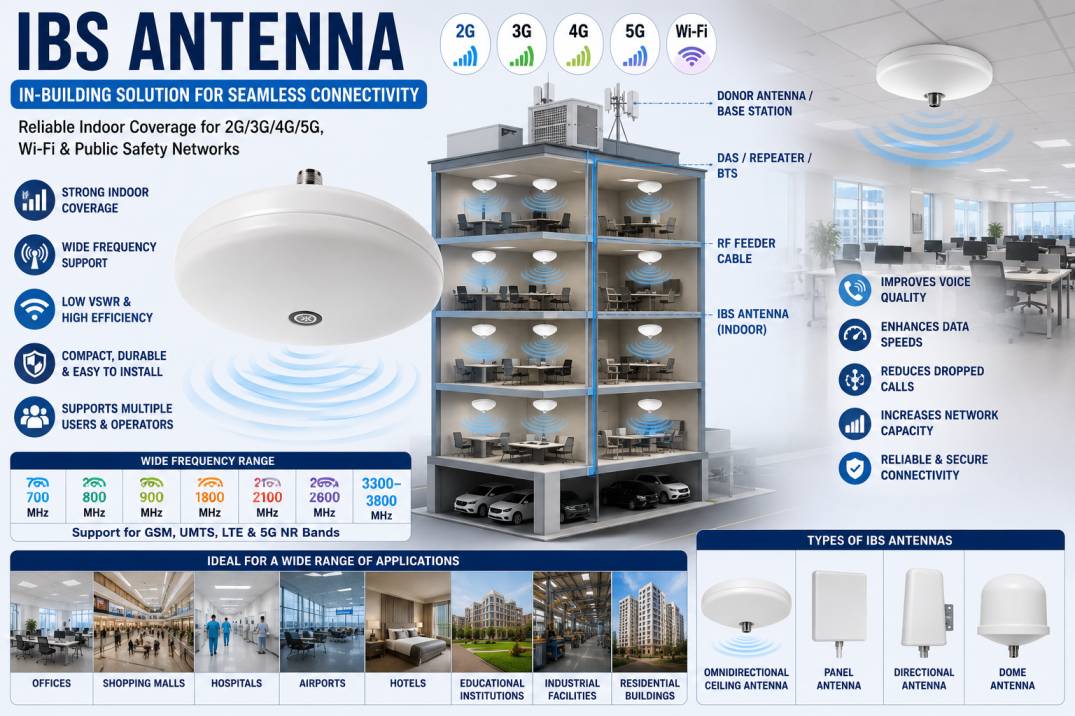
An IBS Antenna, also known as an In-Building Solution Antenna, is a specialized antenna designed to improve wireless network coverage and capacity inside buildings where outdoor cellular signals are weak or blocked. As modern buildings become more complex with concrete walls, steel structures, tinted glass, and multiple floors, mobile signals often struggle to penetrate indoor environments. This results in poor voice quality, dropped calls, slow internet speeds, and unreliable communication.
IBS antennas are deployed as part of Distributed Antenna Systems (DAS) and indoor wireless networks to provide seamless mobile connectivity for 2G, 3G, 4G LTE, 5G, Wi-Fi, and public safety communication systems. They distribute RF signals uniformly throughout indoor spaces, ensuring strong and stable wireless coverage in offices, hospitals, shopping malls, airports, hotels, stadiums, educational institutions, industrial facilities, and residential complexes.
With the increasing demand for high-speed mobile data, IoT devices, smart buildings, and next-generation 5G services, IBS antennas have become essential components of modern communication infrastructure. They not only improve signal strength but also enhance network capacity, reduce interference, and provide better user experiences.
This comprehensive guide explains everything you need to know about IBS antennas, including their construction, working principle, types, specifications, applications, advantages, and selection criteria.
What Is an IBS Antenna?
An IBS Antenna (In-Building Solution Antenna) is an indoor RF antenna specifically engineered to distribute wireless signals throughout enclosed spaces. It connects to a Distributed Antenna System (DAS), signal repeater, or cellular base station and radiates RF signals evenly across indoor environments.
Unlike outdoor base station antennas, IBS antennas are optimized for short-range indoor coverage, delivering consistent signal strength while minimizing dead zones. They support multiple frequency bands and can simultaneously handle cellular, Wi-Fi, public safety, and private communication networks depending on system design.
IBS antennas are available in several designs, including ceiling-mounted omnidirectional antennas, wall-mounted panel antennas, directional antennas, and low-profile dome antennas to suit different indoor environments.
How Does an IBS Antenna Work?
An IBS antenna receives RF signals from a cellular base station, DAS, or signal repeater through low-loss coaxial cables or fiber-fed distributed systems. The antenna then radiates these signals across indoor areas, providing uniform wireless coverage.
The process involves:
Receiving RF signals from the network source.
Distributing the signal through cables or splitters.
Radiating the signal inside the building.
Receiving uplink signals from mobile devices.
Sending those signals back to the base station.
By reducing signal attenuation caused by walls and obstacles, IBS antennas improve voice quality, increase data throughput, and enhance overall network performance.
Construction of an IBS Antenna
Radiating Element
The radiating element transmits and receives RF signals. It is carefully designed to provide uniform indoor coverage with low signal distortion.
Antenna Housing
The housing protects internal components from dust, moisture, and physical damage. It is typically manufactured from UV-resistant ABS plastic or flame-retardant materials suitable for indoor environments.
RF Connector
Most IBS antennas use industry-standard RF connectors such as:
- N-Type Female
- 4.3-10 Connector
- 7/16 DIN Connector
- SMA Connector
The connector provides a secure interface between the antenna and feeder cable.
Mounting Hardware
IBS antennas include ceiling brackets, wall mounts, or pole mounting accessories for quick and secure installation.
Types of IBS Antennas
Omnidirectional IBS Antenna
Omnidirectional antennas radiate RF signals equally in all horizontal directions and are the most common choice for indoor coverage.
Applications include:
- Offices
- Shopping malls
- Hotels
- Hospitals
- Educational institutions
Directional IBS Antenna
Directional antennas focus RF energy in a specific direction to provide higher gain and targeted coverage.
Common applications include:
- Long corridors
- Underground parking
- Warehouses
- Tunnels
- Large halls
Ceiling Dome Antenna
Ceiling-mounted dome antennas provide aesthetically pleasing installations with wide-angle indoor coverage.
Widely used in:
- Corporate offices
- Airports
- Hospitals
- Hotels
- Commercial buildings
Panel IBS Antenna
Panel antennas offer directional coverage and are ideal for targeted signal distribution in specific indoor zones.
Technical Specifications
| Specification | Typical Value |
| Frequency Range | 698–960 MHz, 1710–2700 MHz, 3300–3800 MHz |
| Gain | 2–8 dBi |
| Polarization | Vertical or Dual Polarized |
| VSWR | ≤1.5 |
| Impedance | 50 Ohms |
| Connector Type | N Female / 4.3-10 |
| Power Handling | Up to 100 W |
| Operating Temperature | -40°C to +65°C |
| Radiation Pattern | Omni or Directional |
Frequency Bands Supported
Modern IBS antennas support multiple frequency bands, including:
- GSM 900
- GSM 1800
- UMTS 2100
- LTE 700
- LTE 800
- LTE 1800
- LTE 2300
- LTE 2600
- 5G NR 3300–3800 MHz
Wideband antennas simplify installations by supporting multiple operators and technologies.
Key Features of IBS Antennas
- Wide frequency coverage
- Low VSWR
- High radiation efficiency
- Excellent indoor coverage
- Compact and lightweight design
- Multiple mounting options
- Multi-band support
- Reliable signal distribution
- Low insertion loss
- High durability
- Easy installation
- Long operational life
Applications of IBS Antennas
Corporate Offices
IBS antennas provide uninterrupted mobile connectivity for employees, visitors, and enterprise communication systems.
Shopping Malls
Large commercial complexes use IBS antennas to ensure reliable voice and data services across multiple floors.
Hospitals
Hospitals rely on IBS systems for mission-critical communication, patient monitoring, and emergency services.
Airports
IBS antennas deliver seamless coverage throughout terminals, boarding gates, lounges, and operational areas.
Hotels
Hotels deploy IBS antennas to enhance guest connectivity and support modern hospitality services.
Educational Institutions
Universities and schools use IBS systems to improve wireless communication for students and staff.
Industrial Facilities
Factories and warehouses benefit from stable wireless communication for automation, IoT devices, and operational efficiency.
Residential Buildings
High-rise apartments and residential complexes use IBS antennas to eliminate indoor mobile signal dead zones.
Advantages of IBS Antennas
- Eliminates indoor signal dead zones
- Improves voice call quality
- Enhances mobile data speeds
- Supports multi-operator networks
- Compatible with 2G, 3G, 4G, and 5G
- Reduces dropped calls
- Improves user experience
- Supports emergency communication systems
- Increases network capacity
- Easy integration with DAS
- Low maintenance
- Long service life
Limitations of IBS Antennas
- Requires professional installation
- Performance depends on proper network design
- Additional equipment such as DAS or repeaters may be required
- Initial deployment costs can be higher for large buildings
- Incorrect antenna placement can reduce coverage efficiency
How to Choose the Right IBS Antenna
When selecting an IBS antenna, consider:
- Supported frequency bands
- Required indoor coverage area
- Antenna gain
- Radiation pattern
- Connector compatibility
- Power handling
- Building layout
- Mounting type
- Number of users
- Compatibility with DAS and repeaters
- Environmental conditions
IBS Antenna vs Outdoor Antenna
| Feature | IBS Antenna | Outdoor Antenna |
| Installation | Indoor | Outdoor |
| Coverage | Indoor Areas | Wide Outdoor Areas |
| Gain | Moderate | High |
| Radiation Pattern | Omni/Directional | Mostly Directional |
| Weather Protection | Indoor Design | Weatherproof |
| Main Application | Buildings | Cellular Towers |
Industries Using IBS Antennas
IBS antennas are widely deployed in:
- Telecommunications
- Healthcare
- Hospitality
- Education
- Airports
- Railway Stations
- Shopping Malls
- Industrial Automation
- Government Buildings
- Smart Cities
- Data Centers
- Corporate Campuses
Installation Best Practices
For optimal performance:
- Install antennas at recommended ceiling heights.
- Maintain proper spacing between antennas.
- Use low-loss RF feeder cables.
- Minimize cable lengths where possible.
- Verify VSWR before commissioning.
- Perform RF coverage surveys after installation.
- Avoid mounting near large metal objects.
- Follow manufacturer installation guidelines.
Future Trends of IBS Antennas
The rapid deployment of 5G networks, private LTE systems, smart buildings, and IoT infrastructure is driving the evolution of IBS antennas. Modern antennas now support wider frequency ranges, MIMO technology, dual polarization, higher efficiency, and compact low-profile designs. Future IBS solutions will integrate AI-driven network optimization, beamforming technologies, and advanced multi-band capabilities to deliver superior indoor wireless experiences for next-generation communication systems.
Conclusion
IBS antennas are essential components of modern indoor wireless communication systems, providing reliable signal coverage, improved network capacity, and seamless connectivity in environments where outdoor signals cannot adequately penetrate. Their ability to support multiple frequency bands, operators, and wireless technologies makes them an indispensable part of Distributed Antenna Systems and 5G infrastructure. By selecting the appropriate antenna type, gain, frequency range, and installation method, organizations can significantly improve indoor mobile coverage, user satisfaction, and network performance.
Frequently Asked Questions (FAQs)
1. What is an IBS antenna?
An IBS antenna is an In-Building Solution antenna designed to provide reliable indoor wireless coverage for cellular, 4G LTE, 5G, and other communication networks.
2. What is the purpose of an IBS antenna?
Its primary purpose is to improve indoor mobile signal strength, eliminate dead zones, enhance voice quality, and increase wireless data performance.
3. Where are IBS antennas used?
IBS antennas are used in offices, hospitals, hotels, airports, shopping malls, educational institutions, factories, residential buildings, and stadiums.
4. What frequency bands do IBS antennas support?
Modern IBS antennas support GSM, UMTS, LTE, and 5G frequency bands, including 698–960 MHz, 1710–2700 MHz, and 3300–3800 MHz.
5. What is the difference between an IBS antenna and an outdoor antenna?
An IBS antenna is optimized for indoor coverage with moderate gain, while an outdoor antenna is designed for long-distance outdoor communication and typically offers higher gain.
6. Can IBS antennas support multiple mobile operators?
Yes. Wideband IBS antennas can support multiple operators and multiple wireless technologies simultaneously when integrated with compatible DAS infrastructure.
7. What connector types are commonly used with IBS antennas?
Common connectors include N-Type Female, 4.3-10, 7/16 DIN, and SMA connectors.
8. Are IBS antennas compatible with 5G networks?
Yes. Modern IBS antennas are designed to support 5G NR frequency bands along with legacy 2G, 3G, and 4G LTE networks.
9. How do I choose the right IBS antenna?
Select an IBS antenna based on the required frequency bands, antenna gain, radiation pattern, connector type, indoor coverage area, building layout, and compatibility with the DAS or repeater system.
10. What are the benefits of installing an IBS antenna?
IBS antennas improve indoor coverage, reduce dropped calls, enhance mobile data speeds, support multiple wireless technologies, increase network capacity, and provide a better overall user experience.