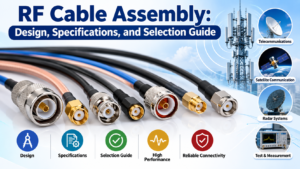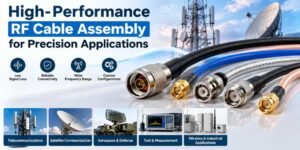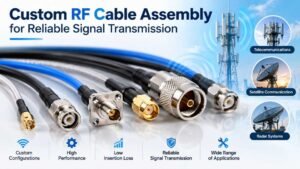
The rapid evolution of RF and microwave communication systems has increased the demand for cable assemblies that offer superior electrical performance while providing greater flexibility during installation. Traditional semi-flexible cables have long been used in aerospace, defense, telecommunications, laboratory testing, and satellite communication because of their stable electrical characteristics and low signal loss. However, modern communication systems require cable solutions that are easier to install, withstand repeated movement, and reduce installation time without sacrificing RF performance.
Flexible cables designed to replace semi-flexible cables have become an ideal solution for these demanding applications. These advanced RF cables combine excellent electrical performance with outstanding mechanical flexibility, making them suitable for environments where cables must bend repeatedly, fit into compact spaces, or be routed through complex equipment.
Today’s high-performance flexible RF cables utilize advanced dielectric materials, precision shielding, and low-loss conductors to deliver electrical characteristics that closely match traditional semi-flexible cables while providing significant advantages in durability, ease of installation, and maintenance.
This comprehensive guide explains what flexible cables replacing semi-flexible cables are, how they work, their construction, features, technical specifications, applications, advantages, limitations, and how to select the right cable for your RF system.
What Are Flexible Cables Replacing Semi-Flexible Cables?
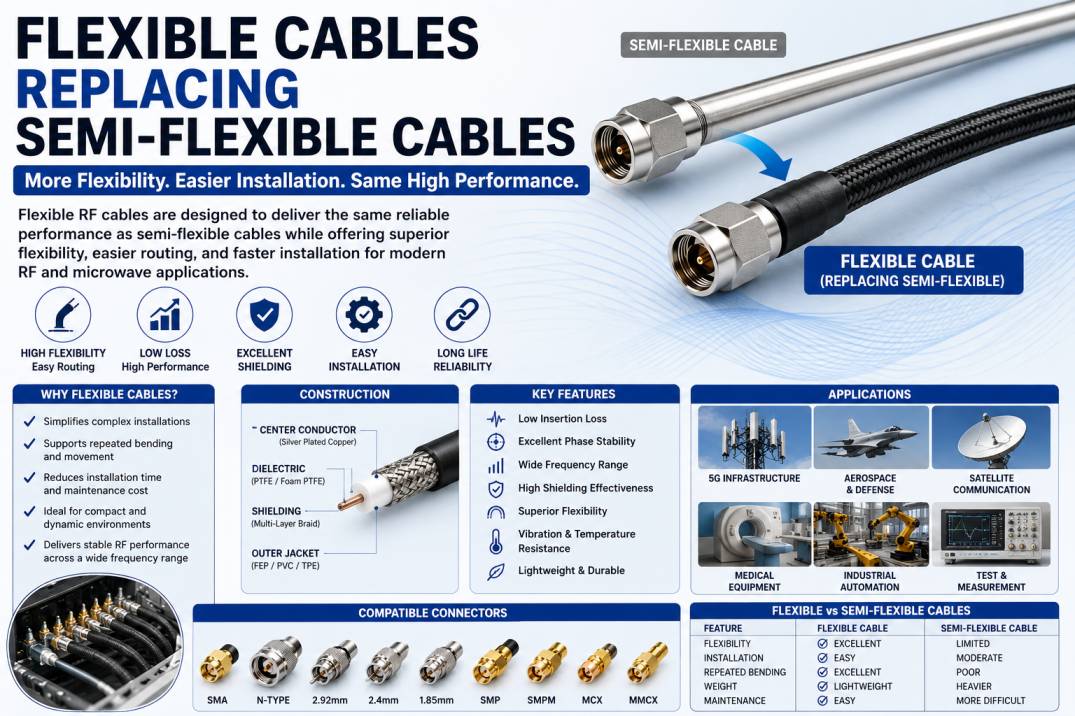
Flexible cables replacing semi-flexible cables are advanced RF coaxial cables specifically designed to provide electrical performance comparable to traditional semi-flexible cables while offering significantly greater mechanical flexibility. These cables maintain low insertion loss, stable impedance, excellent shielding, and high-frequency performance while allowing repeated bending without permanent deformation.
Unlike semi-flexible cables, which generally hold their shape once bent, flexible replacement cables can be routed, repositioned, and reinstalled multiple times without degrading their electrical performance. This makes them highly suitable for modern communication equipment, production environments, and systems requiring regular maintenance.
Why Flexible Cables Are Replacing Semi-Flexible Cables
The transition from semi-flexible to flexible RF cables is driven by several practical and technical advantages.
Modern RF systems require compact installations where cables must pass through tight spaces without introducing mechanical stress. Flexible cables simplify routing, reduce installation complexity, and minimize the risk of cable damage during assembly.
Additionally, industries increasingly require cable assemblies capable of withstanding vibration, repeated movement, and frequent maintenance. Flexible RF cables meet these demands while maintaining consistent electrical characteristics across wide frequency ranges.
How Flexible RF Cables Work
Flexible RF cables operate on the same coaxial transmission principle as semi-flexible cables. A center conductor carries the RF signal while the surrounding dielectric maintains constant spacing between the conductor and the shield. The braided or multi-layer shield protects against electromagnetic interference (EMI) and minimizes signal leakage, while the outer jacket provides mechanical and environmental protection.
Advanced manufacturing techniques ensure that flexible RF cables maintain stable impedance, low VSWR, and excellent phase stability even when bent repeatedly.
Construction of Flexible RF Cables
Center Conductor
The center conductor carries the RF signal.
Common materials include:
- Silver-plated copper
- Oxygen-free copper
- Copper-clad steel
Silver plating improves conductivity and reduces high-frequency losses.
Dielectric
The dielectric maintains the required spacing between the conductors.
Common dielectric materials include:
- PTFE
- Expanded PTFE
- Foam PTFE
- Low-loss polyethylene
These materials provide excellent electrical insulation while minimizing signal attenuation.
Shielding
Flexible RF cables use advanced shielding to reduce EMI.
Shield options include:
- Copper braid
- Double braid
- Silver-plated braid
- Foil and braid combination
Multi-layer shielding significantly improves signal integrity.
Outer Jacket
The protective jacket enhances flexibility and durability.
Common jacket materials include:
- FEP
- PVC
- TPE
- LSZH
- Polyurethane
Key Features
Flexible RF cables replacing semi-flexible cables provide numerous performance advantages.
- High flexibility
- Low insertion loss
- Excellent shielding effectiveness
- Stable impedance
- Low VSWR
- Excellent phase stability
- Lightweight construction
- Superior vibration resistance
- Long service life
- High-frequency compatibility
- Easy installation
- Reusable cable routing
Technical Specifications
| Specification | Typical Value |
| Characteristic Impedance | 50 Ohms |
| Frequency Range | DC to 67 GHz (model dependent) |
| VSWR | Less than 1.25 |
| Shielding Effectiveness | Greater than 90 dB |
| Insertion Loss | Very Low |
| Operating Temperature | -55°C to +200°C |
| Jacket Material | FEP / PVC / TPE |
| Bend Radius | Small |
| Flex Life | Thousands of Bend Cycles |
Comparison Between Flexible and Semi-Flexible Cables
| Feature | Flexible Cable | Semi-Flexible Cable |
| Flexibility | Excellent | Limited |
| Repeated Bending | Excellent | Poor |
| Installation | Easy | Moderate |
| Routing | Simple | Difficult |
| Vibration Resistance | High | Moderate |
| Mechanical Stability | High | Very High |
| Maintenance | Easy | More Difficult |
| Weight | Lightweight | Heavier |
Frequency Range
Flexible RF cables are available for a broad range of frequencies.
Typical operating ranges include:
- DC to 6 GHz
- DC to 12 GHz
- DC to 18 GHz
- DC to 26.5 GHz
- DC to 40 GHz
- DC to 50 GHz
- DC to 67 GHz
Specialized designs support even higher frequencies.
Compatible RF Connectors
Flexible replacement cables can be terminated with various connector types.
Common connectors include:
- SMA
- N-Type
- TNC
- BNC
- 2.92 mm
- 2.4 mm
- 1.85 mm
- SMP
- SMPM
- SSMP
- MCX
- MMCX
Applications
5G Infrastructure
Flexible RF cables are widely used in base stations, remote radio units, distributed antenna systems, and small-cell installations.
Aerospace
Aircraft communication systems, navigation equipment, and avionics rely on flexible cables for dependable RF signal transmission.
Defense
Military communication systems, radar equipment, electronic warfare systems, and tactical vehicles require flexible cables capable of operating under vibration and harsh environmental conditions.
Satellite Communication
Ground stations, VSAT terminals, satellite payloads, and communication antennas utilize flexible RF cables for stable high-frequency performance.
Medical Equipment
MRI systems, diagnostic instruments, imaging equipment, and wireless medical devices depend on low-loss flexible RF cable assemblies.
Industrial Automation
Robotics, automated manufacturing systems, machine vision, and industrial sensors benefit from the flexibility and durability of these cables.
Laboratory Testing
Flexible RF cables are commonly used with network analyzers, spectrum analyzers, oscilloscopes, calibration systems, and RF test benches.
Advantages
- Easy cable routing
- Reduced installation time
- Lower maintenance cost
- Excellent RF performance
- Superior flexibility
- Lightweight construction
- Improved vibration resistance
- Longer operational life
- Better cable management
- Reduced mechanical stress
- Reliable signal transmission
- High durability
Limitations
- Higher cost than standard flexible coaxial cables
- Slightly lower mechanical rigidity than semi-flexible cables
- Performance depends on cable quality
- Requires proper connector termination
How to Choose the Right Flexible RF Cable
When selecting a flexible cable to replace a semi-flexible cable, consider:
- Operating frequency
- Cable diameter
- Insertion loss
- Shielding effectiveness
- Connector compatibility
- Bend radius
- Environmental conditions
- Temperature range
- Power handling
- Mechanical flexibility
Industries Using Flexible Replacement Cables
Flexible RF cables are widely used across many industries.
- Telecommunications
- Aerospace
- Defense
- Satellite Communication
- Broadcasting
- Medical Electronics
- Industrial Automation
- Research Laboratories
- Semiconductor Manufacturing
- Wireless Networking
Future Trends
As RF and microwave technologies continue evolving toward higher frequencies, cable manufacturers are developing flexible RF cables with lower attenuation, improved shielding, enhanced phase stability, reduced weight, and better mechanical durability. The expansion of 5G, future 6G networks, satellite internet, autonomous vehicles, advanced radar systems, and IoT infrastructure will continue driving the demand for flexible cable solutions that can replace traditional semi-flexible designs while maintaining exceptional RF performance.
Conclusion
Flexible cables replacing semi-flexible cables represent the next generation of RF transmission technology. They provide the ideal balance between electrical performance and mechanical flexibility, making them suitable for modern communication systems requiring easy installation, repeated movement, and dependable signal integrity. With low insertion loss, stable impedance, excellent shielding, and superior durability, these cables have become the preferred choice for aerospace, defense, medical, telecommunications, industrial automation, and laboratory applications. Selecting the correct flexible RF cable based on frequency, connector type, shielding, and environmental conditions ensures long-term reliability and outstanding system performance.
Frequently Asked Questions (FAQs)
1. What are flexible cables replacing semi-flexible cables?
They are advanced RF coaxial cables designed to provide similar electrical performance to semi-flexible cables while offering greater flexibility and easier installation.
2. Why are flexible cables replacing semi-flexible cables?
Flexible cables simplify installation, support repeated bending, improve cable routing, reduce maintenance, and maintain excellent RF performance.
3. What industries use flexible RF replacement cables?
They are widely used in telecommunications, aerospace, defense, satellite communication, medical equipment, industrial automation, and RF testing.
4. What frequency range do flexible RF cables support?
Depending on the model, they can operate from DC up to 67 GHz or higher.
5. Are flexible RF cables as reliable as semi-flexible cables?
Yes. High-quality flexible RF cables provide excellent impedance stability, low insertion loss, high shielding effectiveness, and long-term reliability.
6. Which connectors are compatible with flexible RF cables?
Common connectors include SMA, N-Type, BNC, TNC, 2.92 mm, 2.4 mm, 1.85 mm, SMP, SMPM, MCX, and MMCX.
7. Can flexible RF cables withstand repeated bending?
Yes. They are specifically designed for applications requiring continuous movement, repeated flexing, and vibration resistance.
8. What are the advantages of flexible RF cables?
Key advantages include easy installation, low signal loss, superior flexibility, excellent EMI shielding, lightweight construction, and long service life.
9. How do I choose the right flexible RF cable?
Consider frequency range, insertion loss, connector compatibility, shielding performance, bend radius, operating temperature, and environmental conditions.
10. Are flexible RF cables suitable for 5G applications?
Yes. Flexible RF cables are extensively used in 5G infrastructure, including base stations, antennas, distributed antenna systems (DAS), and RF front-end equipment.