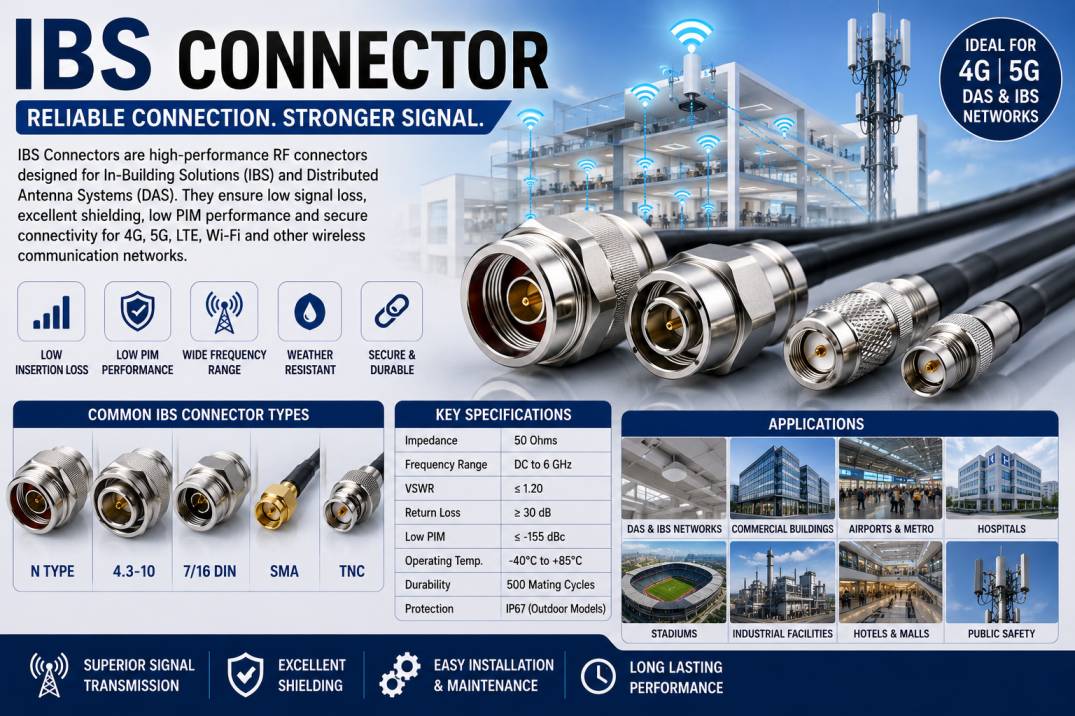
An IBS Connector (In-Building Solution Connector) is a specialized RF connector designed for reliable signal transmission in Distributed Antenna Systems (DAS), in-building wireless networks, and modern telecom infrastructure. These connectors are engineered to provide low insertion loss, excellent impedance matching, superior shielding, and long-term reliability in high-frequency communication systems.
As mobile operators continue expanding 4G LTE, 5G, Wi-Fi, and public safety communication networks, IBS connectors have become an essential component for ensuring seamless indoor coverage. They connect RF cables, antennas, splitters, couplers, repeaters, and base station equipment while maintaining consistent signal performance throughout commercial buildings, airports, hospitals, shopping malls, stadiums, hotels, metro stations, and industrial facilities.
Modern IBS connectors are designed to support high-frequency operation, low Passive Intermodulation (Low PIM), weather resistance, and easy installation, making them ideal for demanding indoor and outdoor RF environments.
This comprehensive guide explains everything about IBS connectors, including their construction, working principle, types, specifications, applications, advantages, and selection process.
What Is an IBS Connector?
An IBS Connector is a precision RF connector used primarily in In-Building Solutions (IBS) and Distributed Antenna Systems (DAS). It provides a secure electrical and mechanical connection between RF cables and communication equipment, allowing radio frequency signals to travel with minimal attenuation and reflection.
IBS connectors are commonly used with feeder cables, jumper cables, antennas, RF splitters, power dividers, couplers, repeaters, and base stations to ensure high-quality wireless signal distribution inside buildings.
These connectors are manufactured using high-quality conductive materials with precision machining to maintain excellent electrical performance across a wide frequency range.
How Does an IBS Connector Work?
An IBS connector creates a continuous RF transmission path by joining coaxial cables to wireless communication equipment.
When properly installed, the connector maintains the cable’s characteristic impedance, reducing signal reflections and minimizing insertion loss.
Its metallic body also acts as an electromagnetic shield, protecting transmitted signals from external interference.
A properly terminated IBS connector ensures:
- Stable impedance
- Low VSWR
- Minimal signal attenuation
- Excellent return loss
- Reliable long-term performance
Construction of an IBS Connector
Center Contact
The center contact transfers RF signals.
Common materials include:
- Brass
- Beryllium Copper
- Phosphor Bronze
Most premium connectors use gold plating for improved conductivity and corrosion resistance.
Dielectric Insulator
The dielectric maintains the spacing between conductors.
Common materials include:
- PTFE
- Teflon
- Engineering Thermoplastics
These materials provide low dielectric loss and excellent temperature stability.
Outer Body
The connector body provides shielding and mechanical strength.
Materials include:
- Brass
- Stainless Steel
- Nickel-Plated Brass
Coupling Mechanism
Depending on the connector type, coupling may use:
- Threaded coupling
- Push-fit mechanism
- Quick-lock design
Key Features of IBS Connectors
- Low insertion loss
- Excellent return loss
- Superior shielding effectiveness
- Low Passive Intermodulation (Low PIM)
- High durability
- Corrosion-resistant finish
- Precision impedance matching
- Wide frequency compatibility
- Easy installation
- Long operational life
- Excellent vibration resistance
- Weather-resistant construction
Technical Specifications
| Specification | Typical Value |
| Characteristic Impedance | 50 Ohms |
| Frequency Range | DC to 6 GHz (Model Dependent) |
| VSWR | ≤ 1.20 |
| Return Loss | Better than 30 dB |
| Insertion Loss | Very Low |
| Low PIM | ≤ -155 dBc |
| Contact Plating | Gold |
| Body Finish | Nickel or Silver |
| Operating Temperature | -40°C to +85°C |
| Waterproof Rating | IP67 (Outdoor Models) |
Common Types of IBS Connectors
Several connector types are commonly used in IBS installations.
N Type Connector
Used for feeder cables and outdoor telecom systems.
4.3-10 Connector
Compact design with excellent Low PIM performance.
7/16 DIN Connector
Designed for high-power cellular base stations.
SMA Connector
Used in indoor RF equipment and laboratory applications.
TNC Connector
Ideal for wireless communication equipment.
DIN Female Connector
Commonly installed in DAS components and antennas.
Frequency Range
IBS connectors support a broad range of wireless frequencies including:
- 700 MHz
- 800 MHz
- 900 MHz
- 1800 MHz
- 2100 MHz
- 2300 MHz
- 2600 MHz
- 3500 MHz
- Up to 6 GHz
These frequency bands support:
- GSM
- LTE
- 4G
- 5G
- Wi-Fi
- Public Safety Networks
Applications of IBS Connectors
IBS connectors are used across multiple industries.
Telecommunications
- Mobile base stations
- Indoor coverage systems
- DAS installations
- Small cell networks
Commercial Buildings
- Shopping malls
- Hotels
- Hospitals
- Airports
- Office buildings
Transportation
- Metro stations
- Railway stations
- Tunnels
- Airports
Industrial Facilities
- Manufacturing plants
- Warehouses
- Smart factories
Public Safety Networks
- Emergency communication
- Fire safety systems
- Police communication
Data Centers
- RF communication
- Wireless infrastructure
Advantages of IBS Connectors
- Excellent RF performance
- Low insertion loss
- High return loss
- Low PIM design
- Reliable indoor coverage
- Easy maintenance
- High mechanical strength
- Excellent corrosion resistance
- Wide frequency compatibility
- Long service life
- Stable electrical performance
- Suitable for 4G and 5G infrastructure
Limitations of IBS Connectors
- Requires precision installation
- Higher-quality connectors have higher cost
- Improper termination increases signal loss
- Specialized installation tools may be required
How to Choose the Right IBS Connector
Before selecting an IBS connector, consider:
- Frequency range
- Connector interface
- Cable compatibility
- Low PIM requirements
- Environmental conditions
- Waterproof rating
- Power handling
- Return loss
- VSWR
- Manufacturer certifications
IBS Connector vs Standard RF Connector
| Feature | IBS Connector | Standard RF Connector |
| Primary Use | DAS & Indoor Networks | General RF Systems |
| Low PIM | Yes | Model Dependent |
| Indoor Coverage | Excellent | Standard |
| Shielding | Superior | Good |
| Frequency Stability | Excellent | Good |
| Telecom Applications | Optimized | General Purpose |
Industries Using IBS Connectors
IBS connectors are widely used in:
- Telecom Operators
- System Integrators
- Wireless Infrastructure Providers
- Construction Companies
- Hospitals
- Airports
- Stadiums
- Shopping Malls
- Smart Buildings
- Industrial Automation
Maintenance Tips
To maximize connector life:
- Keep connectors clean.
- Tighten connectors using recommended torque.
- Inspect sealing rings periodically.
- Avoid excessive bending near connectors.
- Replace damaged connectors immediately.
- Protect unused ports with dust caps.
Future Trends of IBS Connectors
With the rapid expansion of 5G, private LTE, smart buildings, Industrial IoT, and next-generation wireless communication, IBS connectors continue to evolve with enhanced Low PIM performance, compact form factors, improved weather sealing, and higher frequency support. Manufacturers are developing connectors compatible with advanced 5G and future 6G networks while maintaining excellent electrical performance and long-term durability in challenging environments.
Conclusion
IBS connectors are essential components in modern in-building wireless communication systems. Their ability to provide low-loss RF transmission, excellent impedance matching, superior shielding, and Low PIM performance makes them indispensable for Distributed Antenna Systems, 4G, 5G, LTE, Wi-Fi, and public safety communication networks. Selecting the correct connector based on frequency, cable type, environmental requirements, and system design ensures reliable indoor coverage, improved network efficiency, and long-term operational stability.
Frequently Asked Questions (FAQs)
1. What is an IBS Connector?
An IBS Connector is a specialized RF connector used in In-Building Solutions (IBS) and Distributed Antenna Systems (DAS) to connect RF cables and wireless communication equipment.
2. What are IBS connectors used for?
They are used in indoor wireless coverage systems, 4G and 5G networks, DAS installations, commercial buildings, hospitals, airports, shopping malls, and public safety communication systems.
3. What impedance do IBS connectors use?
Most IBS connectors are designed with a characteristic impedance of 50 Ohms for optimal RF performance.
4. What frequency range do IBS connectors support?
Depending on the connector type, IBS connectors typically support frequencies from DC to 6 GHz, covering GSM, LTE, Wi-Fi, and 5G applications.
5. What is Low PIM in IBS connectors?
Low Passive Intermodulation (Low PIM) reduces unwanted signal interference, improving network quality and performance in multi-carrier communication systems.
6. Which connector types are commonly used in IBS systems?
Common connector types include N-Type, 4.3-10, 7/16 DIN, SMA, and TNC connectors.
7. Are IBS connectors suitable for outdoor installations?
Yes. Many IBS connectors are available with IP67-rated weatherproof designs for outdoor telecom installations.
8. Why is impedance matching important in IBS connectors?
Proper impedance matching minimizes signal reflections, reduces VSWR, and ensures maximum power transfer throughout the RF communication system.
9. Can IBS connectors be used for 5G networks?
Yes. Modern IBS connectors are specifically designed to support 4G LTE, 5G NR, Wi-Fi, and private LTE networks with excellent RF performance.
10. How do I choose the right IBS connector?
Select an IBS connector based on operating frequency, cable type, connector interface, Low PIM requirements, environmental conditions, waterproof rating, and telecom system specifications.