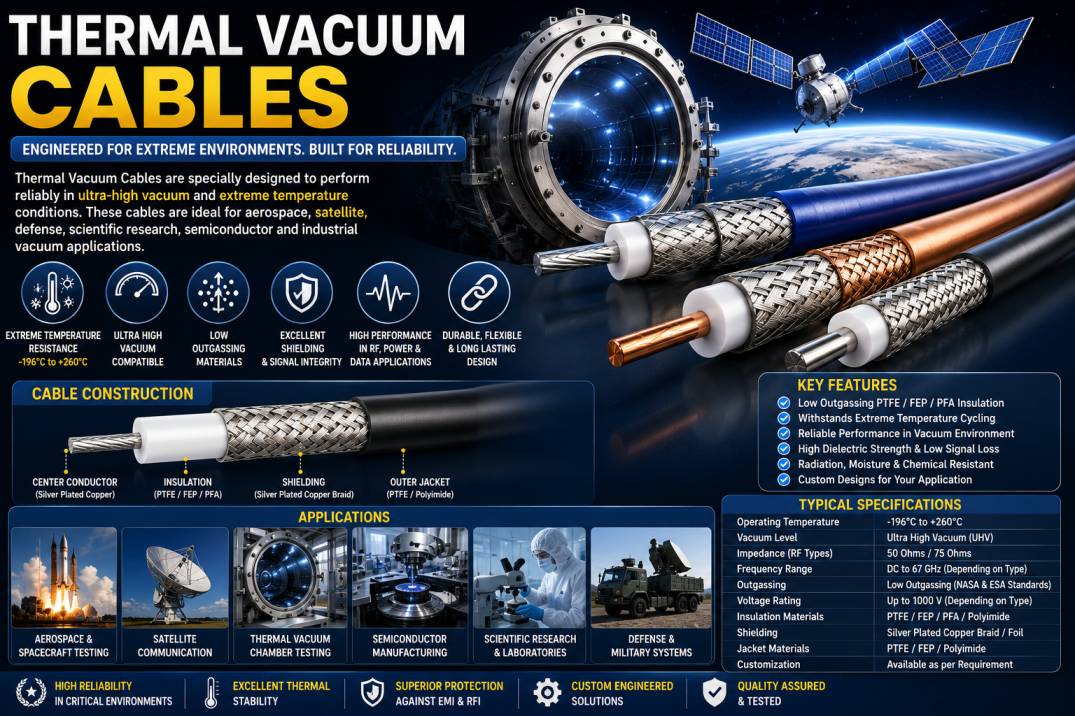
Thermal Vacuum (TVAC) Cables are specially engineered cables designed to operate reliably in extreme environmental conditions where conventional cables fail. These high-performance cables are manufactured to withstand ultra-high vacuum, severe temperature fluctuations, radiation exposure, and mechanical stress, making them essential for aerospace, satellite, defense, scientific research, semiconductor manufacturing, and space simulation applications.
In thermal vacuum chambers, equipment is tested under conditions that closely replicate the harsh environment of outer space. These tests expose cables to high temperatures, cryogenic cooling, vacuum pressure, and repeated thermal cycling. Standard electrical cables often experience insulation degradation, outgassing, cracking, and electrical failure under such conditions. Thermal Vacuum Cables eliminate these problems by using specialized materials with excellent thermal stability, low outgassing properties, and superior electrical insulation.
As space exploration, satellite communication, and advanced scientific research continue to expand, the demand for reliable Thermal Vacuum Cables is increasing rapidly. These cables play a critical role in maintaining uninterrupted power transmission, signal integrity, and data communication in some of the world’s most demanding environments.
This comprehensive guide explains everything you need to know about Thermal Vacuum Cables, including their construction, working principle, specifications, applications, advantages, and selection criteria.
What Are Thermal Vacuum Cables?
Thermal Vacuum Cables are specialized electrical or RF cables designed to operate inside thermal vacuum chambers and other extreme environments where pressure is extremely low and temperatures vary from cryogenic levels to several hundred degrees Celsius.
These cables are manufactured using low-outgassing insulation materials and precision conductors to ensure stable electrical performance during vacuum testing and long-term space missions.
Unlike conventional cables, Thermal Vacuum Cables are specifically engineered to minimize contamination inside vacuum chambers while maintaining reliable signal transmission and electrical continuity.
How Do Thermal Vacuum Cables Work?
Thermal Vacuum Cables function by transmitting electrical power, RF signals, or digital data while maintaining electrical stability under vacuum and thermal stress.
The cable construction minimizes outgassing, prevents insulation cracking, and maintains constant electrical characteristics despite repeated temperature cycling.
High-performance insulation materials resist thermal expansion and contraction, while precision conductors ensure minimal signal loss throughout the operating frequency range.
Because there is no air inside a vacuum chamber, these cables rely entirely on advanced material engineering rather than environmental cooling to maintain long-term performance.
Construction of Thermal Vacuum Cables
Center Conductor
The center conductor carries electrical current or RF signals.
Common conductor materials include:
- Silver-plated copper
- Nickel-plated copper
- Oxygen-free copper
- Copper alloy
These conductors provide excellent conductivity while resisting oxidation.
Insulation
The insulation separates conductors and provides electrical isolation.
Common insulation materials include:
- PTFE
- FEP
- PFA
- Polyimide
- ETFE
These materials exhibit extremely low outgassing and exceptional thermal stability.
Shielding
Many Thermal Vacuum Cables include braided or foil shielding to protect against electromagnetic interference.
Shield materials include:
- Silver-plated copper braid
- Nickel-plated copper braid
- Aluminum foil
- Stainless steel braid
Outer Jacket
The jacket protects the cable from mechanical damage and environmental exposure.
Typical materials include:
- PTFE
- FEP
- PFA
- Polyimide
- Silicone (selected applications)
Key Features of Thermal Vacuum Cables
- Low outgassing materials
- Excellent vacuum compatibility
- High temperature resistance
- Cryogenic temperature performance
- Superior dielectric strength
- Low signal attenuation
- High mechanical durability
- Excellent flexibility
- Radiation resistance
- Moisture resistance
- Chemical resistance
- Long operational life
Technical Specifications
| Specification | Typical Value |
| Operating Temperature | -196°C to +260°C |
| Vacuum Compatibility | Ultra High Vacuum (UHV) |
| Characteristic Impedance | 50 Ohms / 75 Ohms (RF Types) |
| Insulation Material | PTFE / FEP / PFA |
| Shielding | Single or Double Shield |
| Outgassing Standard | Low Outgassing Materials |
| Voltage Rating | Up to 1000 V (depending on design) |
| Frequency Range | DC to 67 GHz (RF versions) |
| Jacket Material | PTFE / Polyimide |
| Flexibility | High |
Types of Thermal Vacuum Cables
Several cable designs are available depending on application requirements.
RF Thermal Vacuum Cables
Designed for transmitting microwave and RF signals inside vacuum environments.
Power Thermal Vacuum Cables
Used for supplying electrical power to test equipment and spacecraft components.
Data Transmission Cables
Used for transmitting digital communication signals in vacuum chambers.
High Voltage Thermal Vacuum Cables
Designed for electrical systems operating at elevated voltages under vacuum conditions.
Multi-Core Thermal Vacuum Cables
Used when multiple power and signal circuits are required within a single cable assembly.
Applications of Thermal Vacuum Cables
Spacecraft Testing
Satellite subsystem testing
Payload qualification
Space hardware validation
Thermal cycling
Aerospace
Aircraft electronics
Avionics testing
Navigation systems
Communication modules
Satellite Communication
Ground testing
Satellite integration
RF communication systems
Space payload testing
Scientific Research
Particle accelerators
Vacuum laboratories
Cryogenic research
Material testing
Semiconductor Manufacturing
Vacuum processing
Wafer fabrication
Plasma chambers
Cleanroom equipment
Defense
Radar testing
Military electronics
Electronic warfare
Secure communication systems
Medical Equipment
Vacuum diagnostic systems
Medical imaging
Scientific instruments
Industrial Vacuum Systems
Vacuum furnaces
Coating equipment
Material processing
Research laboratories
Advantages of Thermal Vacuum Cables
- Reliable performance in vacuum
- Excellent temperature resistance
- Low outgassing
- High electrical reliability
- Superior insulation
- Long service life
- Excellent shielding
- High-frequency compatibility
- Resistant to radiation
- Suitable for harsh environments
- Low maintenance
- Stable mechanical properties
Limitations of Thermal Vacuum Cables
- Higher manufacturing cost
- Specialized installation requirements
- Limited availability compared to standard cables
- Requires compatible connectors
- Custom assemblies may increase lead time
How to Choose the Right Thermal Vacuum Cable
Selecting the correct Thermal Vacuum Cable requires evaluating several technical factors.
- Operating temperature range
- Vacuum level
- Voltage rating
- Frequency requirements
- Cable flexibility
- Shielding effectiveness
- Insulation material
- Connector compatibility
- Radiation exposure
- Mechanical stress
- Certification requirements
Thermal Vacuum Cable vs Standard Cable
| Feature | Thermal Vacuum Cable | Standard Cable |
| Vacuum Compatibility | Excellent | Not Suitable |
| Temperature Range | Very Wide | Moderate |
| Outgassing | Very Low | Higher |
| Radiation Resistance | High | Limited |
| Thermal Stability | Excellent | Moderate |
| Space Applications | Yes | No |
| RF Performance | Excellent | Standard |
| Service Life | Longer | Standard |
Industries Using Thermal Vacuum Cables
Thermal Vacuum Cables are widely used in:
- Aerospace
- Space Research
- Satellite Communication
- Defense
- Scientific Laboratories
- Semiconductor Manufacturing
- Medical Research
- Industrial Vacuum Systems
- RF Testing Laboratories
- Government Research Organizations
Maintenance Tips
Proper maintenance improves long-term cable reliability.
- Avoid sharp bending
- Keep connectors clean
- Inspect insulation regularly
- Prevent excessive mechanical stress
- Store in dry, dust-free environments
- Use approved vacuum-compatible connectors
- Follow recommended bend radius
Future Trends of Thermal Vacuum Cables
The increasing demand for satellite constellations, lunar exploration, Mars missions, reusable launch vehicles, quantum communication, semiconductor manufacturing, and advanced aerospace systems is driving innovation in Thermal Vacuum Cable technology. Manufacturers are developing cables with even lower outgassing characteristics, higher radiation resistance, lighter materials, improved flexibility, enhanced shielding, and operating temperatures exceeding current limits. These advancements will support the next generation of space exploration, scientific research, and high-performance vacuum systems.
Conclusion
Thermal Vacuum Cables are essential components for applications operating in extreme thermal and vacuum environments. Their advanced materials, low outgassing properties, exceptional temperature resistance, and reliable electrical performance make them indispensable for aerospace, satellite communication, scientific research, defense, and semiconductor industries. By selecting the appropriate cable based on temperature range, vacuum compatibility, electrical requirements, and environmental conditions, engineers can ensure dependable operation and long-term reliability in even the harshest testing and operational environments.
Frequently Asked Questions (FAQs)
1. What is a Thermal Vacuum Cable?
A Thermal Vacuum Cable is a specialized cable designed to operate reliably in ultra-high vacuum environments and extreme temperature conditions commonly found in aerospace and scientific applications.
2. Where are Thermal Vacuum Cables used?
They are used in spacecraft testing, satellite systems, aerospace, semiconductor manufacturing, scientific laboratories, medical research, defense, and vacuum chambers.
3. Why are low-outgassing materials important in Thermal Vacuum Cables?
Low-outgassing materials prevent contamination inside vacuum chambers and help maintain accurate testing conditions and reliable equipment performance.
4. What temperature range can Thermal Vacuum Cables withstand?
Depending on the construction, Thermal Vacuum Cables typically operate from -196°C to +260°C.
5. Which insulation materials are commonly used?
PTFE, FEP, PFA, ETFE, and Polyimide are commonly used because of their excellent thermal stability and low outgassing characteristics.
6. Can Thermal Vacuum Cables carry RF signals?
Yes. RF Thermal Vacuum Cables are specifically designed to transmit high-frequency signals with low attenuation and excellent shielding.
7. Are Thermal Vacuum Cables suitable for space applications?
Yes. They are widely used for spacecraft, satellite payloads, and thermal vacuum chamber testing because of their reliability under extreme conditions.
8. What industries commonly use Thermal Vacuum Cables?
Major industries include aerospace, defense, satellite communication, semiconductor manufacturing, scientific research, industrial vacuum systems, and medical equipment.
9. How do Thermal Vacuum Cables differ from standard cables?
They use specialized low-outgassing materials, withstand wider temperature ranges, perform reliably in vacuum environments, and offer greater resistance to radiation and thermal cycling.
10. How do I choose the right Thermal Vacuum Cable?
Select the cable based on operating temperature, vacuum compatibility, voltage rating, frequency range, shielding, insulation material, connector type, flexibility, and environmental requirements.