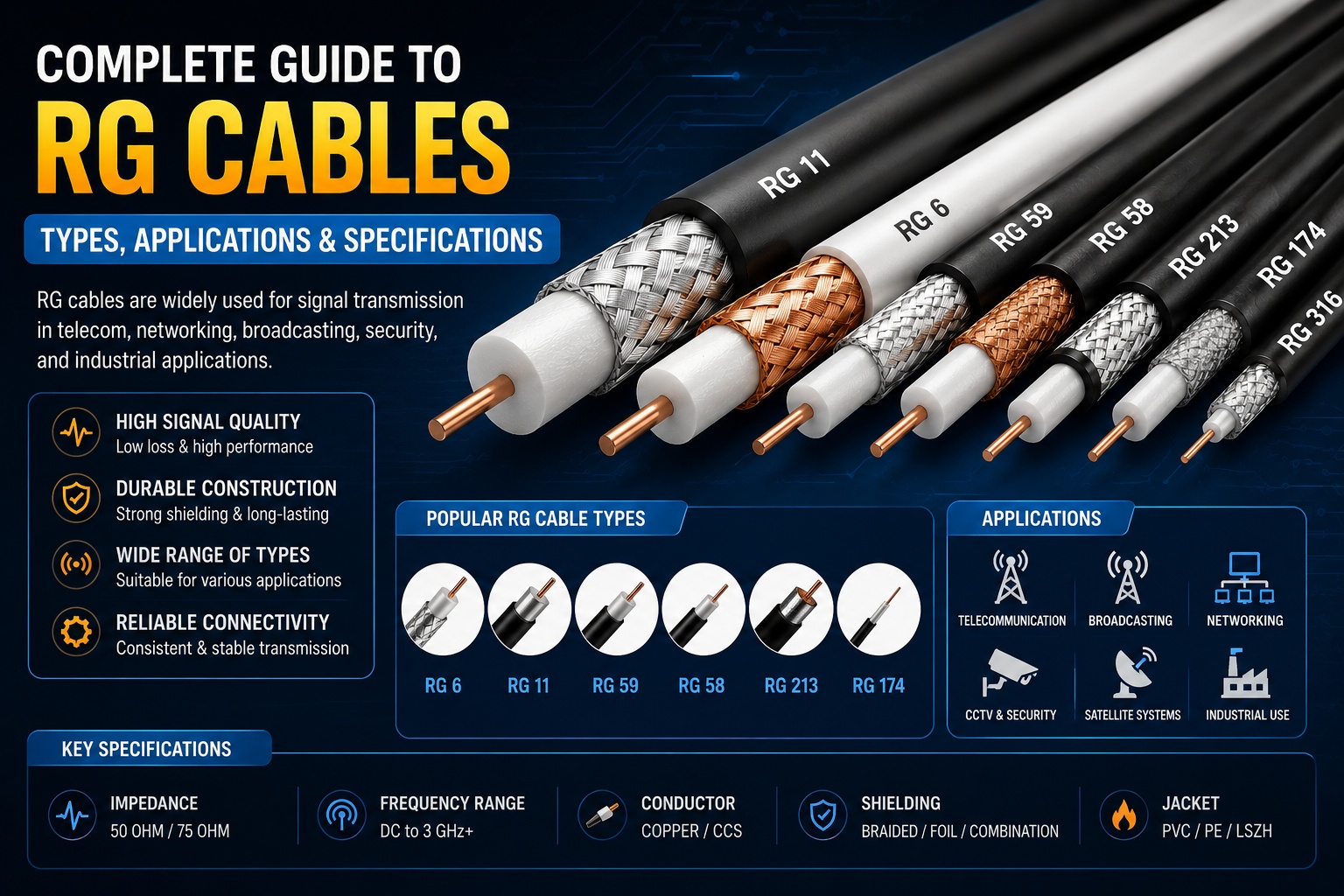
RG cables are among the most widely used coaxial cables in RF, telecom, broadcasting, networking, and wireless communication systems. Whether it is television broadcasting, Wi-Fi communication, CCTV systems, GPS devices, or telecom infrastructure, RG cables play a critical role in transmitting high-frequency signals with reliability and low signal loss.
The term “RG” stands for “Radio Guide,” a designation originally developed for military communication systems during World War II. Over time, RG cables became standard coaxial cables used across commercial, industrial, telecom, and residential applications. Today, different RG cable types such as RG58, RG59, RG6, RG174, RG213, and RG316 are widely used depending on impedance, shielding, frequency range, and application requirements.
This detailed guide explains everything about RG cables, including their construction, working principles, major types, technical specifications, advantages, and applications in modern RF and telecom systems.
What is an RG Cable?
An RG cable is a type of coaxial cable specifically designed for radio frequency (RF) signal transmission. It consists of a central conductor surrounded by dielectric insulation, metallic shielding, and an outer protective jacket. The coaxial structure helps minimize electromagnetic interference (EMI) while maintaining stable signal transmission over varying distances.
RG cables are commonly available in 50 Ohm and 75 Ohm impedance variants:
- 50 Ohm RG cables are mainly used in RF communication, telecom systems, wireless networking, antennas, and laboratory equipment.
- 75 Ohm RG cables are widely used in television broadcasting, CCTV systems, cable TV, satellite communication, and broadband networks.
Construction of RG Cable
An RG cable consists of several layers designed for efficient RF signal transmission and protection against interference.
1. Center Conductor
The central conductor carries the RF signal. It is generally made from:
- Solid copper
- Copper-clad steel (CCS)
- Stranded copper
Solid copper conductors provide better conductivity and lower signal loss.
2. Dielectric Insulation
A dielectric layer surrounds the conductor and maintains proper spacing between the conductor and shield. Common materials include:
- Polyethylene (PE)
- Foam PE
- PTFE
- FEP
This layer directly affects impedance and signal performance.
3. Metallic Shielding
Shielding protects the cable from EMI and RF interference. RG cables may use:
- Copper braid
- Aluminum foil
- Double shielding
- Quad shielding
Better shielding results in improved signal stability and reduced external interference.
4. Outer Jacket
The external jacket protects the cable against moisture, abrasion, UV exposure, and environmental damage. Common jacket materials include:
- PVC
- PE
- LSZH (Low Smoke Zero Halogen)
How RG Cable Works
RG cables transmit electrical signals through the center conductor while the outer shield acts as a return path and EMI barrier. The coaxial design ensures that signals remain confined within the cable structure, reducing signal leakage and maintaining high-frequency performance.
This structure allows RG cables to support:
- RF communication
- Broadband transmission
- Satellite signals
- Wireless networking
- Microwave frequencies
- High-speed data communication
Common Types of RG Cables
Different RG cable types are designed for different applications. Each cable differs in impedance, shielding, attenuation, flexibility, and frequency handling capability.
RG58 Cable
RG58 is one of the most popular 50 Ohm RF coaxial cables used in wireless communication and networking systems.
Features of RG58 Cable
- 50 Ohm impedance
- Flexible construction
- Moderate signal attenuation
- Suitable for short RF connections
- Compatible with BNC and SMA connectors
Applications of RG58 Cable
- RF communication systems
- Wireless antennas
- Ham radio systems
- Laboratory equipment
- WLAN systems
- CCTV applications
RG58 was previously used in Ethernet networking systems such as 10BASE2.
RG59 Cable
RG59 is a 75 Ohm coaxial cable mainly used for low-frequency video transmission applications.
Features of RG59 Cable
- 75 Ohm impedance
- Flexible and cost-effective
- Suitable for short-distance transmission
- Lower shielding than RG6
Applications of RG59 Cable
- Analog CCTV systems
- Video transmission
- Low-frequency RF systems
- Composite video signals
Although RG59 is still widely used, RG6 has largely replaced it in high-bandwidth applications because of better shielding and lower attenuation.
RG6 Cable
RG6 is one of the most widely used 75 Ohm coaxial cables for television, broadband, and satellite communication systems.
Features of RG6 Cable
- Excellent shielding performance
- Low attenuation
- Better bandwidth handling
- Thicker insulation than RG59
- Available in quad shield variants
Applications of RG6 Cable
- Cable TV systems
- Satellite communication
- Broadband internet
- HDTV installations
- Video distribution networks
RG6 provides lower signal loss compared to RG59, especially at higher frequencies.
RG174 Cable
RG174 is a miniature RF coaxial cable designed for compact electronic systems.
Features of RG174 Cable
- Small diameter
- High flexibility
- Lightweight design
- Suitable for compact devices
Applications of RG174 Cable
- GPS systems
- Wi-Fi modules
- Embedded systems
- RF adapters
- Internal antenna connections
RG174 is commonly used in applications where space is limited.
RG213 Cable
Features of RG213 Cable
RG213 is a heavy-duty 50 Ohm coaxial cable designed for high-power RF transmission.
- Thick conductor
- Low attenuation
- High power handling
- Excellent shielding
- Suitable for outdoor installations
Applications of RG213 Cable
- Telecom towers
- Base station antennas
- Amateur radio systems
- RF transmission systems
- Outdoor communication systems
RG213 offers superior durability and long-distance RF performance.
RG316 Cable
RG316 is a high-frequency miniature coaxial cable with PTFE insulation and silver-plated conductors.
Features of RG316 Cable
- High temperature resistance
- Compact size
- Excellent flexibility
- Stable high-frequency performance
Applications of RG316 Cable
- Aerospace systems
- GPS devices
- RF modules
- Military communication
- Microwave systems
RG316 is commonly used in high-frequency and compact RF assemblies.
Technical Specifications of RG Cables
| Cable Type | Impedance | Frequency Capability | Major Application |
|---|---|---|---|
| RG58 | 50 Ohm | Moderate RF Frequency | Wireless Communication |
| RG59 | 75 Ohm | Low to Medium Frequency | CCTV & Video |
| RG6 | 75 Ohm | High Frequency | TV & Broadband |
| RG174 | 50 Ohm | RF Applications | Compact Devices |
| RG213 | 50 Ohm | High Power RF | Telecom Systems |
| RG316 | 50 Ohm | High Frequency | Aerospace & RF Modules |
Advantages of RG Cables
Excellent Signal Shielding
RG cables are designed with metallic shielding that protects against electromagnetic interference and signal leakage.
Stable RF Performance
These cables provide consistent RF signal transmission across different frequency ranges.
Wide Frequency Support
RG cables support low-frequency video transmission as well as GHz-level RF applications.
Flexible Installation
Many RG cable types offer flexible construction for easy routing and installation.
Durable Construction
High-quality RG cables provide long operational life even in harsh environmental conditions.
Applications of RG Cables
RG cables are used across numerous industries and communication systems.
Telecom Industry
Used in:
- BTS systems
- RF antennas
- DAS networks
- Telecom towers
- 4G/5G infrastructure
Broadcasting Systems
RG cables are widely used for:
- Television broadcasting
- Cable TV
- Satellite systems
- HDTV distribution
Wireless Communication
Used in:
- Wi-Fi systems
- RF communication
- Wireless routers
- IoT devices
CCTV & Security Systems
RG59 and RG6 cables are commonly used for:
- Analog CCTV
- Video surveillance
- Security camera systems
Industrial Applications
Used in:
- RF testing equipment
- Microwave systems
- Aerospace communication
- Embedded RF systems
Difference Between RG58 and RG6
| Parameter | RG58 | RG6 |
|---|---|---|
| Impedance | 50 Ohm | 75 Ohm |
| Primary Use | RF Communication | TV & Broadband |
| Frequency Handling | Moderate | High |
| Shielding | Standard | Better Shielding |
| Signal Loss | Higher | Lower |
| Flexibility | High | Moderate |
RG58 is commonly used for RF communication systems, while RG6 is preferred for television and broadband applications.
Important Factors While Choosing RG Cable
Impedance Matching
Selecting the correct impedance is critical for minimizing signal reflection and maintaining performance.
Frequency Range
Choose a cable suitable for the required operating frequency.
Signal Attenuation
Lower attenuation cables are preferred for long-distance transmission.
Shielding Quality
Better shielding improves EMI protection and signal stability.
Environmental Conditions
Outdoor installations require UV-resistant and weatherproof cable jackets.
Connector Compatibility
Ensure compatibility with connectors such as:
- SMA
- BNC
- N Type
- F Type
- TNC
RG Cable vs LMR Cable
RG cables and LMR cables are both used for RF transmission, but they differ in performance and applications.
| Parameter | RG Cable | LMR Cable |
|---|---|---|
| Signal Loss | Moderate | Very Low |
| Flexibility | Good | Moderate |
| Cost | Economical | Higher |
| RF Efficiency | Standard | Superior |
| Application | General RF Use | High-Performance RF |
LMR cables are preferred for long-distance telecom installations because of their lower attenuation.
Future of RG Cables in RF & Telecom Industry
Despite the emergence of advanced low-loss RF cables, RG cables continue to play an important role in telecom and communication systems. Their affordability, flexibility, and wide compatibility make them suitable for:
- IoT applications
- RF testing
- Consumer electronics
- CCTV systems
- Broadband installations
- Wireless communication
As telecom infrastructure continues expanding globally, RG cables remain essential components in RF connectivity solutions.
Conclusion
RG cables are among the most versatile and widely used coaxial cables in modern communication systems. From television broadcasting and broadband internet to wireless networking, telecom infrastructure, and RF communication, these cables provide reliable signal transmission across countless applications.
Understanding the differences between RG cable types such as RG58, RG59, RG6, RG174, RG213, and RG316 helps in selecting the right cable for specific RF and telecom requirements. Factors such as impedance, shielding, attenuation, flexibility, and frequency compatibility must always be considered before cable selection.
Whether for telecom towers, CCTV systems, Wi-Fi networks, or RF antennas, high-quality RG cables ensure stable connectivity, minimal signal loss, and long-term performance in demanding communication environments.