
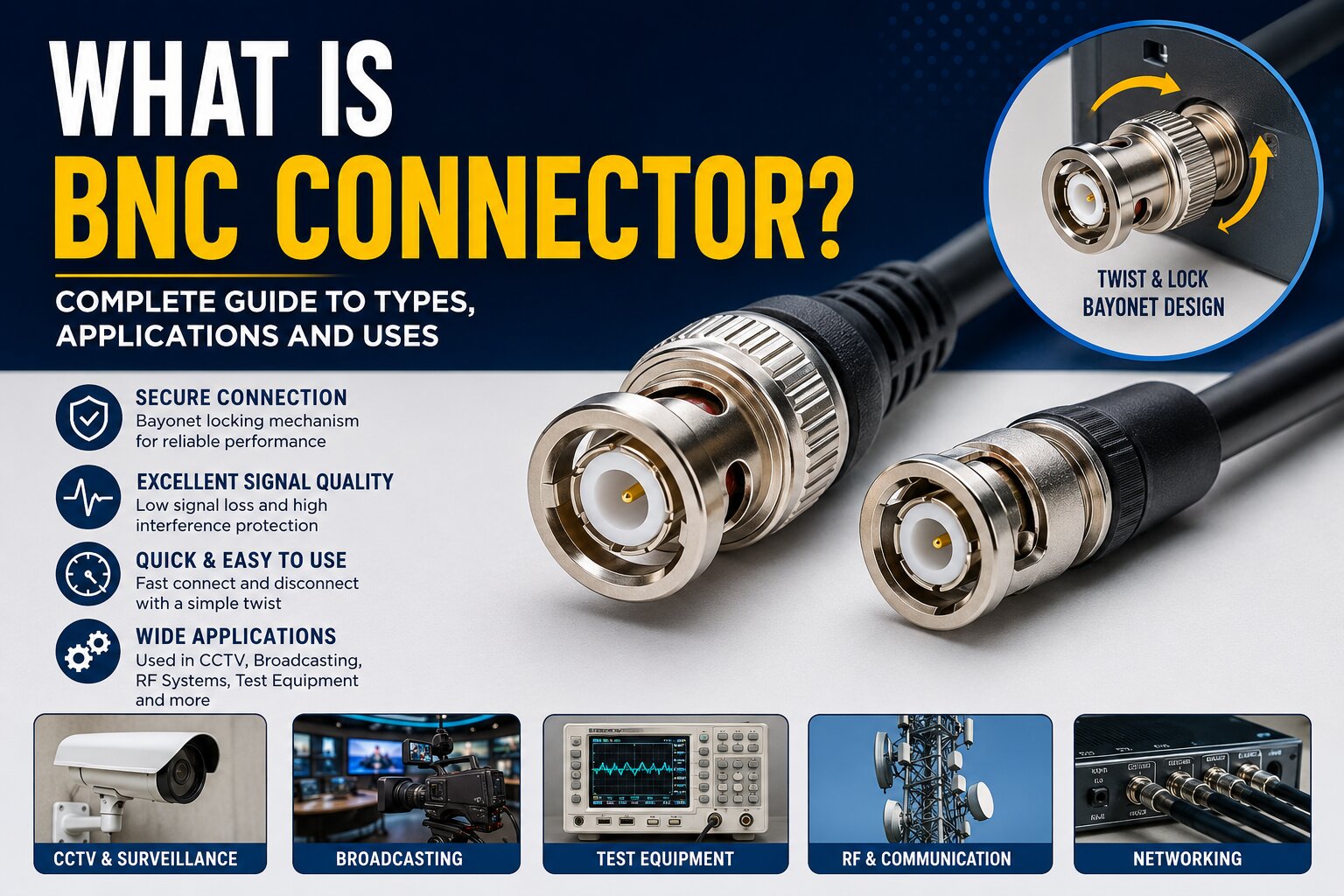
A BNC connector is a widely used radio frequency connector designed for coaxial cable connections in communication, broadcasting, CCTV, and electronic equipment. It is known for its secure locking mechanism, stable signal transmission, and easy installation process.
The term BNC stands for Bayonet Neill–Concelman, named after its inventors. The connector uses a bayonet-style coupling system that allows quick connection and disconnection with a simple twist-lock action.
BNC connectors are commonly used in RF systems, video transmission equipment, laboratory instruments, antennas, and surveillance systems because of their excellent shielding and reliable performance.
Today, BNC connectors remain one of the most trusted solutions for transmitting radio frequency and video signals in professional and industrial applications.
What is a BNC Connector?
A BNC connector is a miniature quick-connect RF connector specially designed for coaxial cables. It is used to transmit analog and digital signals while minimizing signal loss and electromagnetic interference.
The connector consists of:
- A center conductor for signal transmission
- An outer shield for grounding
- A dielectric insulator
- A bayonet locking mechanism
BNC connectors are mainly available in 50-ohm and 75-ohm impedance versions depending on the intended application.
Full Form of BNC Connector
The full form of BNC is:
Bayonet Neill–Concelman
- Bayonet refers to the locking mechanism
- Neill refers to Paul Neill
- Concelman refers to Carl Concelman
The connector was developed to provide a secure and efficient RF connection for communication systems.
How Does a BNC Connector Work?
A BNC connector works by creating a secure electrical connection between coaxial cables and electronic devices.
The center pin transfers the signal while the outer metal shield protects against electromagnetic interference. The bayonet coupling locks the connector firmly into place with a quarter-turn motion.
This design offers:
- Fast connection and disconnection
- Stable RF performance
- Strong mechanical reliability
- Reduced signal leakage
Because of these advantages, BNC connectors are widely used in systems requiring accurate signal transmission.
Main Components of a BNC Connector
A BNC connector contains several important parts that help maintain signal integrity and mechanical stability.
Center Pin
The center pin carries the RF or video signal. It is often gold-plated to improve conductivity and corrosion resistance.
Dielectric Insulator
The insulator separates the center conductor from the outer body while maintaining proper impedance.
Outer Shell
The metal outer shell provides shielding and grounding protection.
Bayonet Locking Ring
This mechanism allows the connector to lock securely with a quick twist.
Cable Crimp Section
This section attaches the coaxial cable to the connector body.
Types of BNC Connectors
BNC connectors are available in different configurations for specific applications.
BNC Male Connector
The male connector includes a center pin and locking mechanism.
Common Uses
- CCTV systems
- RF communication
- Video equipment
BNC Female Connector
The female connector accepts the male pin and is commonly mounted on devices and panels.
50 Ohm BNC Connector
This type is mainly used for radio frequency and data communication applications.
Applications
- RF systems
- Wireless communication
- Antennas
75 Ohm BNC Connector
The 75-ohm connector is designed for video signal transmission.
Applications
- CCTV cameras
- Broadcasting
- HD video systems
BNC T Connector
A T connector splits or combines signal paths.
Uses
- Video distribution
- Networking systems
Right Angle BNC Connector
These connectors help in installations where space is limited.
BNC Bulkhead Connector
Bulkhead connectors are designed for panel mounting applications.
Applications of BNC Connectors
BNC connectors are used across multiple industries because of their dependable signal transmission capabilities.
CCTV and Surveillance Systems
BNC connectors are commonly used in analog CCTV camera systems.
Benefits
- Secure video connection
- Low signal loss
- Easy installation
Broadcasting Industry
Broadcast equipment uses BNC connectors for professional video transmission.
Applications
- Studio cameras
- Video routers
- SDI systems
RF Communication Systems
BNC connectors support radio frequency transmission in communication devices.
Examples
- Antennas
- RF analyzers
- Wireless systems
Laboratory Equipment
Many test and measurement devices use BNC interfaces.
Equipment
- Oscilloscopes
- Signal generators
- Frequency analyzers
Aerospace and Defense
Military-grade BNC connectors are used in high-reliability communication systems.
Advantages of BNC Connectors
BNC connectors offer several advantages over traditional connector systems.
Quick Locking System
The bayonet mechanism enables fast connection and removal.
Excellent Signal Quality
BNC connectors minimize signal loss and interference.
Strong Shielding
The outer metal shell protects signals from EMI and RFI.
Reliable Performance
The secure connection prevents accidental cable disconnection.
Compact Design
Their small size allows efficient use in electronic devices.
Durable Construction
BNC connectors are built for long operational life in demanding environments.
BNC Connector Cable Types
Different coaxial cables are compatible with BNC connectors.
RG58 Cable
Used mainly with 50-ohm BNC connectors for RF applications.
RG59 Cable
Commonly used in CCTV and video systems.
RG6 Cable
Provides lower attenuation for high-frequency video transmission.
Technical Specifications of BNC Connectors
BNC connector specifications vary depending on application and design.
Impedance
- 50 ohm
- 75 ohm
Frequency Range
Most BNC connectors support frequencies up to 4 GHz.
Voltage Rating
Depends on connector design and insulation quality.
Operating Temperature
Industrial BNC connectors can withstand extreme temperatures.
Installation Methods of BNC Connectors
There are different installation methods based on application requirements.
Crimp Type BNC Connector
Installed using a crimping tool for secure cable attachment.
Compression Type BNC Connector
Provides stronger weatherproof sealing for outdoor applications.
Solder Type BNC Connector
Uses soldering for highly secure electrical connections.
Difference Between 50 Ohm and 75 Ohm BNC Connectors
Understanding impedance differences is important for proper signal transmission.
50 Ohm BNC Connector
Features
- Better power handling
- Suitable for RF systems
- Common in communication equipment
75 Ohm BNC Connector
Features
- Lower signal attenuation
- Ideal for video transmission
- Common in broadcasting systems
Common Uses of BNC Connectors
BNC connectors are used in numerous systems and industries.
Video Transmission
Professional video systems use BNC connectors for stable signal transfer.
Radio Frequency Applications
RF communication equipment relies on BNC connectivity.
Test Equipment
Electronic laboratories use BNC connectors in measurement instruments.
Security Systems
CCTV surveillance systems commonly use BNC cable assemblies.
Common Problems with BNC Connectors
Improper installation can lead to performance issues.
Loose Connection
Low-quality connectors may disconnect over time.
Signal Reflection
Impedance mismatch can cause signal distortion.
Corrosion
Outdoor installations may suffer from moisture damage.
Cable Damage
Excessive bending can weaken coaxial cables.
Tips for Selecting the Right BNC Connector
Choosing the correct connector improves system reliability.
Match Cable Type
Ensure compatibility with RG58, RG59, or RG6 cables.
Check Impedance
Use 50 ohm or 75 ohm connectors based on application requirements.
Consider Frequency Range
Higher-frequency systems require precision connectors.
Evaluate Environmental Conditions
Outdoor installations may need weatherproof designs.
BNC Connector vs Other RF Connectors
BNC connectors differ from other RF connector types.
BNC vs SMA Connector
BNC Connector
- Faster connection
- Easy handling
- Moderate frequency range
SMA Connector
- Threaded locking
- Higher frequency capability
- Smaller size
BNC vs RCA Connector
BNC Connector
- Better shielding
- Professional-grade locking
- Improved signal integrity
RCA Connector
- Consumer electronics use
- Simple push-fit design
Future of BNC Connectors
BNC connectors continue to evolve with modern communication technologies.
Recent advancements include:
- High-frequency precision BNC connectors
- Enhanced shielding performance
- Miniature connector designs
- Improved corrosion resistance
Despite newer technologies, BNC connectors remain essential in surveillance, broadcasting, RF communication, and industrial electronics.
Conclusion
A BNC connector is an important RF connector used for secure and reliable signal transmission in video, communication, and electronic systems. Its bayonet locking design, strong shielding capability, and low signal loss make it ideal for professional applications.
From CCTV systems and broadcasting equipment to RF communication and laboratory instruments, BNC connectors continue to provide dependable performance across industries. Understanding their types, applications, specifications, and installation methods helps in selecting the right connector for any project.
As technology advances, BNC connectors remain a trusted solution for stable coaxial cable connectivity and high-quality signal transmission.