
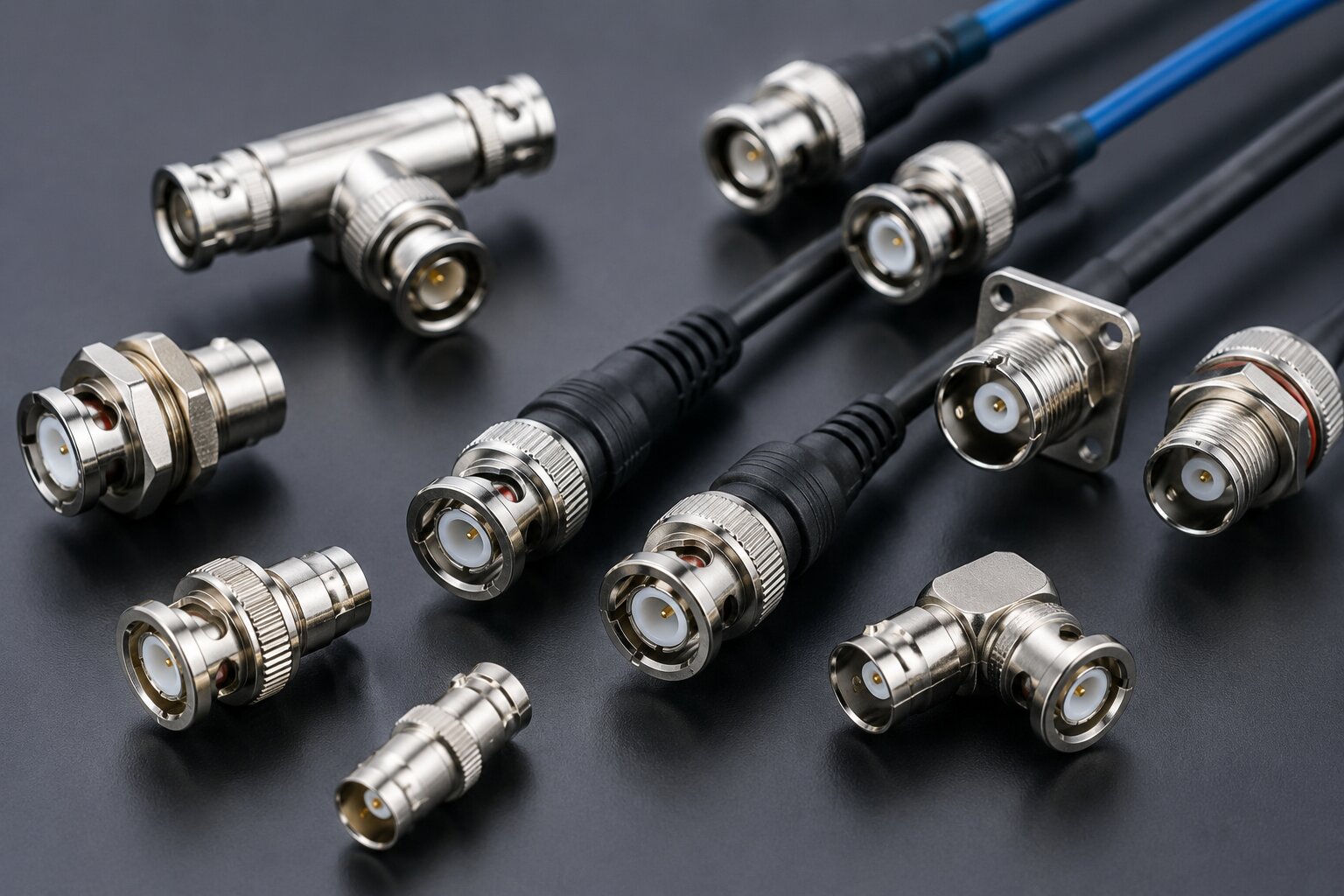
The BNC connector is one of the most widely used RF connectors in the electronics, telecommunications, broadcasting, and surveillance industries. Known for its reliable locking mechanism and excellent signal transmission capabilities, the BNC connector is commonly used for radio frequency applications up to several gigahertz.
BNC stands for Bayonet Neill–Concelman, named after its inventors Paul Neill and Carl Concelman. The connector was developed for quick connect and disconnect functionality while maintaining stable electrical performance. Its bayonet-style locking system allows secure connections with a simple quarter-turn motion, making it highly practical in professional installations.
Today, BNC connectors are extensively used in CCTV systems, RF communication equipment, laboratory instruments, video transmission devices, military systems, and broadcasting applications. Their durability, low signal loss, and easy installation make them an industry-standard solution for coaxial cable connectivity.
This complete guide explains everything about BNC connectors, including their types, working principles, applications, advantages, specifications, and selection criteria.
What is a BNC Connector?
A BNC connector is a miniature quick-connect RF connector designed for coaxial cables. It is primarily used for transmitting radio frequency signals in low-voltage applications.
The connector features:
- A center pin for signal transmission
- An outer metal shell for grounding and shielding
- A bayonet locking mechanism for secure attachment
- Compatibility with several coaxial cable types
BNC connectors are commonly available in both male and female configurations and support impedance values of 50 ohm and 75 ohm depending on the application.
Working Principle of BNC Connector
The BNC connector works by maintaining a continuous shielded connection between coaxial cables and electronic equipment. The center conductor carries the signal, while the outer conductor acts as grounding and electromagnetic shielding.
The bayonet locking system ensures:
- Fast installation
- Strong mechanical stability
- Reduced accidental disconnection
- Reliable signal integrity
When inserted and twisted, the connector locks into place securely, minimizing signal interruption and maintaining consistent RF performance.
Main Components of a BNC Connector
Understanding the structure of a BNC connector helps in selecting the correct type for various applications.
Center Pin
The center pin carries the electrical signal. It is usually gold-plated to improve conductivity and reduce corrosion.
Dielectric Insulator
This component separates the center conductor from the outer shell and maintains impedance consistency.
Outer Shield
The outer metal body provides grounding and protects signals from electromagnetic interference.
Bayonet Coupling Mechanism
The bayonet coupling system allows quick locking through a push-and-twist motion.
Cable Attachment Section
This section connects the coaxial cable to the connector through crimping, soldering, or compression methods.
Types of BNC Connectors
BNC connectors are available in multiple types depending on cable configuration, impedance, mounting style, and application requirements.
BNC Male Connector
The BNC male connector contains a center pin and rotating locking ring. It connects to female BNC ports on devices and cables.
Features
- Secure bayonet locking
- Quick installation
- High-frequency performance
- Commonly used in RF systems
Applications
- CCTV cameras
- Oscilloscopes
- RF communication systems
- Test instruments
BNC Female Connector
The BNC female connector contains receptacles for accepting male connectors. It is usually mounted on equipment panels or adapter assemblies.
Applications
- Video equipment
- Networking devices
- Monitoring systems
- Laboratory devices
50 Ohm BNC Connector
The 50-ohm BNC connector is optimized for radio frequency signal transmission and data communication applications.
Common Uses
- RF transmitters
- Wireless communication
- Radio systems
- Antenna connections
Advantages
- Better power handling
- Low signal reflection
- Excellent RF performance
75 Ohm BNC Connector
The 75-ohm version is mainly used for video signal transmission where minimal signal loss is critical.
Common Applications
- HD video systems
- Broadcasting
- CCTV installations
- Television production
BNC T Connector
A BNC T connector allows branching of signals into multiple directions.
Uses
- Ethernet networking
- CCTV distribution
- Signal splitting applications
BNC Bulkhead Connector
Bulkhead BNC connectors are designed for panel mounting and provide secure cable routing through enclosures.
Benefits
- Strong mechanical support
- Professional installation
- Improved cable management
Right Angle BNC Connector
These connectors are used where installation space is limited.
Applications
- Compact devices
- Rack-mounted equipment
- Tight cable routing systems
BNC Adapter
BNC adapters connect different connector interfaces or gender types.
Common Adapter Types
- BNC to SMA
- BNC to RCA
- BNC male to female
- Twin BNC adapter
BNC Connector Cable Types
Different coaxial cables are compatible with BNC connectors depending on frequency and application.
RG58 Cable
RG58 is commonly used with 50-ohm BNC connectors in RF communication systems.
Characteristics
- Flexible cable
- Good RF performance
- Suitable for medium-frequency applications
RG59 Cable
RG59 is primarily used for 75-ohm video applications.
Common Uses
- CCTV systems
- Video surveillance
- Broadcast video transmission
RG6 Cable
RG6 offers lower attenuation and better shielding than RG59.
Applications
- HDTV systems
- Satellite communication
- High-frequency video transmission
Applications of BNC Connectors
BNC connectors are widely used across numerous industries due to their dependable RF performance.
CCTV and Surveillance Systems
BNC connectors are highly popular in CCTV camera installations.
Reasons for Use
- Reliable video transmission
- Easy installation
- Strong mechanical locking
- Long cable support
Analog CCTV systems commonly use BNC connectors with RG59 coaxial cable.
Broadcasting Industry
Television studios and broadcasting facilities rely heavily on BNC connectors for video signal transmission.
Applications
- SDI video systems
- HD broadcasting
- Video routers
- Camera systems
RF Communication Systems
BNC connectors are used extensively in radio communication equipment.
Examples
- Ham radios
- Antennas
- Wireless systems
- RF analyzers
Laboratory and Test Equipment
Electronic test instruments commonly use BNC interfaces for signal connectivity.
Equipment Examples
- Oscilloscopes
- Signal generators
- Spectrum analyzers
- Frequency counters
Aerospace and Defense
Military and aerospace systems use high-quality BNC connectors for secure signal transmission.
Benefits
- Rugged construction
- High reliability
- Stable RF performance
- Resistance to vibration
Medical Equipment
Medical imaging and diagnostic devices use BNC connectors for accurate signal handling.
Applications
- Monitoring systems
- Imaging devices
- Diagnostic instruments
Advantages of BNC Connectors
BNC connectors remain popular because of their numerous technical and operational advantages.
Quick Connection Mechanism
The bayonet locking system allows rapid installation and removal without tools.
Excellent Signal Integrity
BNC connectors provide low signal loss and minimal interference.
Strong Mechanical Stability
The locking system prevents accidental disconnection in critical applications.
Compact Design
Their compact size allows efficient use in high-density equipment panels.
Wide Compatibility
BNC connectors support multiple cable types and adapter configurations.
Durable Construction
Most BNC connectors are made from nickel-plated brass or stainless steel for long operational life.
Technical Specifications of BNC Connectors
The technical specifications of BNC connectors vary based on type and application.
Impedance
- 50 ohm
- 75 ohm
Frequency Range
Standard BNC connectors support frequencies up to 4 GHz, while precision versions may handle higher frequencies.
Voltage Rating
Voltage handling depends on connector design and insulation materials.
Operating Temperature
Most industrial BNC connectors operate between -55°C and +155°C.
Contact Resistance
Low contact resistance ensures efficient signal transmission.
Shielding Effectiveness
High-quality BNC connectors provide excellent EMI and RFI shielding.
BNC Connector Installation Methods
Different installation methods are used depending on application requirements.
Crimp Type BNC Connector
Crimp connectors use a crimping tool for cable attachment.
Advantages
- Fast installation
- Reliable connection
- Professional finish
Compression BNC Connector
Compression connectors provide excellent weather resistance and cable retention.
Applications
- Outdoor CCTV
- Broadcast systems
- Harsh environments
Solder Type BNC Connector
These connectors require soldering of the center conductor.
Benefits
- Strong electrical connection
- Durable performance
How to Choose the Right BNC Connector
Selecting the correct BNC connector is essential for maintaining signal quality and system reliability.
Determine Impedance
Choose 50 ohm or 75 ohm connectors based on application requirements.
Select Compatible Cable Type
Ensure the connector matches the coaxial cable dimensions and impedance.
Consider Frequency Requirements
Higher frequency applications require precision connectors with better shielding.
Evaluate Environmental Conditions
Outdoor or industrial installations may require weatherproof connectors.
Check Mounting Requirements
Select panel mount, bulkhead, or cable mount versions depending on installation needs.
Common Problems with BNC Connectors
Improper installation or poor-quality connectors can lead to performance issues.
Signal Loss
Caused by poor crimping, damaged cables, or impedance mismatch.
Loose Connection
Low-quality connectors may loosen over time, causing intermittent signals.
Corrosion
Outdoor installations may experience corrosion without proper protection.
EMI Interference
Poor shielding can introduce electromagnetic interference.
Maintenance Tips for BNC Connectors
Proper maintenance improves connector lifespan and system performance.
Keep Connectors Clean
Dust and dirt can affect signal quality.
Avoid Excessive Bending
Sharp cable bends can damage coaxial cables and connectors.
Use Protective Caps
Protect unused connectors from moisture and contaminants.
Inspect Connections Regularly
Routine inspections help detect loose or damaged connectors early.
Difference Between BNC and Other RF Connectors
Several RF connectors are available in the market, but BNC connectors remain unique for specific applications.
BNC vs SMA Connector
BNC Connector
- Quick bayonet locking
- Easier installation
- Lower frequency range
SMA Connector
- Threaded coupling
- Higher frequency support
- Smaller size
BNC vs TNC Connector
BNC Connector
- Faster connection
- Common in video applications
TNC Connector
- Threaded locking
- Better vibration resistance
- Improved microwave performance
BNC vs RCA Connector
BNC Connector
- Professional-grade locking
- Better shielding
- RF compatibility
RCA Connector
- Consumer electronics use
- Push-fit connection
- Lower shielding performance
Future of BNC Connectors
Although newer connector technologies are emerging, BNC connectors continue to remain highly relevant across industries.
Modern advancements include:
- High-frequency precision BNC connectors
- Miniature BNC designs
- Improved shielding technologies
- Enhanced corrosion resistance
- HD video transmission compatibility
The continued growth of surveillance systems, broadcasting infrastructure, and RF communication ensures ongoing demand for BNC connectors.
Conclusion
BNC connectors play a critical role in RF communication, video transmission, broadcasting, surveillance, and laboratory systems. Their secure bayonet locking design, strong shielding capability, and reliable signal transmission make them one of the most trusted connector solutions in the electronics industry.
From CCTV installations and broadcasting equipment to RF communication systems and medical devices, BNC connectors deliver stable performance across a wide range of applications. Understanding the various connector types, cable compatibility, installation methods, and technical specifications helps in selecting the right connector for specific requirements.
As communication and video technologies continue to evolve, BNC connectors remain an essential component for dependable coaxial connectivity and professional-grade signal transmission.