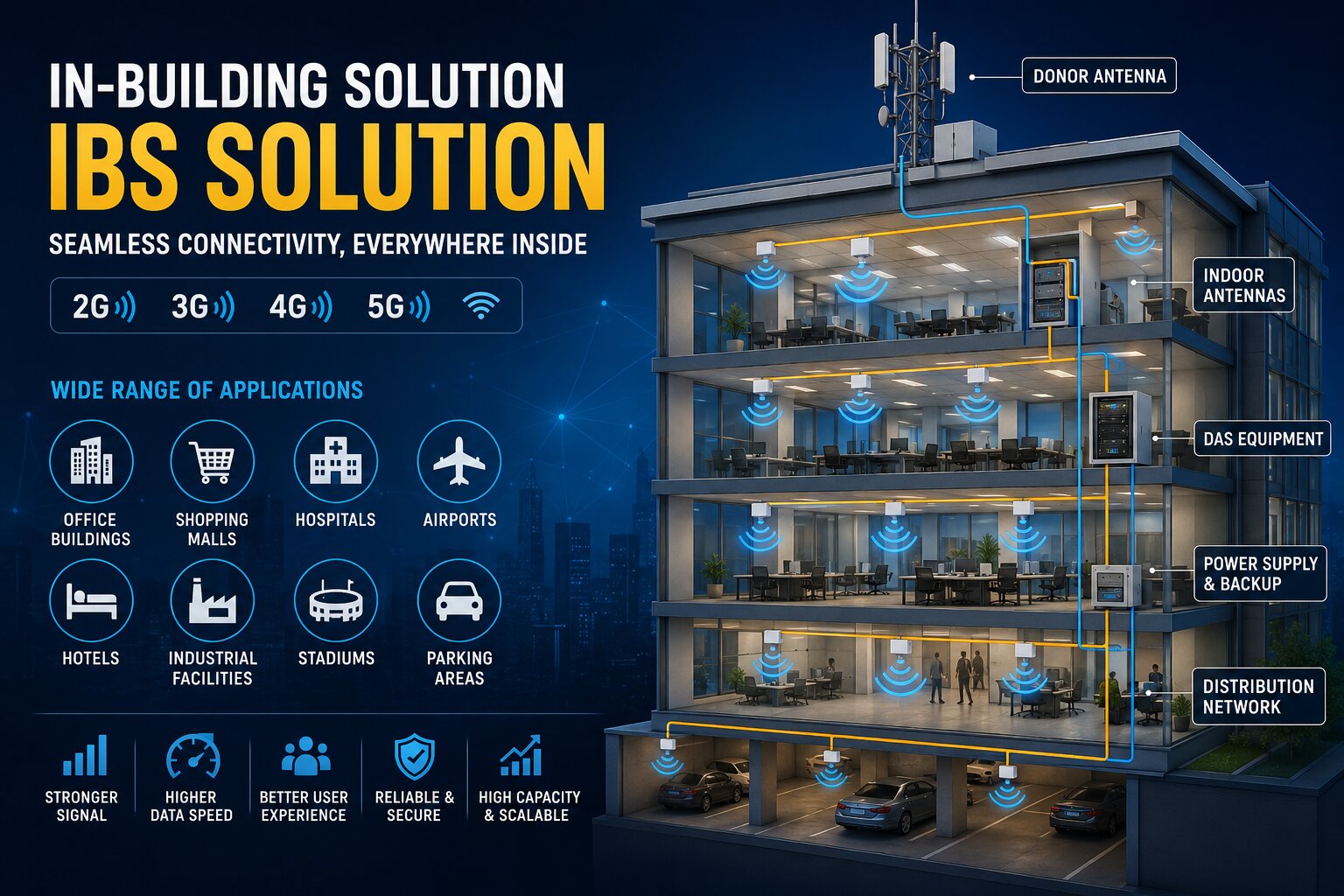
Modern communication networks are expected to provide seamless mobile connectivity everywhere, including inside commercial buildings, shopping malls, hospitals, airports, hotels, offices, factories, and underground parking areas. However, traditional outdoor cellular towers often fail to deliver strong indoor coverage because building materials such as concrete, steel, glass, and metal structures weaken mobile signals.
To overcome these coverage challenges, In-Building Solutions (IBS) are deployed. An In-Building Solution is a specialized telecommunication system designed to improve mobile network coverage and capacity inside buildings and enclosed areas.
IBS solutions are widely used by telecom operators, enterprises, smart buildings, industrial facilities, airports, hospitals, and large commercial complexes to provide reliable voice and data communication for 2G, 3G, 4G LTE, and 5G networks.
As businesses and consumers increasingly depend on high-speed mobile connectivity, IBS systems have become an essential part of modern building infrastructure.
Introduction to In-Building Solution (IBS)
An In-Building Solution is a distributed telecom network installed inside buildings to ensure strong indoor wireless communication coverage. IBS systems distribute cellular signals throughout the building using antennas, cables, repeaters, and signal distribution equipment.
The primary purpose of an IBS system is to eliminate indoor network issues such as:
- Weak signal strength
- Call drops
- Slow internet speed
- Network congestion
- Poor voice quality
- Dead zones inside buildings
IBS systems support multiple wireless technologies, including:
- GSM
- CDMA
- 3G
- 4G LTE
- 5G
- Wi-Fi
- Public safety communication systems
In large buildings, more than 70% of mobile data usage occurs indoors. Therefore, indoor connectivity has become critical for businesses, customers, and telecom operators.
Why In-Building Solutions Are Important
Modern buildings are constructed using materials that significantly reduce cellular signal penetration. Energy-efficient glass, reinforced concrete, aluminum structures, and thick walls often block outdoor mobile signals.
Additionally, high user density inside buildings creates network congestion. Thousands of people simultaneously using mobile devices can overload nearby outdoor cellular towers.
IBS solutions help solve these problems by delivering dedicated indoor wireless coverage and capacity.
Key reasons why IBS solutions are important include:
- Reliable indoor mobile coverage
- Faster internet speed
- Better voice quality
- Improved user experience
- Support for high user density
- Seamless 4G and 5G connectivity
- Enhanced emergency communication
- Increased business productivity
Industries such as healthcare, aviation, hospitality, retail, manufacturing, and smart infrastructure rely heavily on uninterrupted indoor communication systems.
How an IBS Solution Works
An In-Building Solution captures cellular signals from a telecom network and distributes them efficiently throughout the building.
The basic working process includes:
- Signal source receives network signals
- Signals are amplified or processed
- Distribution network carries signals throughout the building
- Indoor antennas radiate signals in different areas
- Mobile devices connect to the indoor network
The IBS system ensures consistent coverage across all indoor locations, including difficult areas such as:
- Basements
- Elevator shafts
- Parking areas
- Staircases
- Underground tunnels
- Large halls
IBS systems can be designed for single operators or multiple telecom operators depending on project requirements.
Main Components of an IBS System
An In-Building Solution contains several important components that work together to deliver indoor cellular coverage.
Signal Source
The signal source provides network connectivity to the IBS system.
Common signal sources include:
- Base Transceiver Station (BTS)
- Small Cells
- Repeaters
- Donor Antennas
- Fiber-fed radio units
The signal source determines network quality and system capacity.
Donor Antenna
A donor antenna captures outdoor cellular signals from nearby telecom towers.
It is typically mounted on:
- Rooftops
- Towers
- External walls
The donor antenna transfers signals to the IBS network.
Repeaters and Amplifiers
Repeaters amplify weak cellular signals before distributing them indoors.
Their functions include:
- Signal boosting
- Coverage enhancement
- Compensation for cable loss
Repeaters are commonly used in medium-sized buildings.
Distributed Antenna System (DAS)
The DAS network distributes RF signals throughout the building using multiple indoor antennas.
A DAS can be:
- Passive DAS
- Active DAS
- Hybrid DAS
DAS systems are the backbone of most IBS deployments.
Indoor Antennas
Indoor antennas radiate wireless signals throughout the building.
Common indoor antenna types include:
- Ceiling mount antennas
- Panel antennas
- Omni-directional antennas
- Directional antennas
Proper antenna placement is critical for uniform coverage.
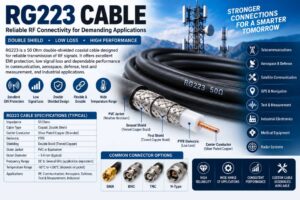
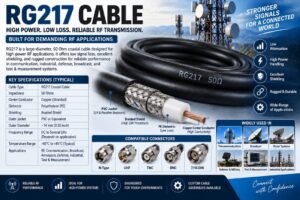
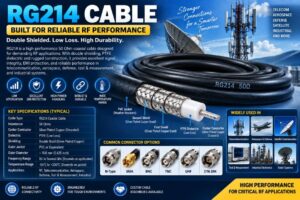
Coaxial Cables and Fiber Optic Cables
These cables carry RF signals between components.
Coaxial cables are used in passive systems, while fiber optic cables are used in active IBS systems for long-distance signal transmission.
Splitters, Couplers and Tappers
These RF components distribute signals to multiple antennas while maintaining balanced signal levels.
Power Supply System
IBS systems require reliable power for active equipment such as amplifiers and repeaters.
Backup power systems are often included for uninterrupted operation.
Types of In-Building Solutions
Different IBS architectures are used depending on building size, user density, and coverage requirements.
Passive DAS
Passive DAS systems use coaxial cables, splitters, and passive RF components to distribute signals.
Advantages include:
- Lower installation cost
- Simple design
- Easy maintenance
Passive DAS is suitable for:
- Small offices
- Hotels
- Medium-sized buildings
However, passive systems may experience higher signal loss over long cable distances.
Active DAS
Active DAS converts RF signals into optical signals for transmission through fiber optic cables.
Advantages include:
- Excellent signal quality
- Long-distance coverage
- Higher capacity
- Better scalability
Active DAS is widely used in:
- Airports
- Stadiums
- Large commercial complexes
- Smart cities
Hybrid DAS
Hybrid DAS combines passive and active distribution technologies.
This provides:
- Cost optimization
- Improved performance
- Flexible deployment
Small Cell IBS
Small cell solutions use compact low-power cellular base stations installed indoors.
Benefits include:
- High-speed data
- Improved capacity
- Easy deployment
- 5G compatibility
Small cells are commonly used in enterprise offices and commercial buildings.
Repeater-Based IBS
Repeater systems amplify outdoor cellular signals and redistribute them indoors.
These systems are cost-effective for:
- Small buildings
- Rural locations
- Basic indoor coverage improvement
Applications of IBS Solutions
In-Building Solutions are widely used across multiple industries.
Commercial Buildings
Office complexes require reliable indoor mobile coverage for employees and visitors.
IBS systems support:
- Business communication
- Video conferencing
- Cloud applications
- Mobile internet access
Shopping Malls
Large malls experience heavy mobile data traffic.
IBS systems improve:
- Customer experience
- Mobile payments
- Retail operations
- Digital advertising
Hospitals
Hospitals require uninterrupted communication for patient care and emergency services.
IBS systems support:
- Medical staff communication
- Emergency coordination
- IoT medical devices
- Telemedicine systems
Airports
Airports require high-capacity communication systems for passengers and operational staff.
IBS solutions support:
- Passenger connectivity
- Airline communication
- Security systems
- Airport operations
Hotels and Hospitality
Hotels require strong indoor mobile coverage for guest satisfaction.
IBS systems improve:
- Mobile connectivity
- Wi-Fi integration
- Smart room services
Industrial Facilities
Factories and industrial plants often contain heavy machinery and metal structures that interfere with wireless signals.
IBS solutions enable:
- Industrial automation
- IoT communication
- Worker safety systems
- Remote monitoring
Stadiums and Event Venues
High user density requires advanced IBS systems capable of handling massive mobile traffic.
Applications include:
- Live streaming
- Social media usage
- Digital ticketing
- Emergency communication
Residential Buildings
Modern apartments and smart homes require stable indoor network connectivity.
IBS systems improve:
- Mobile signal strength
- Voice quality
- High-speed internet access
Underground Areas
IBS systems provide connectivity in:
- Basements
- Parking lots
- Metro stations
- Underground tunnels
Advantages of IBS Solutions
In-Building Solutions provide several important advantages.
Improved Indoor Coverage
IBS eliminates weak signal areas inside buildings.
Better Voice Quality
Users experience clearer calls with fewer call drops.
Higher Data Speed
IBS improves mobile internet speed and network reliability.
Increased Network Capacity
Dedicated indoor infrastructure supports large numbers of users.
Enhanced User Experience
Reliable connectivity improves customer satisfaction and business productivity.
Support for Multiple Operators
Neutral host IBS systems can support multiple telecom operators simultaneously.
5G Readiness
Modern IBS systems are designed for future 5G deployment.
Improved Emergency Communication
Reliable indoor communication is critical during emergencies.
Energy Efficient Design
Advanced IBS systems reduce network power consumption.
Challenges in IBS Deployment
Although IBS systems provide major benefits, they also present certain challenges.
High Initial Cost
Large IBS deployments require significant investment.
Complex Network Design
Coverage planning and RF optimization require specialized expertise.
Interference Management
Improper design can create signal interference problems.
Multi-Operator Integration
Supporting multiple telecom operators may increase complexity.
Regulatory Compliance
IBS installations must comply with telecom and building regulations.
Maintenance Requirement
Regular maintenance and monitoring are essential for performance optimization.
IBS and 5G Technology
5G technology is increasing the importance of IBS systems.
High-frequency 5G signals have limited penetration capability inside buildings. Therefore, indoor 5G coverage requires advanced IBS infrastructure.
5G IBS solutions support:
- Ultra-fast data speed
- Low latency
- Massive IoT connectivity
- Smart building applications
- AI-powered systems
Future-ready IBS systems are being designed with fiber infrastructure and small cells to support growing 5G demands.
IBS Design Process
Designing an IBS system involves several important steps.
Site Survey
Engineers analyze the building structure and existing signal strength.
RF Planning
Coverage areas, antenna placement, and signal levels are calculated.
Capacity Planning
The system is designed according to expected user traffic.
Equipment Selection
Appropriate antennas, cables, repeaters, and DAS components are selected.
Installation
Equipment is installed throughout the building.
Testing and Optimization
RF testing ensures proper signal coverage and performance.
IBS Installation Guidelines
Proper installation is essential for system performance.
Antenna Placement
Antennas should provide uniform coverage without interference.
Cable Routing
RF cables should minimize signal loss and avoid electromagnetic interference.
Power Backup
Critical IBS systems should include backup power supplies.
Ventilation
Active equipment requires adequate cooling and airflow.
Compliance Standards
Installations must follow telecom safety and fire regulations.
IBS Maintenance and Monitoring
Regular maintenance ensures long-term reliability.
Signal Testing
Periodic RF testing identifies coverage issues.
Equipment Inspection
Active devices should be inspected for proper operation.
Software Monitoring
Modern IBS systems include remote monitoring and alarms.
Cable Inspection
Damaged cables and connectors should be replaced promptly.
Future of IBS Solutions
The future of IBS technology is strongly connected with smart infrastructure and 5G expansion.
Emerging trends include:
- AI-based network optimization
- Cloud-managed IBS systems
- Open RAN integration
- Private 5G networks
- Smart building connectivity
- Massive IoT support
- Edge computing integration
As indoor data consumption continues growing, IBS systems will become increasingly important for modern communication infrastructure.
Choosing the Right IBS Solution
Selecting the correct IBS system depends on several factors.
Building Size
Large buildings require advanced DAS systems.
User Density
High-density environments need higher-capacity networks.
Technology Requirement
The system should support current and future wireless technologies.
Coverage Requirement
Underground and complex areas require specialized planning.
Budget
Passive, active, or hybrid systems can be selected according to budget.
Operator Requirement
Determine whether the system will support single or multiple telecom operators.
Conclusion
An In-Building Solution is a critical telecom infrastructure system designed to provide reliable indoor wireless communication coverage. As modern buildings become more complex and mobile data demand continues increasing, IBS systems are essential for ensuring seamless connectivity inside commercial, industrial, residential, and public spaces.
IBS solutions improve indoor signal strength, voice quality, mobile internet speed, network capacity, and user experience. Technologies such as DAS, small cells, repeaters, and fiber-based systems enable reliable communication across all indoor areas, including challenging underground locations.
Industries such as healthcare, aviation, hospitality, manufacturing, retail, telecom, and smart infrastructure heavily depend on advanced IBS systems for uninterrupted communication and operational efficiency.
With the rapid deployment of 5G networks and smart building technologies, the role of IBS solutions will continue to expand. Future-ready IBS systems will support faster data speeds, massive IoT connectivity, AI-powered automation, and next-generation wireless communication infrastructure.
For businesses and telecom operators seeking reliable indoor network performance, In-Building Solutions remain one of the most effective and scalable communication technologies available today.